
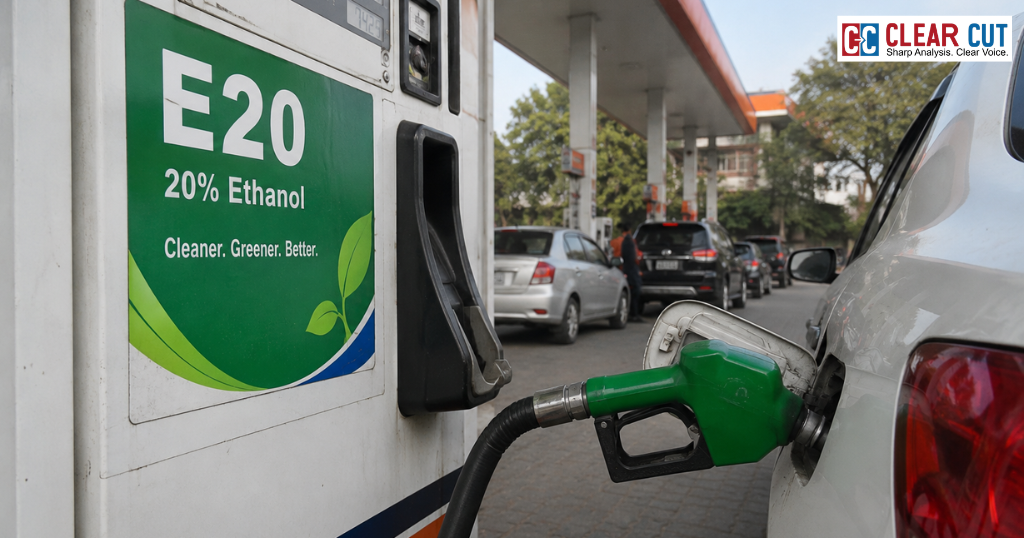
- India has achieved 20% ethanol blending (E20) ahead of its 2030 target, marking a major shift in reducing crude oil imports and cutting emissions.
- However, the programme faces challenges like heavy reliance on food crops (maize, rice), rising costs, and limited infrastructure for E20 adoption.
- While E20 is a key milestone in India’s energy transition, long-term sustainability depends on second-generation biofuels and better policy balance.
India is past an important tipping point. Mixing ratios have risen from 1.14% during 2014-15 to 20% in the current Ethanol Supply Year of 2025-26. This figure is quite important considering that India imports 87% of its crude oil, which makes it susceptible to pricing issues and geopolitical instabilities. But there is a much more complex picture underneath this impressive figure that cannot be overlooked by policymakers.
India’s Ethanol Ambition and the Policy Push
The EBP program was initiated way back in 2003; however, the key push towards its implementation was seen in the form of the National Biofuel Policy in 2018, where the blending target of 20% was set for 2030. This deadline was then brought forward to 2025 through the Cabinet Committee on Economic Affairs in December 2020.
After that, a roadmap and the country’s ethanol demand was projected by NITI Aayog for petrol blending from 173 crore liters in 2019-20 to over 1000 crore liters in 2025-26, which involved a doubling of its production capacity. This expansion of capacity has largely happened, but its base is less firm than the figures indicate.
The Hidden Challenges of Scaling E20
One structural challenge that emerges first is the issue of feedstock dependency. Currently, grains, especially maize and rice, account for roughly 65% of the ethanol output of India, with maize going up from 6.2% share in the supply portfolio for ESY 2022-23 to a whopping 50% in ESY 2024-25. This is not only because one difficulty gets solved here but also because a new challenge pops out: maize is used by other sectors like poultry, starch production, and others in addition to competing against these in terms of water-guzzling crops like sugarcane and rice to make green fuel.
Vehicle compatibility is another factor that makes the situation more complex. The estimated reduction in fuel efficiency due to E20 incompatibility is 6-7% in case of four-wheelers that were initially designed for E0 fuel and later configured for E10, while the reduction in fuel efficiency for two-wheelers would be 3-4%. Meanwhile, while efforts are underway to make new BS-VI vehicles compatible with E20 fuel, there are numerous old vehicles in India that suffer from reduced fuel efficiency without gaining any benefit in terms of cost reductions. The availability of E20 fuel across India remains poor as, by April 2024, only 13,500 PSU fuel stations sold E20 fuel in India.
Economic and Agricultural Tensions
There have been unfavorable changes to the economics as well. In 2020-21, during the time of preparation of NITI Aayog’s roadmap, ethanol was cheaper than petrol. The weighted average cost of procurement in 2024-25 reached up to ₹71.32 per liter, which included logistics and GST charges – a figure that was more expensive than refined petrol. This situation implies that oil marketing companies are incurring a cost difference for maintaining the blending obligation without reducing costs for consumers who already incur a mileage difference.
The food-versus-fuel debate, often dismissed as alarmist, carries genuine policy weight. In the case of maize, competition is fierce as diverse industries — poultry, alcohol, and starch — need greater amounts of the crop. For rice, the trade-off is between meeting food, export, and ethanol needs simultaneously. The government’s counterargument — that ethanol draws on surplus and damaged stocks — has merit, but surplus conditions are inherently temporary and weather-dependent.
Environmental Trade-offs
While the environmental rationale behind E20 is a valid one, the story comes with some caveats. The greenhouse gas emissions of sugarcane-derived ethanol are reportedly lower by around 65 % than petrol, while those of maize ethanol are 50 % less. But according to the IEA, even in its Net Zero scenario, advanced biofuels made of wastes and residues would need to account for more than 40 % of the biofuel demand in 2030, which is much higher than the 9 % share they occupied in 2021. India’s current programme continues to be largely based on first-generation biofuels and, therefore, lacks lifecycle assessment at the national level.
Lessons from Global Experience
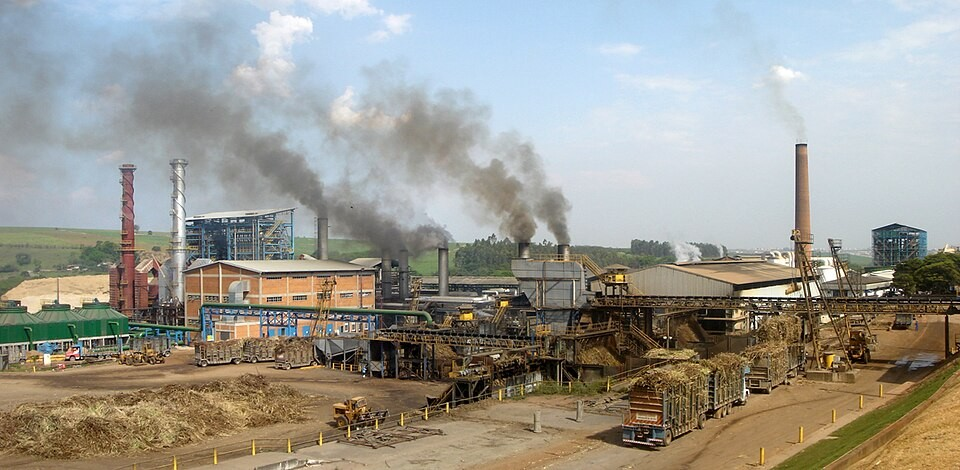
Brazil is often mentioned as the exemplar case. Brazil’s ethanol programme, PROALCOOL, has set blending quotas since the 1970s, which have reached the current level of 27% anhydrous ethanol in all retail petrol due to investments in a flexible fuel fleet and sugarcane farming over several decades. Ethanol produced from sugarcane in Brazil is claimed to be more effective and affects staple food prices to a lesser degree than corn ethanol made in the US, which was criticized for many years for being responsible for the volatility of global food prices. The decisive distinction is that Brazil created its ethanol industry over five decades under conditions suitable only for sugarcane production. India is trying to replicate this process much faster and in a more challenging environment.
The Road Ahead
However, according to the IEA, the potential for India is to increase its biofuels utilization up to three times in the next five years by overcoming hurdles related to increasing ethanol blend ratio and introducing it for use in diesel and jet fuel – but it will require careful monitoring of costs, sustainable feedstocks, and favorable policy beyond ethanol. In this regard, the roadmap developed by the government itself shows that the next logical step will be the second-generation ethanol production from agriculture residues, which can be seen by the example of the pilot project implemented by Panipat Refinery based on paddy straw.
Conclusion
E20 is a legitimate accomplishment and a hard-won one at that in the energy transition of India. It minimizes India’s dependence on imports, boosts the earnings of Indian farmers, and cuts down emissions from a fleet of vehicles that operate using petrol. However, the present design of E20, which is dependent on grains, infrastructure-challenged, and economically inverted, makes it function as an ephemeral milestone and not as a sustainable structure. What really matters about E20 is not whether or not India has achieved the 20 % blending mark but whether it will be able to establish a second generation of everything else.
Clear Cut Climate Desk
New Delhi, UPDATED: June 30, 2026 14:00 IST
Written By: Tanmay J. Urs