- India’s ageing population is creating a growing silver economy, with the elderly population expected to reach nearly 346 million by 2050.
- The growing senior-care market offers opportunities in healthcare, elderly services and employment, but gaps in pensions, workforce participation and geriatric care remain major challenges.
Is India Ready for the Silver Economy?
India’s growth journey has been driven by the youth. Today, the same population curve that is
supposed to bring a demographic dividend is curving towards the less tumultuous sibling of a demographic dividend — a Demographic Tax. Now the problem for policy makers, employers and investors is not if but how India will age, as the process is happening much more quickly than the country’s per-capita income.
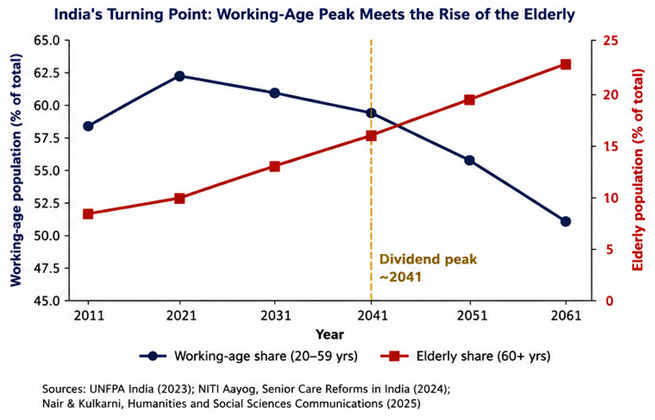
The term “demographic dividend” has been the backbone of India’s growth narrative for three decades and promised that decades of growth before the developed world’s ageing dividend would arrive. The answer to that is no. It is, however, time-limited and the clock has started chiming. The age structure transition modelling of India projects that by the year 2041, the working-age population (20-59 years) of the country will peak at about 59% of the total. The same working-age demographic force, which has powered India’s development, is now expected to start working the other way (UNFPA India, referenced in recent literature on the demographic dividend). Simultaneously, India’s elderly population, which was just over 104 million (10.1% of the population) in the last decade, is expected to nearly triple by 2050, reaching nearly 346 million or close to one-fifth of all Indians (NITI Aayog 2024; KPMG India 2025).
The Dividend Window Is Real and Narrower Than It Looks
There is an economic argument for the dividend, which is supported by much evidence. The foreign researchers using the Spectrum demographic-economic model are projecting a rise in India’s GDP per capita of more than 43% over a 30 year period (2011- 2041) if there are favourable age-structure changes, as compared with a businessas- usual scenario with India’s population only changing according to its current age structure (for the 2011-2041 period) (study on population and economics in 2022, using the model version Spectrum 5.753). Using
more recent panel data from 1981 to 2021, the study (Humanities and Social Sciences Communications, 2025) estimates the demographic dividend’s effect to be around 1.9 percentage points of annual economic growth with its impact becoming stronger since 2011, and becoming quite negative following the COVID-19 shock in 2020-21.
However, the automatic aspect of the dividend has always been a matter of choice. It has been the long-standing trend in the age-structural transition in South Asia to warn that a favourable dependency ratio can only translate into growth if accompanied by investments in education, skilling and job creation (Navaneetham and Dharmalingam, Population Ageing, 2012).
More recent microsimulation projections of India’s labour force for 2060 go further, they
suggest that low participation of women in the labour force implies that the labour-force
dependency ratio will likely not truly be favourable at all, unless female labour-force
participation increases significantly: subnational regions with a lower labour-force dependency ratio and higher participation of women have significantly better projections than the national average (recent labourforce microsimulation research, 2025). To sum up, about 50% of the potential dividend of India is lying on the sidelines.
“Only a little more than one-third of India’s elderly are currently working and interventions to power the silver economy remain the exception, not the rule.”
— NITI Aayog, Senior Care Reforms in India (2024)
The Ageing Arithmetic: Faster Than the Growth Curve
The change in India has come to be seen as a succession of “population crossovers” thresholds when one demographic phase takes over another. In fact, a global shift is taking place that can be described as a structural change in a society where a greater proportion of countries are now part of societies with population declining as a result of ageing and labour force shrinking (S. Irudaya Rajan and J. Retnakumar, EPW, 2026, based on UNFPA data 2025). The paper also revisits the demographic ageing trend that India is undergoing, which dates back to the rapid decline in fertility and increase in longevity observed in Kerala and which had been traced by Irudaya Rajan in earlier papers, from decade-long studies of Kerala’s early demographic transition as a harbinger of the ageing India (Bhat and Rajan, EPW, 1990; Rajan, Asia-Pacific Population Journal, 1989).
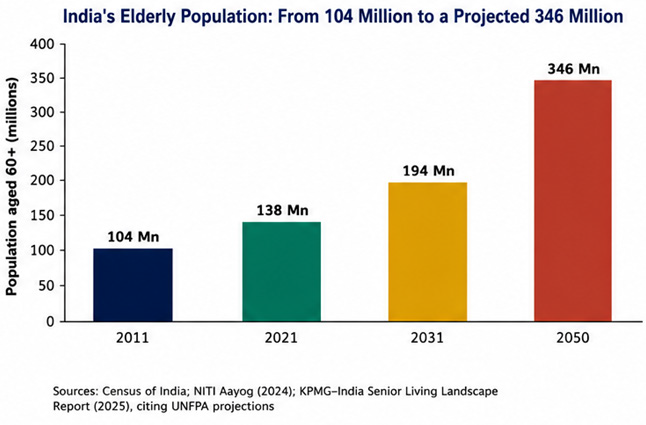
The numbers are significant since India’s transformation is compressed. India, and most of South Asia, is on course to make the transition from an ageing to an aged society in a fraction of that time, and institutions designed for young people have little time to adjust (Rajan and Mishra on India’s senior citizens, Springer, 2020).
Not One India, But Several: The Regional Divide
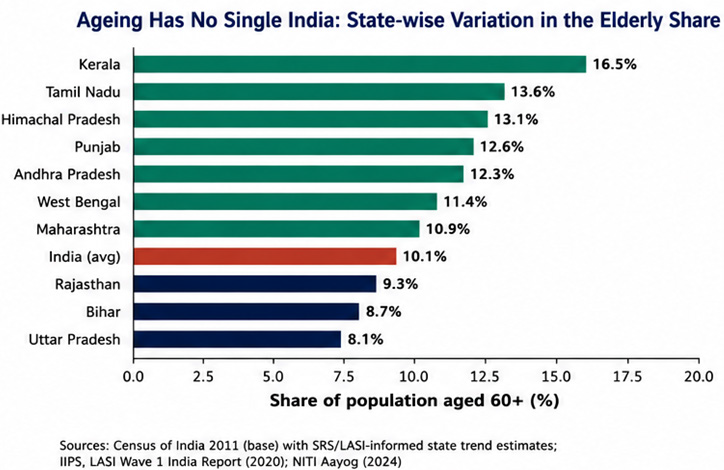
India’s ageing is very uneven. The nationally representative Longitudinal Ageing Study in India (LASI) conducted by the International Institute for Population Sciences, Harvard T.H. Chan School of Public Health and the University of Southern California indicates that the mean age of the older population in Kerala is in the region of 60 compared with 56 in Karnataka, demonstrating the extent of lead up time the southern state enjoys in the process of transition
(LASI Wave 1 documentation, IIPS 2020). Besides, Kerala also has the highest per capita
income among the elderly at around ₹57,731 per year, compared to the lowest figure in Bihar
of ₹26,628 per year, which influences their experiences of ageing across the country (LASI Wave 1, IIPS Executive Summary, 2021).
This is the same divide in terms of health burdens. A higher proportion of the elderly in Goa
(60%) and Kerala (57%) report ever having been diagnosed with cardiovascular disease (LASI, International Journal of Epidemiology, 2022) and diabetes rates are higher among the
elderly in Kerala (35%) than in less developed states. A separate mapping activity, based on Wave 1 data, reveals that Kerala and Tamil Nadu are the states with high disability in daily activities and prevalence of depressive symptoms, but remain otherwise well-resourced with health systems and services, a cautionary reminder that economic development does not necessarily lead to wellbeing for the elderly (Population Geography, 2025).
The Silver Economy: A Market Still Finding Its Feet
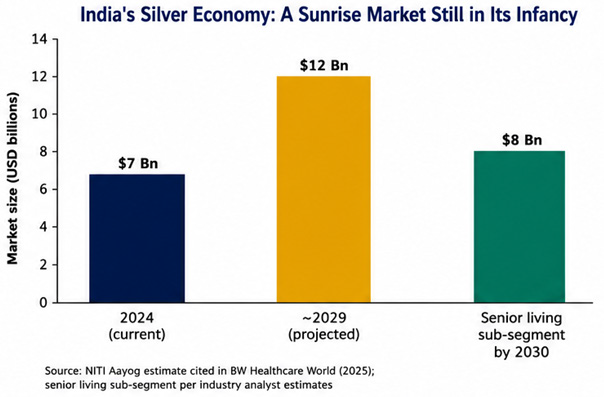
But as ageing is a fact of life, so too is the silver economy, the answer of a market to the ageing population, and the India’s silver economy is still in its infancy. As per NITI Aayog’s position paper titled ‘Senior Care Reforms in India: Reimagining the Senior Care Paradigm,’ the current senior care industry size is estimated at US$7 billion and is expected to hit US$12 billion in 5 years, with the senior-living sub-segment projected to grow more than 300% by the end of the decade to hit US$7-8 billion. When looked at individually, the elderly care products market (mobility, monitoring, incontinence and home-care consumables) was estimated at about ₹73,000 crore in 2024, with homecare being the largest segment accounting for 46.2% of the overall market value, as Indians prefer to stay at home rather than be institutionalized (IMARC Group market analysis, 2025). The government’s schemes are just now meeting
demand. The Atal Vayo Abhyuday Yojana (AVYAY) and the SAGE (Seniorcare Ageing Growth Engine) portal for elder-care startups are clear moves toward formalising the previously unorganised, familyrun elder-care space, while new players like Antara Senior Care’s AGEasy retail format, launched in Gurugram in March 2025, are examples of how organised players are creating integrated physical and digital channels for elder-care products and geriatric
care (IMARC Group, 2025).
The Gaps That Could Undercut the Opportunity
There are three areas in the literature that do not have a corresponding structure in the study. The first is that pension coverage is thin; according to the position paper of NITI Aayog, 78% of India’s elderly do not have any pension cover whatsoever and 70% rely on family members to maintain themselves on a day-today basis, which compounds the difficulty of having to rely on the informal sector, where more than 80% of Indian workers have no retirement benefits provided by their employers (as per the analysis of CareEdge Ratings regarding the Indian Eldercare Industry, 2026). Second, a low level of participation of the elderly in the workforce, even by necessity, remains low in India, relative to their needs: Only 34% of the elderly in India are employed at present, and continued economic activity is one of the most obvious levers available to offset the pressure on the dependency-ratio (NITI Aayog, 2024). Third, the ratio of the caregivers is dangerously low; the American Geriatrics Society’s standard requirement
of one geriatrician for every 700 patients, say, applies to India’s elderly population, which would
mean that there is a need for approximately 214,000 geriatricians, but there are only in the hundreds. (BW Healthcare World, 2025)
The fourth, not so obvious dimension, is academic research, which demonstrates that the elderly are not just a burden but an economic contributor. Data from the Longitudinal Ageing
Study of India are used to illustrate the contribution of older people to the economic outcomes
of their households as caregivers to grandchildren, as continuing workers and as healthy household members who provide economic relief to younger members in the form of reduced workload and income (Irudaya Rajan Sebastian and Udaya S. Mishra, in an edited volume on ageing research, 2014–2017). Policy dealing with the elderly, however, based solely on the fiscal burden they represent may be incomplete.
Building the Data Infrastructure to Match the Demography
One subtle success story is the process of measurement itself. Like the US Health and Retirement Study, which LASI draws inspiration from, the survey is harmonised with its
sister surveys such as China’s CHARLS, Korea’s KLoSA, and Japan’s JSTAR and is designed
to be conducted every couple of years for 25 years, so as to give India for the very first time a
harmonised biennial data set on the health, economic, and social well-being of its older population, in every single state and union territory (IIPS, LASI programme documentation). Such a data infrastructure is vital for a nation as regionally diverse as India: that is how the planners can recognize that while the problem that needs to be solved in Kerala is entirely
different from the problem of Bihar.
The Bottom Line
India’s dilemma is not a choice between the dividend and the ageing; rather, India is experiencing both together, differently timed across various Indian states. The working age
bulge that is peaking in 2041 gives India about fifteen years more to improve on skills development, women workforce participation and pensions coverage, before the problem of ageing becomes the primary demographic reality. The silver economy is real and amounts to single digit billions of dollars, but the development of the sector is happening at an even smaller pace than what will be required by the potential size of its future market (estimated at
346 million people). Readiness of India for the challenge can be more related to treating both the closing window of opportunity of the dividend and the opening window of the silver economy as one single process.
About the Author:
Subhanshu Jaiswal is Assistant Manager – MLE at DevInsights, a research, monitoring, evaluation, and learning (RMEL) organization that generates evidence to support informed decision-making in the social development sector.
Clear Cut Gender Desk
New Delhi, UPDATED: August 18, 2026 01:00 IST
Written By: Subhanshu Jaiswal
Designation: Assistant Manager – MLE at Devinsights