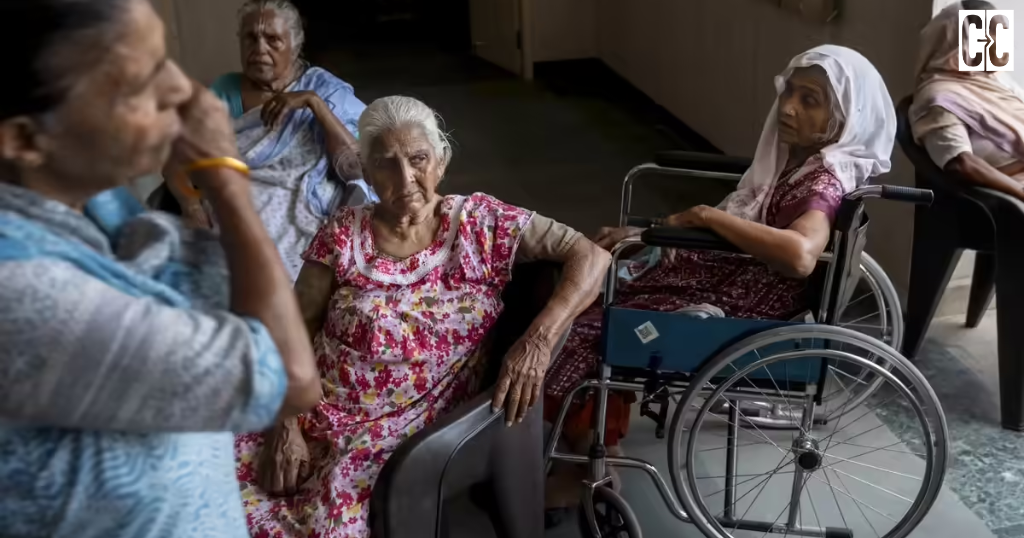


Nearly two decades after Parliament passed India’s only Law specifically for older people, the bill’s fundamental flaws continue to lie unresolved as the judiciary strains the existing legislation to bridge them – a new bill to correct these issues has been pending in Parliament since 2019.
India’s population of individuals aged 60 and above was 149 million in 2022 and is predicted to jump to 347 million – one in five Indians – by 2050, according to the United Nations Population Fund (UNFPA) India Aging Report 2023. India’s primary legal protection for these elderly individuals, the Maintenance and Welfare of Parents and Senior Citizens Act, 2007, was devised in an era for a less populated and much younger version of that group. The Act mandatorily requires children and legal heirs to maintain elderly parents and relatives.
It establishes quasi-judicial tribunals with the power to enforce this responsibility within 90 days and requires states to set up more nursing homes and geriatric care units. Today, 18 years after the legislation received presidential assent, this remains India’s only Law focused solely on protecting the rights of elders, and the Act’s structure and enforcement record are creaking under immense pressure.
A Fast-Track Tribunal, With Limits Built In
The scheme is easy to understand. An aged person who is unable to support them self, even a childless older adult claiming maintenance from a childless relation from whom they would have inherited property, can go to a Maintenance Tribunal, headed by an officer of Sub-Divisional Officer level or higher, and request a monthly allowance from children or a relation. Such applications have to be decided by the tribunals within 90 days; the proceedings are intended to avoid the need for advocates on both sides, keeping expenditure to a minimum, and any order by the tribunals would be enforceable like a criminal court order, including punishment by imprisonment for intentional refusal to comply.
The corresponding Section 23 gives senior citizens the right to take back property that has been gifted to a relative, rather than promised care, if that care has been withdrawn.
It is a criminal offense to abandon a senior citizen, though the penalty is a limited one – up to three months’ imprisonment and a fine of 5,000. In addition, the states are mandated to provide at least one nursing home per district (according to the Act) and to reserve hospital beds and hospital queues for the elderly. It doesn’t, however, touch upon the limit for the maximum maintenance amount a family can be made to pay, 10,000 a month, a figure that has not been updated since 2007.
Where Enforcement is Lacking.
Enforcement has also varied by state, and even after initial investment, the returns took a long time to materialise. Kerala, often lauded as the bestperforming example, now has 27 Maintenance Tribunals and 14 Appellate Tribunals that have dealt with over 20,000 cases in total, and processed 4,232 petitions just in 2021, a speed its officials attribute to support staff hired from 2017. Before that, in a 2015 report on its own tribunals by the state Social Justice Department, there was an average of 130 applications and 60 disposals in 2014, and only a quarter of these were disposed of within the Act’s stipulated 90 days.
The impact of such coverage, too, is not uniform across nursing homes; there are just 696 units funded by the Union Integrated Program for Senior Citizens throughout India, where the target should have been one district, and in over 700 districts of the country, a state like Nagaland, as of November 2025, has not declared the operation of the very first nursing home.
Also, the issue is visibility: HelpAge India’s nationwide study of over 5,000 elderly individuals across 10 states in early 2024 reported that one in three hadn’t earned any income of their own in the past year, and 7% reported direct abuse. Others didn’t feel comfortable coming forward.
The Judiciary Steps In
Since Parliament remains largely silent, much of the task of modernizing the Act – much of which centered on Section 23 – fell to the Court. In S. Vanitha v. Deputy Commissioner, Bengaluru Urban District (2021), for example, the Court found that Tribunals could indeed order eviction if they deemed it necessary to safeguard the life and property of a senior citizen.

That finding was repeated the following year in Sudesh Chhikara v. Ramti Devi, and then elaborated further in January of 2025 when, in Urmila Dixit v. Sunil Sharan Dixit, the Court determined that officers exercising the powers granted under Section 23 can go beyond cancelling a gift deed and must also be able to physically place the senior citizen transferor back in possession – nullifying a less forceful application of Section 23 by the Madhya Pradesh High Court. That process continued in September of 2025 when, in Kamalkant Mishra v.In an additional Collector, the Court rejected a Bombay High Court ruling that allowed an estranged son to continue occupying two Mumbai properties that belong to his elderly parents and gave him until November to leave.
The Court’s interventions have, in fact, turned Section 23 into the most effective lever in the Act, yet they also demonstrate the significant role courts have had to play in shaping its contours over the past few years, rather than Parliament.
The Unenacted bill
The 2019 amendment bill was much bolder; it would have scrapped the limit altogether, allowing tribunals to decide based on both parties’ incomes and standards of living, and also included a measure to regulate private care homes. It expired with the dissolution of the Lok Sabha in which it was moved, and hasn’t been tabled again since. The Ministry of Social Justice and Empowerment confirmed the lapse in a written answer to a question in Parliament on 3 December 2025. They offered no timeline for a fresh attempt – nearly six years after the first was presented. The government’s more visible reaction has, until now, focused on administrative actions rather legislative reform.
In May 2026, the ministry introduced the JEEVAN application and the SHATAYU caregiver dashboard. In addition to allowing easier access to support and benefits for senior citizens and their caregivers through technology, the initiatives do not change the core, static law at its heart.
How Other Ageing Nations Measure up
It’s not unusual for countries to have enacted such measures, but none has done so as hesitantly as India. Singapore introduced a similar Maintenance of Parents Act in the mid1990s. Still, it was updating its regulations as late as 2023 to allow its tribunals to trash unsubstantiated claims immediately, prevent children who had abandoned their own offspring from filing suit, and order the parents’ offspring to make non-cash payments, things the Indian Tribunals still cannot do. China tried a different angle; its 2013 revision of the Law on the Protection of the Rights and Interests of the Elderly compels grown children to ensure not just financial provision but physical contact and communication with older people – essentially equating loneliness with financial abandonment. In India, the focus remains solely on the financial aspect; its Maintenance and Care of Parents and Senior Citizens Act of 2007 focuses impartially on money and property and glosses over the social isolation that frequently appears in discussions of growing old in India.
At a special session in November 2025, Justice Surya Kant of the Supreme Court warned of a potential danger. As India’s modernity catches up with it, it could lose the inter-generational relationships it once assumed would persist. Justice Kant recalled a recent case in which the Court used its extraordinary powers to give back a woman’s home after almost half a century of disputes. “The guarantee of dignity does not expire with age,” he explained. By this standard, too, the Act has not measured up well.
Its tribunals have uneven staffing after nearly 18 years; penalties have been largely untouched, and its more recent advances are mostly the result of judicial creativity, not legislative action. We may not require new apps to ensure that the Act meets its foundational promises, but it certainly requires amendments that Parliament has not yet delivered.
Clear Cut Gender, Research Desk
New Delhi, UPDATED: August 17 2026 09:00 IST
Written By: Yatharth Pathak