
- Assam floods 2026 have affected thousands of people, highlighting the urgent need for stronger disaster relief and climate resilience measures.
- Corporate CSR in India must move beyond post-flood relief and invest in preventive measures such as early-warning systems, resilient infrastructure and community preparedness.
- Better CSR accountability and pre-monsoon planning can help reduce the economic and humanitarian impact of recurring floods.
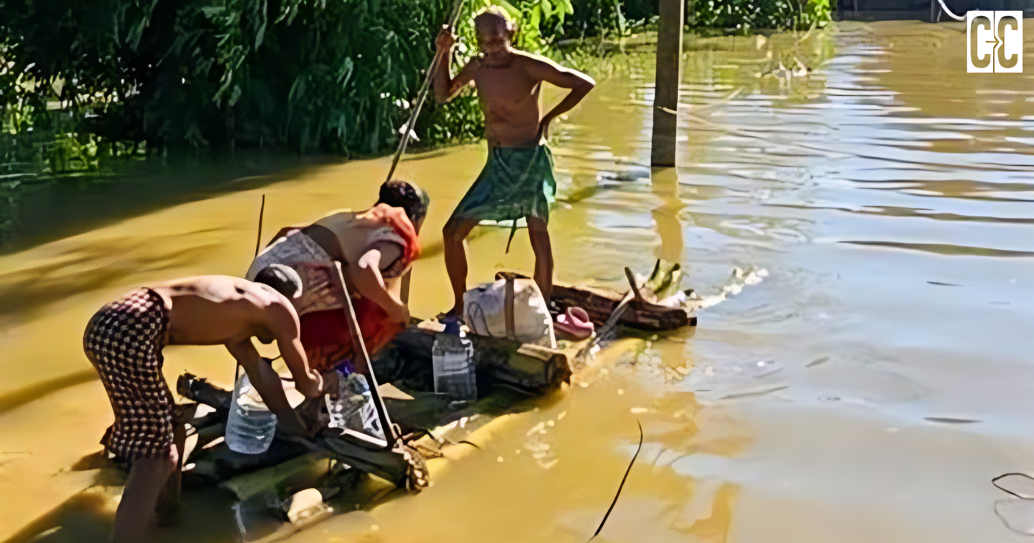
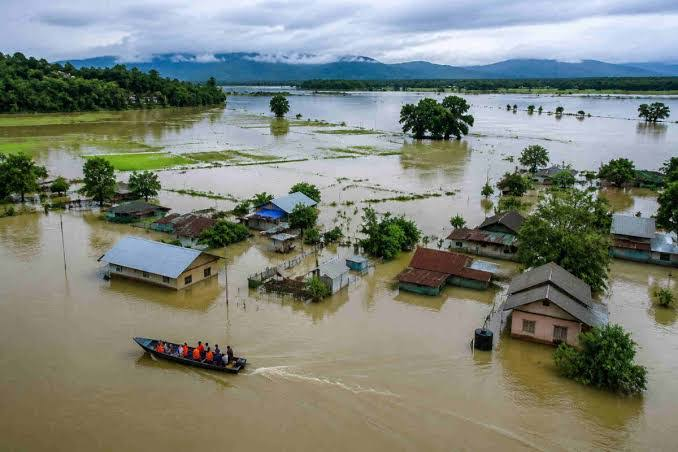
By early August 2026, roughly 481 villages across Assam had gone completely underwater. 90 relief camps were sheltering close to 30,000 people. Another 94 distribution centres supplied essentials to those who had not been evacuated. This is not Assam’s first devastating flood season. Unless something structural changes, it will not be its last. The death toll climbed past 80 and over 1.7 lakh people were reported affected. The response has revealed corporate India’s disaster machinery efficiency and how much of it remains reactive.
Anatomy of a Recurring Disaster
The 2026 Assam floods followed a familiar pattern. The monsoon rainfalls submerged the farmlands, which had overwhelmed the Brahmaputra and its tributaries. It displaced families crowding into relief camps for weeks at a stretch. Chief Minister Himanta Biswa Sarma ordered door-to-door digital damage assessments as flood waters receded in parts of the state. Meanwhile, the Army, National Disaster Response Force, State Disaster Response Force and police ran joint evacuation operations. Community institutions, including local gurdwaras that opened their kitchens and shelters to displaced families, filled gaps that formal relief infrastructure could not close fast enough.
Where Corporate CSR Stepped In
Political parties and corporates mobilised crore-scale relief campaigns as the toll rose, channelling funds toward emergency shelter, food distribution and medical camps. This mirrors a broader pattern across India’s recent flood seasons, in Punjab, Kerala, Karnataka and Jammu and Kashmir, where CSR-funded disaster response has become a near-annual reflex for large corporates, insurers and foundations. The speed of this mobilisation is genuinely impressive; the challenge is that most of it activates only after visible destruction, not before.
The Gap Between Charity and Preparedness
India’s CSR framework under Schedule VII of the Companies Act explicitly permits spending on disaster management, relief and rehabilitation, yet the overwhelming majority of disaster-linked CSR capital continues to flow into post-event relief rather than pre-event resilience: flood-resistant housing, early-warning systems, embankment strengthening or drainage infrastructure in known flood corridors. Assam’s flood damage assessments, done village by village and often digitally for the first time this year, could feed directly into predictive CSR planning for the following monsoon, but that feedback loop rarely closes in practice.
What a Resilience-First Model Would Look Like
A small number of companies are beginning to experiment with pre-monsoon interventions, funding embankment audits, community flood shelters built above historical high-water marks, and weather-alert systems tied to local mobile networks. These remain exceptions rather than the rule. Given that Assam, Bihar, Kerala, Punjab and Jammu and Kashmir have all recorded major flood events within the past two monsoon seasons, the state of India’s disaster-linked CSR spending is now, in effect, a recurring annual expense rather than an emergency allocation, and it deserves to be planned as one.
The Compounding Economic Cost
The damage extends well beyond immediate casualty figures. In Odisha, thousands of acres of farmland were submerged this monsoon season, threatening the livelihoods of entire agricultural communities for the coming harvest cycle. In Jammu and Kashmir, hundreds of mountain-dwelling communities were left without electricity or clean water for extended periods, a secondary crisis that relief camps focused on food and shelter often struggle to address quickly. Nationally, this monsoon’s flash floods and landslides are estimated to have affected close to a million people in the northeast alone, with thousands of homes losing power entirely. These cascading, sector-crossing losses are precisely why disaster-linked CSR needs a multi-sector response plan, not a single relief-camp playbook applied uniformly everywhere.
The Way Forward: Accountability and Action
Every monsoon, corporate India proves it can move fast when the water is already at the doorstep. What it has not yet proven is that it can move early enough to keep the water out. The accountability question for 2027’s flood season starts now: companies with disaster-relief CSR budgets should be required, as a matter of transparency, to disclose what share of that spending is pre-emptive versus reactive, and district administrations in flood-prone corridors should publish standing wish-lists of resilience infrastructure that CSR capital can fund before the rains arrive, not after the villages go under. Assam’s families should not have to wait for the next flood to find out whether this year’s lessons were learned.
Clear Cut Climate, CSR, Livelihood Desk
New Delhi, UPDATED: August 16 2026 06:00 IST
Written By: Tanmay J. Urs