

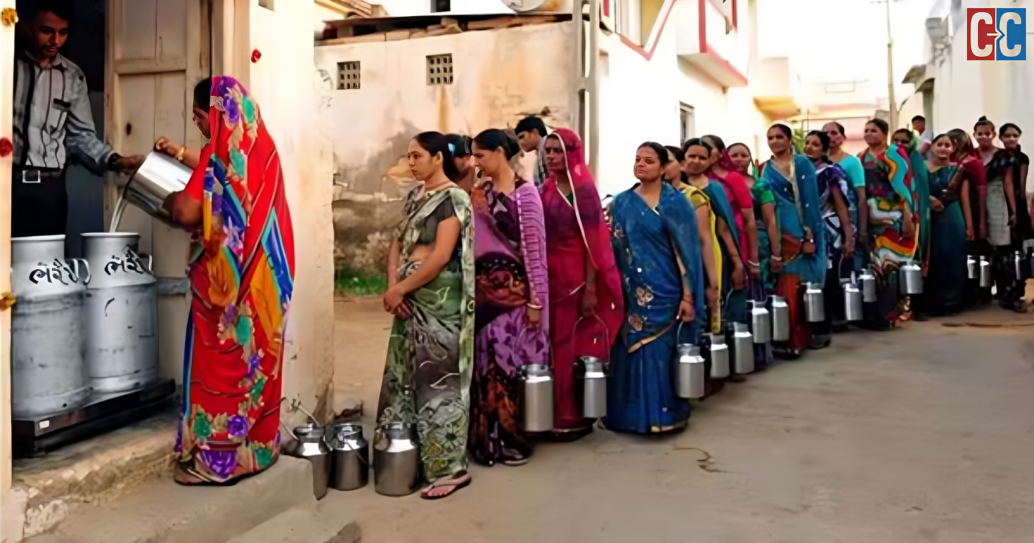
Amul began as a farmer-led cooperative in Gujarat, connecting dairy cooperative societies and milk producer members to create a farmer-owned dairy movement. Through Operation Flood and the Gujarat Cooperative Milk Marketing Federation, the model helped transform India’s dairy sector and strengthen rural livelihoods.
Before 1946, milk farmers around Anand in Gujarat sold their produce to private traders who fixed prices as they pleased and often delayed payment for weeks. Angered by this arrangement, farmers under local leader Tribhuvandas Patel, with the backing of Sardar Vallabhbhai Patel, formed their own cooperative that year: the Kaira District Cooperative Milk Producers’ Union, which the world would eventually come to know by its brand name, Amul. This act of farmers taking control aimed to empower them and foster a sense of ownership and pride in their collective effort.

A three-tier idea that scaled
The cooperative’s real transformation began after 1949, when a young dairy engineer named Verghese Kurien joined the effort. Kurien and his colleagues designed a three-tier structure: village-level dairy cooperative societies that collect milk directly from farmers, district-level unions that process it, and a state-level federation that markets it under one brand. It removed the middleman entirely and returned a much larger share of the consumer price to the farmer. The model impressed the then Prime Minister, Lal Bahadur Shastri, enough that in 1965 the government created the National Dairy Development Board and launched Operation Flood, replicating the Amul structure across India. The Gujarat Cooperative Milk Marketing Federation (GCMMF), the apex body that markets the Amul brand today, was formally established in 1973.
What the numbers look like today
GCMMF today is farmer-owned by roughly 3.6 million milk producer members spread across 18,600 villages of Gujarat, whose 18-member unions procure around 300 lakh litres of milk a day. For the financial year 2024-25, GCMMF’s own turnover stood at Rs 65,911 crore, growing more than 11% over the previous year, while the broader Amul brand’s consolidated group turnover had already crossed Rs 80,000 crore (roughly $10 billion) the year before. Brand Finance UK has ranked Amul as the world’s strongest food brand, and the International Farm Comparison Network places GCMMF among the world’s top ten dairy processors by milk-handling volume.
Who actually benefits
The cooperative’s stated purpose was never simply commercial success; it was to protect small and marginal farmers from exploitation. More than 70% of Amul’s producer members are small or marginal farmers and landless labourers, including a considerable population of tribal and Scheduled Caste households. This composition has stayed roughly consistent over decades of GCMMF’s own reporting. The model’s most-cited social impact is arguably in rural women’s economic participation: dairy farming through cooperative societies gave women in Gujarat’s villages an independent, regular cash income stream at a time when most other rural livelihoods offered them none, a shift that historians and business writers covering Kurien’s legacy consistently highlight. This demonstrates the cooperative’s role in fostering social progress and community resilience.
A movement, not just a brand
Operation Flood’s broader legacy is that India became the world’s largest milk producer, a position it has now held for years, built largely on cooperative dairying rather than large corporate dairy farms. Amul’s model has since been referenced and partially replicated by dairy cooperative movements in other developing economies seeking ways to organise smallholder agriculture without ceding control to large private processors.
The limits worth noting The Amul story also has its limitations, which should be noted in a balanced account. Cooperative functioning is good as long as farmer unions are strongly democratic and transparent. There have been sporadic conflicts over ownership and management in district unions over the decades, and not every state has learned the lessons from the “Amul model” at the national level as successfully as the intra-state federation in Gujarat did. These are acknowledged realities.
Clear Cut Livelihood Desk
New Delhi, UPDATED: September 25, 2026 15:00 IST
Written By: Tanmay J. Urs