
Twelve years after the launch of the Swachh Bharat Mission, India has made significant progress in expanding toilet access and reducing open defecation. However, the next challenge lies in sustaining sanitation outcomes through behavioural change, safe waste management, local governance, lifecycle financing and reliable public services.
From Toilet Access to the Challenge of Sustaining Sanitation
Twelve years after the launch of the Swachh Bharat Mission (SBM) in October 2014, India’s sanitation landscape has changed fundamentally. Sanitation moved from being largely a household and rural development concern to a national political and governance priority. Government reporting states that rural sanitation coverage increased from 39% in 2014 to 100% in 2019, with more than 100 million individual household toilets constructed during Phase I, and that all villages had declared themselves open-defecation free (ODF) by October 2019.
Yet a twelve-year assessment cannot stop at administrative achievements. NFHS-5 reported that 70.2% of India’s population lived in households using an improved sanitation facility in 2019–21, compared with 48.5% in 2015–16. This difference does not invalidate SBM’s achievements. Infact, it demonstrates why sanitation must be assessed through multiple measures. A toilet constructed is not necessarily a toilet used, and a toilet used is not automatically part of a safely managed sanitation system.
THE CENTRAL POLICY TRANSITION
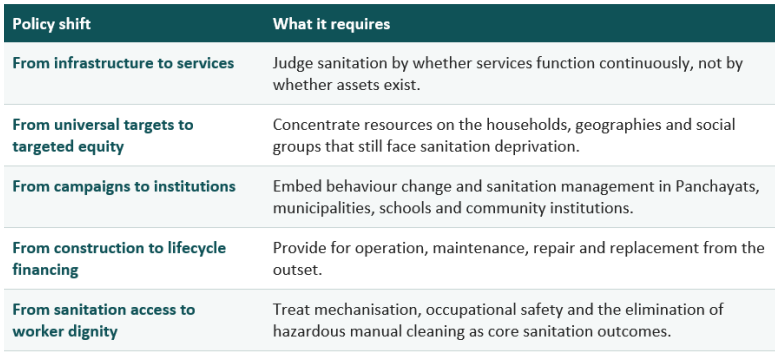
From infrastructure creation to service sustainability: ensuring sustained use, safe containment, faecal-sludge and wastewater management, solid-waste processing, local-government capacity and worker safety.
01 From Toilet Access to Sanitation Outcomes
SBM’s first phase was fundamentally an access and open-defecation-reduction programme. Its political and administrative success lay in creating urgency around toilet construction and making sanitation visible in public policy.
A core measurement issue is related to coverage, access, use, and safely managed sanitatio.
Household-level evidence presents a more differentiated picture. Alongside the NFHS-5 data, the Household Consumption Expenditure Survey 2022–23 continues to capture variation in
household access to latrines by social and economic characteristics.
The policy implication is important. The remaining sanitation challenge is increasingly concentrated rather than universal. Future interventions need to identify the households and communities that remain excluded instead of relying only on national averages.
02 Behaviour Change Is Harder Than Infrastructure Delivery
SBM rightly positioned sanitation as a behaviour change mission rather than merely a toilet construction scheme. But behaviour is sustained only when infrastructure is functional, accessible, clean and convenient. Water availability, privacy, perceptions of pit technologies, household preferences and social norms all influence whether a toilet is used.
This is particularly important for women and girls. Household sanitation can improve privacy, dignity and safety, including during menstruation and at night. But a gender-responsive sanitation policy must extend beyond household toilets to public sanitation, menstrual hygiene, accessibility and sanitation for women who work or travel outside the home.
03 The Bigger Challenge: What Happens After the Toilet?
The move from ODF to ODF Plus is one of the most important developments in India’s sanitation policy. SBM-Grameen Phase II explicitly focuses on sustaining ODF status and expanding solid and liquid waste management.
Human waste doesn’t simply disappear when it goes down the drain in a toilet or septic tank. A working sanitation system requires a complete sanitary chain. From containment through emptying, transportation, treatment, to safe disposal/reuse. If downstream management is weak, sanitation gains can become environmental contamination.
The same principle applies to urban solid waste. Door-to-door collection is necessary, but it is only one part of the system. Segregation, transportation, processing, recycling and final disposal must work together. The Ministry of Housing and Urban Affairs’ sanitation dashboard illustrates the scale of the urban waste-management transition, but the test is now whether the whole chain performs reliably, not how many assets have been created.
04 Sanitation Is Now a Local-Governance Problem
The next phase depends on strong local institutions. Gram Panchayats and urban local bodies are increasingly responsible for operating community sanitation facilities, managing waste and coordinating local service providers.
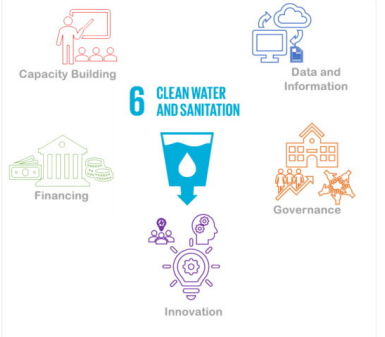
This makes lifecycle financing essential. Building a toilet is a capital intervention; keeping it functional for ten years is a service-delivery responsibility. Likewise, constructing a waste-processing facility does not guarantee that it will receive segregated waste, operate continuously or remain financially viable. Future financing should therefore place greater emphasis on recurrent costs, performance and service quality. Local governments need predictable resources, technical capacity and clearly assigned responsibilities.
06 The Policy Agenda for the Next Decade
Conclusion
The twelve-year journey of Swachh Bharat should neither be reduced to a story of toilet construction nor dismissed because significant gaps remain. Its greatest achievement was to change the scale, visibility and political importance of sanitation in India. But the problem has changed.
2014 Can India provide toilets?
2026 Can India provide sanitation as a reliable public service?
The next decade should be judged not by the number of toilets constructed or villages declared ODF, but by whether sanitation remains safe, functional and equitable long after the campaign ends. The first twelve years built the infrastructure and the political momentum. The next phase must build the systems that make sanitation sustainable.
About the Author:
Asmita Yadav is Deputy General Manager -MLE at DevInsights, a research, monitoring, evaluation, and learning (RMEL) organization that generates evidence to support informed decision-making in the social development sector.
Clear Cut Education Desk
New Delhi, UPDATED: November 03, 2026 16:50 IST
Written By: Asmita Yadav
Designation: Deputy General Manager– MLE at Devinsights