- Aruna Roy left the IAS in 1975 to work with rural communities, co-founded MKSS, and led the grassroots movement that resulted in the Right to Information (RTI) Act, 2005, empowering citizens to hold the government accountable.
- She also played a key role in shaping MGNREGA, championed the Right to Food and pension movements, and continues to advocate for transparency, democracy, and citizens’ rights through grassroots activism.
Aruna Roy quit a secure government job in 1975 to live in a mud hut in rural Rajasthan. Three decades later, India had a law that let any citizen demand answers from the state. That law, the Right to Information Act, changed how power works in the world’s largest democracy. It started with one woman who decided the system she served could not fix itself from the inside.
From IAS Officer to Grassroots Organiser
Roy joined the Indian Administrative Service in 1968. She was 21 years old and believed she could serve the country from within the system. By 1974, that belief had cracked. She felt the bureaucracy moved too slowly and too far from the people it was meant to help. She resigned and joined the Social Work and Research Centre, known today as Barefoot College, founded by her husband Sanjit “Bunker” Roy in Tilonia.
For nine years, Roy worked directly with rural communities. She later left Barefoot College too, this time because she wanted more room for political activism. In 1987, along with Nikhil Dey and Shankar Singh, she moved to the village of Devdungri. Three years on, the trio founded the Mazdoor Kisan Shakti Sangathan, or MKSS, an organisation built to fight for fair wages and government accountability rural labourers among and Ayushman Meena farmers.
Building MKSS Without Outside Money
MKSS never registered as a society or a trade union. It had no membership fees and no formal constitution. It ran on contributions from volunteers and supporters alone, and it refused funding from governments or corporations. Roy explained the reasoning behind that choice directly. She pointed out that “a funded movement is limiting” and invoked Gandhi’s principle that anyone fighting their own people must never be open to the charge that their battle is bankrolled by vested interests.
That discipline shaped everything MKSS did next. While investigating unpaid wages for rural workers, the organisation found gaps and inconsistencies in local government records. In 1994, MKSS began holding public hearings where those records were read aloud and checked against what villagers actually knew to be true. The mismatches were glaring. Out of those hearings came a simple, radical demand: ordinary citizens needed the legal right to see government documents for themselves.
The Road to the RTI Act
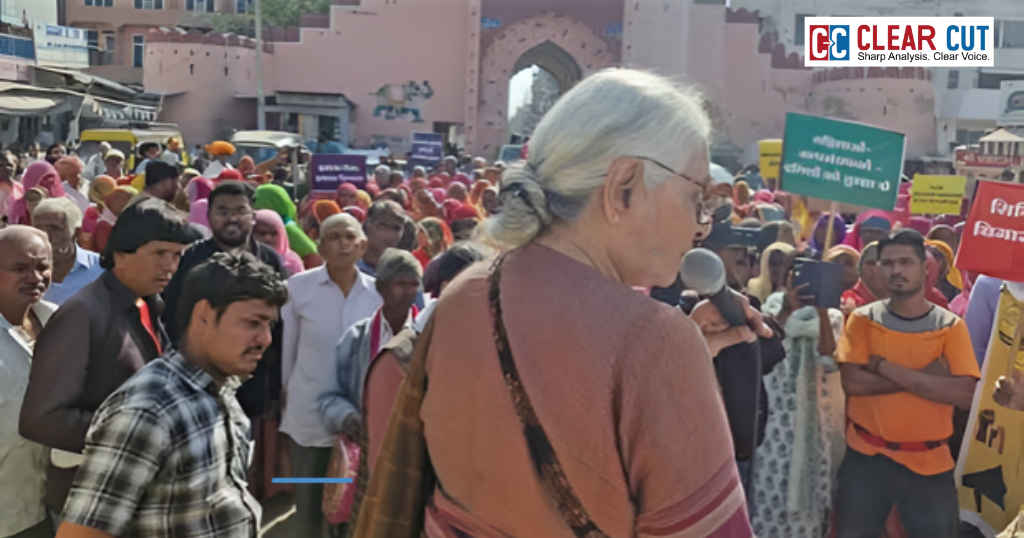
That demand grew into a national campaign. Roy described the philosophy behind it in stark terms, saying decisions affecting millions of people get made by a narrow few, often outside Parliament or even the Cabinet, and that MKSS believes the street functions as its Parliament and its policy room. The campaign pulled in lawyers, journalists, academics and retired judges. Justice PB Sawant, a former Supreme Court judge, helped draft the law itself.
Parliament passed the Right to Information Act in 2005. The law gives Indian citizens the right to request records from public authorities, who must respond within 30 days in most cases. It has since been used to f ile an estimated eight million applications a year. It has also been credited with exposing major corruption cases, including the 2G spectrum scam and irregularities tied to the Commonwealth Games. Roy served on India’s National Advisory Council in 2004-06 and again in 2010-13, a body that helped shape both the RTI Act and what later became MGNREGA.
MGNREGA and the Right to Work
Roy did not stop at transparency. She and MKSS pushed for a legal guarantee of rural employment, work that fed directly into the Mahatma Gandhi National Rural Employment Guarantee Act, passed in 2005. The law promises a hundred days of guaranteed unskilled manual work each year to rural households that want it. Roy has been clear that this campaign succeeded only because economists joined the fight alongside activists, noting that figures including Jean Drèze, Jayati Ghosh and Prabhat Patnaik used fiscal arguments to counter the government’s repeated claim that there was no money for the scheme.
She extended the same organising model to the “Right to Food” movement and later to the “Pension Parishad”, where she lobbied for a universal pension for India’s elderly to be included in the national budget.
A Movement Built on Personal Relationships
Roy often credits the people she organised alongside, not just the laws that resulted. She has spoken at length about Naurti, a Dalit wage worker she met decades ago who became a literacy advocate, a labour leader, a computer operator, and eventually a sarpanch. Their partnership produced a landmark 1983 Supreme Court ruling on minimum wages, Sanjit Roy vs the Government of Rajasthan, built on Articles 14 and 23 of the Constitution. Roy has described her as an extremely courageous woman with whom she remains friends and equals to this day.
This emphasis on equality inside the movement was deliberate. Roy has said that participatory structures only work if leaders are willing to listen and accept dissent, and that reaching consensus always requires giving something up.
Recognition and Continuing Work
Roy received the Ramon Magsaysay Award for Community Leadership in 2000, the Lal Bahadur Shastri National Award for Public Administration in 2010, and a spot on Time magazine’s list of the 100 most influential people in the world in 2011. In December 2024, the BBC named her to its 100 Women list. The same year, she published her memoir, “The Personal is Political: An Activist’s Memoir,” which examines the tension between activism and family life that she has carried for decades.
She remains President Emeritus of the National Federation of Indian Women and continues to work through the School for Democracy, which she co-founded in 2003. She also represented MKSS on the steering committee of the Open Government Partnership, an international coalition of governments and civil society groups, from its founding in 2011 until 2014.
On the question of dissent in Indian democracy today, Roy has not softened her position. She has argued plainly that free speech is the most important right that has eroded over the past several years, and that civil society must keep fighting to protect public space for protest. She has also pointed to a 2018 Supreme Court win, when MKSS successfully filed a public interest litigation to regain access to Jantar Mantar in Delhi, a traditional site for public protest that authorities had shut off. For Roy, that fight was about more than one location. It was about whether ordinary citizens still had a place to be physically heard.
Why Her Work Still Matters
Aruna Roy’s career offers a rare example of a policy outcome built entirely from the ground up. The RTI Act and MGNREGA did not begin in a ministry. They began in village hearings in Rajasthan, where ordinary workers read government records aloud in public and asked, simply, why the numbers did not match what they knew to be true. Roy turned that question into a constitutional right that now belongs to over a billion people. For a magazine series on policy champions, her story is a reminder that the most lasting institutional change in India’s recent history did not come from the top. It came from a mud hut in Devdungri, and from people who refused to stop asking questions.
Clear Cut Research Desk
New Delhi, UPDATED: July 18, 2026 14:47 IST
Written By: Ayushman Meena