

- India has made notable progress towards the Sustainable Development Goals (SDGs), improving its UN SDG Index ranking through achievements in poverty reduction, clean energy, healthcare, and social protection.
- Despite these gains, major challenges remain, including regional disparities, child malnutrition, gender inequality, rising emissions, and institutional weaknesses that threaten the 2030 SDG targets.
With the 2030 deadline for the UN Sustainable Development Goals (SDGs) fast approaching, India finds itself in a complicated position. Looking closely at the country’s progress shows a mix of massive success in infrastructure alongside deep inequalities between different states and a huge funding problem.
The latest UN Sustainable Development Report 2026 places India at the 94th position out of 167 countries, scoring 68.3 out of 100, signalling a clear improvement from its previous rank and making it one of the fastest-improving major economies. The domestic SDG index score tracked by NITI Aayog also improved significantly, jumping from a baseline of 57 in 2018 to 71 in the latest 2023–24 cycle.
As home to over a sixth of the world’s population, India’s domestic success is widely recognized as the ultimate make-or-break factor for the global 2030 targets. Recent official data from the Ministry of Statistics and Programme Implementation (MoSPI) and the UN Sustainable Development Solutions Network (SDSN) reveals that while India is moving fast in key areas of sustainability, persistent structural bottlenecks could still stall its hard-earned momentum.
The Big Wins: Energy, Infrastructure, and Health
Various UN reports have hailed the Indian state for successfully lifting 135 million people out of multidimensional poverty.
- 2023 Global Multidimensional Poverty Index (MPI): Unstacking Global Poverty: Data for High-Impact Action – Published by the United Nations Development Programme (UNDP) and the Oxford Poverty and Human Development Initiative (OPHI). The report states that India lifted 415 million people out of multidimensional poverty between 2005/06 and 2019/21, making it one of the world’s fastest reductions in multidimensional poverty.
- National Multidimensional Poverty Index: A Progress Review 2023 – Prepared by https://hdr.undp.org/content/2023-global-multidimensional-poverty-index-mpi?utm_source=chatgpt.com Aayog in collaboration with UNDP and OPHI. The report finds that 135 million people escaped multidimensional poverty between 2015–16 and 2019–21, with the headcount ratio falling from 24.85% to 14.96%.
Supporting this baseline, the National Indicator Framework (NIF) Progress Report highlights that social protection coverage has scaled up dramatically, increasing from 22 percent in 2016 to 64.3 percent recently.
India has pulled off some of the largest development programs in modern history over the last two decades. The most obvious successes are concentrated in clean energy, health, and rural infrastructure. Ambitious schemes like the Pradhan Mantri Ujjwala Yojana have proved to be a major breakthrough in changing fuel consumption patterns across rural households by providing subsidized LPG connections, which has helped the SDG 7 (Clean Energy) goal record the highest progress score of 96 out of 100 nationwide.
The launch of systematic interventions in healthcare-such as the Pradhan Mantri Matru Vandana Yojana and AB-PMJAY-has further improved the access and quality of medical care, even among the most vulnerable sections. The Maternal Mortality Ratio (MMR) dropped significantly from 130 in 2014-16 to 87 in 2023-24. Concurrently, massive government campaigns have drastically cut down on open defecation.
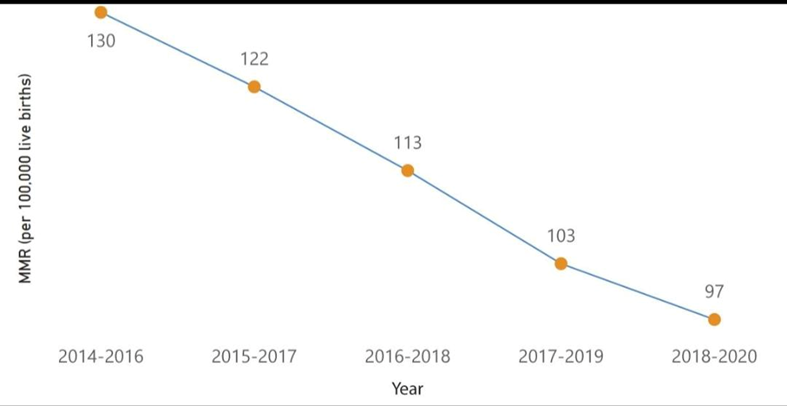
Source: Sample Registration System (SRS), Registrar General of India & Ministry of Health and Family Welfare (PIB)
The Problems: The Huge Gap Between States
However, the biggest issue right now is that this progress is not equal across the country. The national average reveals a massive divide between different regions. Southern states like Kerala and northern states like Uttarakhand are performing exceptionally well, leading the country with an SDG score of 79. On the other hand, states like Bihar and Jharkhand are really struggling because they lack the same budget or institutional strength, with Bihar sitting at the bottom of the NITI Aayog index with a score of 57.
On another front, the UN SDSN warns that Zero Hunger (SDG 2) remains a major crisis. The NFHS-6 notes the child stunting estimates at 29.3 percent and child wasting rates remaining critically high at 19 percent, which is the highest globally. At the same time, rigid social norms keep gender equality scores low, making it hard for women to get equal access to regular jobs and land ownership.
Furthermore, the latest data warns that environmental shifts could severely impede the economic progress of India’s growth story due to rising fuel combustion. Per capita emissions increased from 1.69 tonnes in 2015 to 2.21 tonnes in 2023. Past World Bank data underscores this vulnerability, warning that severe climate change could negate development gains and push up to 45 million Indians into extreme poverty over a 15-year period if mitigation and localized relief strategies are not aggressively implemented.
India also continues to face critical structural challenges under peace, justice, and strong institutions (SDG 16), specifically across four key indicators, including the Corruption Perceptions Index and the Press Freedom Index. Of these concerns, the nation’s performance on the Press Freedom Index marks its most severe long-term decline since 2015. Reflecting a deepening crisis for domestic journalism, India’s media environment score fell by more than 27 points, plummeting from a baseline of 59.51 in 2015 to a historic low of 31.96 by 2026.
Conclusion: The Path Ahead With only 4 years left before 2030, UN reports highlight that only 16 percent of the SDG targets are projected to be achieved globally with none of the 17 goals to be achieved globally. With over 1.4 billion citizens, India’s performance in achieving the Sustainable Development Goals automatically gains immense significance. While India’s performance is commendable across the 17 goals, the institutional and fiscal constraints along with delayed implementations might make India miss the targets for 2030 deadline. For India to achieve its targets to a satisfactory level, India needs a multi-dimensional and proactive approach to integrate the SDGs into its institutional architecture beginning at the grass root levels of government like Panchayat.
Clear Cut Research Desk
New Delhi, UPDATED: July 18, 2026 10:00 IST
Written By: Muskan Pal
Designation: Communication Manager at Devinsights