

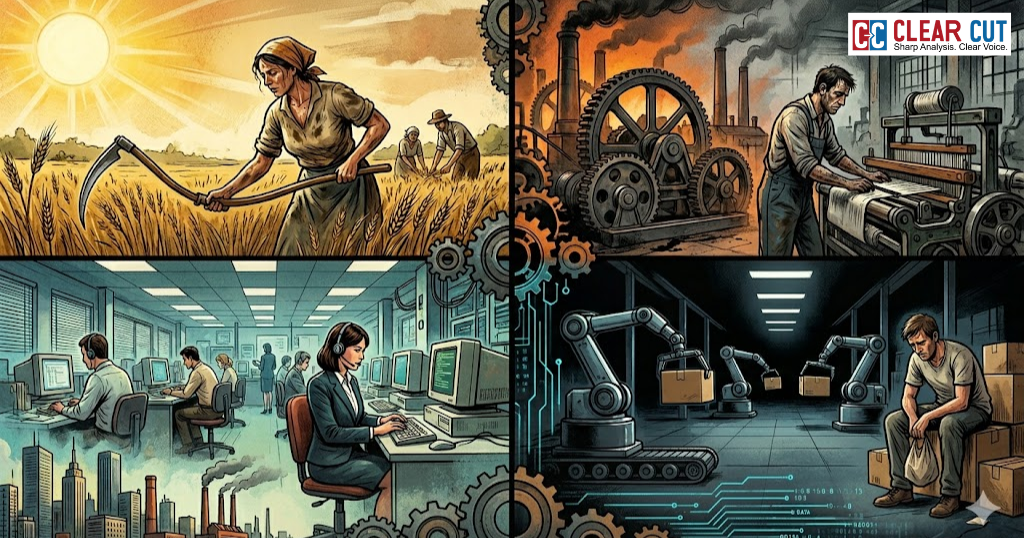
- India now has over 12 million gig workers, but many still face unstable income, lack of healthcare, and no social security.
- AI, automation, and digital platforms are rapidly changing jobs, especially in sectors like manufacturing, logistics, and customer service.
- Nearly 40% of India’s workforce may need reskilling as technology continues to replace repetitive tasks.
- Experts say the focus should be on worker protection, fair labour rights, and skill development so technology benefits everyone equally.
Ramesh, a 28-year-old delivery worker from Delhi working for a food delivery platform, spends nearly 12 hours a day on the road, yet his income remains uncertain from month to month. His story reflects the reality of millions of workers in India at a time when the Economic Survey 2025–26 estimates that the country has over 12 million gig workers. As technology evolves from the era of the industrial revolution to that of artificial intelligence, the way people interact and work has been transformed. However, amid all this progress, there is another more serious challenge that emerges for workers – that of adaptation and change brought about by technological advances.
12 Million Gig Workers, Zero Guarantees
Within the last ten years, the rate at which changes occur has accelerated considerably. India’s gig workforce, for instance, grew by nearly 55% from 7.7 million workers in FY21 to around 12 million in FY25, according to the Economic Survey 2025–26, highlighting how rapidly technology-driven employment patterns are evolving. Automation, machine learning, and apps are no longer imagined possibilities but realities actively reshaping sectors such as manufacturing, retail, and customer service. According to a NITI Aayog report on the future of work, nearly 40% of India’s workforce could require reskilling over the coming years due to increasing automation and adoption of artificial intelligence technologies. Although there are advantages to efficiency and increased productivity for firms, employees now face uncertainties that cannot be overlooked, particularly those who lack the requisite skills and education.

This transformation is very apparent in nations such as India. New possibilities have been presented by technology, ranging from work through the gig economy, online freelancing, to conducting digital businesses via smartphones. According to the Economic Survey 2025–26, India currently has over 12 million gig workers, and the number is expected to continue growing rapidly over the coming decade. While these jobs create employment opportunities, they often lack social security, stable income, and long-term protection for workers. In contrast, these alternatives may not provide the security and stability that previous job roles could offer. The delivery person or the driver for the ride-sharing company might benefit from the freedom of gig economy, but their salary might be unreliable, and they may not have access to health care facilities.
The role of automation further adds another dimension to this situation. In industries such as manufacturing, retail, logistics, and customer service, repetitive tasks are increasingly being automated through artificial intelligence and machine-based systems. According to estimates by NITI Aayog and global workforce studies, nearly 40% of India’s workforce may require reskilling because of automation and AI-driven technological shifts. Sectors such as manufacturing and customer support are considered particularly vulnerable, where routine tasks can be replaced by automated systems, creating uncertainty for low-skilled workers. This implies that organizations will be able to reduce costs and produce products or services at a much higher rate. However, from the worker’s point of view, this may mean job loss or displacement into less remunerative occupations.
This disparity is not only skill-related but geographical as well. Urban centers continue to benefit from investments, technological advancement, and well-paid jobs while other areas find it difficult to catch up. Consequently, the digital gap is slowly becoming a labor gap as well.
Technology Is Not the Problem: How We Build and Deploy It Is
But there is hope amid all the doom and gloom. It is not technology itself that is the issue; rather, it is how it is employed by us humans that causes concern. If planned wisely, however, technology can offer greater possibilities for inclusion. The importance of education and skills cannot be overstated in this regard. Laborers require training in areas relevant to the future, not simply the past.
It is necessary to reconsider labor rights as well. Freelancers and workers from other informal sectors must be granted basic protections such as fair wages, safe working conditions, social security, and healthcare access. India’s four Labour Codes were introduced to simplify and modernize labour regulations, but concerns remain regarding their implementation and the protection of gig and platform workers. In addition, Article 21 of the Indian Constitution, which guarantees the right to life and dignity, should also extend meaningfully to workers in the digital economy. Labour policy must evolve alongside technology while remaining humane and worker-centric.
However, one thing is clear: technology will go through further evolution regardless of everything. Yet again, the effect of technology on people will not be constant, depending upon how today’s society chooses to deal with the issue. In case society approaches it with caution, technology can be useful for improving lives, but otherwise it can increase existing inequalities.
The real issue here is not only to develop better technology but to ensure that any such development actually helps all people and not just some elite few.
Clear Cut Livelihood Desk
New Delhi, UPDATED: May 14, 2026 02:00 IST
Written By: Akash