

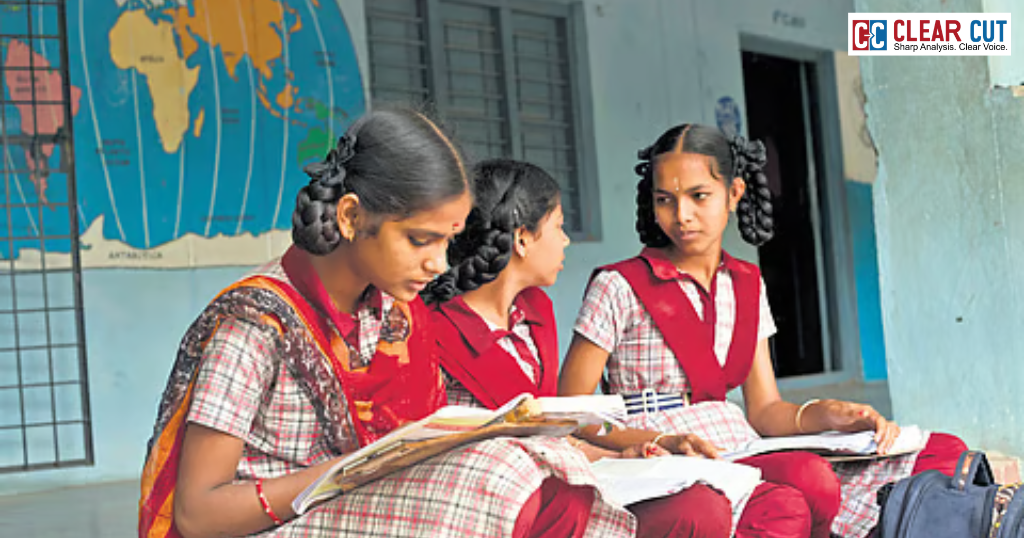
A recent NITI Aayog report reveals a painful reality inside India’s government schools: millions of children still study without electricity, proper toilets, or enough teachers. For many students, especially girls, school is no longer just a place of learning, but a daily struggle for dignity, safety, and the chance to stay.
Every morning, millions of children across India walk into government schools carrying more than backpacks. They carry hope – hope that education will give them a life different from the one their parents lived. For many families, school is the only bridge between poverty and possibility. But for far too many children, that bridge is cracked long before they step into a classroom.
In many government schools across the country, children study in buildings without electricity, without clean drinking water, without proper toilets, and sometimes without enough teachers to teach them. This is not an isolated problem in remote corners of India. It is the everyday reality of public education for millions of students.
India has undoubtedly made progress in bringing children to school. Over the last two decades, enrolment has risen steadily because of initiatives like the Right to Education Act, midday meal schemes, and nationwide education drives. More children are entering classrooms than ever before. But enrolment alone is not education. Writing a child’s name in a register means little if the school they enter cannot support their learning, dignity, or future.
What The Niti Aayog Report Found
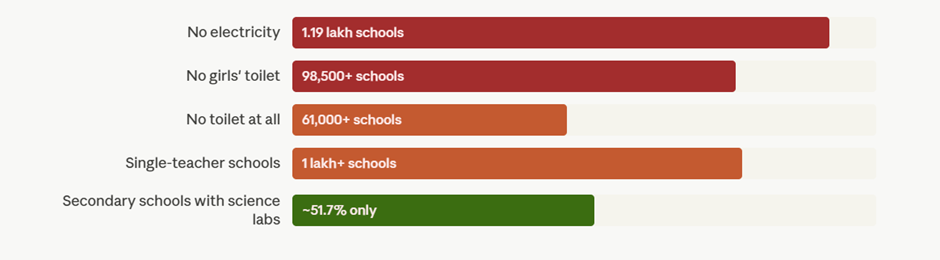
The numbers in the report shatter the image of a rapidly rising India. Even today, more than 98,500 government schools do not have a functional toilet for girls — a basic necessity that determines whether many young girls continue their education or quietly drop out. Over 61,000 schools lack even a usable toilet of any kind, forcing children to study in conditions that strip away dignity as much as comfort.
And perhaps most startling of all, in a country that speaks proudly of becoming a global digital power, more than 1.19 lakh schools still function without electricity. For millions of children, that means classrooms without fans in unbearable summer heat, no computers, no digital learning, and no light to fully see the future they are being promised.
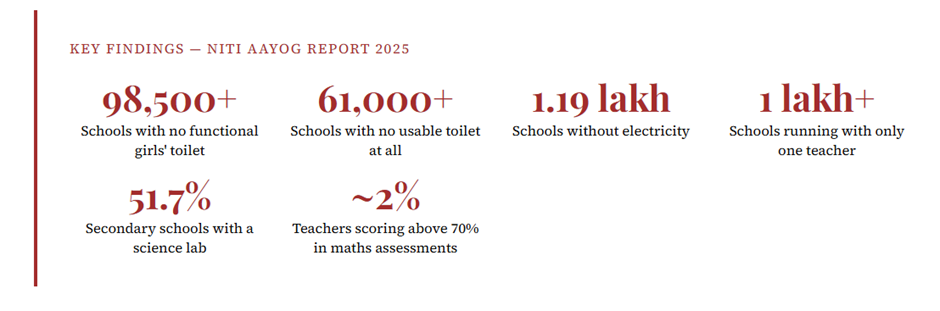
The numbers are difficult to ignore:
* More than 98,500 schools do not have a functional girls’ toilet.
* Over 61,000 schools have no usable toilet at all.
* Nearly 1.19 lakh schools function without electricity.
* More than one lakh schools rely on a single teacher to teach every class and every subject.
* Only about half of secondary schools have a science laboratory.
* Shockingly, only around 2% of teachers scored above 70% in mathematics assessments.
The lack of electricity in schools is not just an infrastructure problem — it directly shapes how children learn every single day. During the unbearable summer heat across much of India, classrooms without fans become exhausting and difficult places to learn. Without electricity, there are no computers, no digital lessons, no internet access, and no opportunity to participate in the modern world policymakers so often speak about. The digital divide does not begin with smartphones; it begins with a classroom that has no power.
For many children, technology is not absent because they lack the internet; it is absent because their classrooms do not even have a working power socket. The digital divide begins long before smartphones or broadband — it begins in a dark classroom where modern learning simply cannot function. The report also highlights poor access to drinking water, missing handwashing facilities, and the lack of digital infrastructure in a large number of schools. Secondary-level dropout rates remain high — and when one looks at these conditions, it becomes painfully clear why.
Poor school infrastructure does not remain confined within classroom walls. Its consequences follow children home, shaping whether they return the next day — or leave education behind altogether.
The Dropout Reality
The numbers reveal how quickly children begin disappearing from the system as they grow older. According to India’s Economic Survey 2024–25, dropout rates rise from 1.9% at the primary level to 5.2% at upper primary, before climbing sharply to 14.1% at the secondary stage — the point where the damage becomes deepest and hardest to reverse. Data from UDISE + 2024–25 further shows that only 47.2% of students complete the full secondary school cohort. In other words, more than half of India’s children are unable to stay in school long enough to finish this crucial stage of education.
For girls, the crisis is even more severe.
UNESCO ’s 2024 Global Education Monitoring Report estimates that India is home to nearly 8.5 million out-of-school girls, most of them from rural and marginalised communities. Between 2019 and 2024 alone, nearly 3 million adolescent girls dropped out of school. In states such as Uttar Pradesh, the numbers are especially alarming: out of 99,218 reported dropouts in a recent year, over 56,000 were girls.
Behind these statistics are countless quiet decisions made every morning by children and families weighing whether school is worth the hardship.
For a girl studying in a school without a functioning toilet, education becomes a daily negotiation with discomfort, embarrassment, and insecurity. She may miss classes during menstruation, fall behind academically, and eventually stop attending altogether. ASER 2024 data shows that while girls’ toilet availability has improved — rising from 66.4% of schools in 2018 to 72% in 2024 — nearly one in three schools still lack adequate facilities. That gap is not minor. Research published in the Journal of Water, Sanitation and Hygiene for Development identifies the absence of proper sanitation and hygiene facilities as one of the direct reasons girls miss school or drop out after puberty. When a school cannot provide something as basic as privacy and dignity, it sends a painful message to every girl who enters its gates: your education is negotiable.
The teacher shortage deepens this inequality even further. India currently faces more than one million teacher vacancies, according to UNESCO’s State of the Education Report for India. Some states carry an especially heavy burden. Uttar Pradesh alone has more than 3.2 lakh unfilled teaching posts, while Bihar has over 2.2 lakh vacancies. In parts of rural Assam, nearly 90% of teaching positions remain vacant; in rural Bihar, the figure is close to 89%.
The result is overcrowded classrooms where meaningful learning becomes almost impossible. In several affected states, pupil-teacher ratios exceed 47 students for every teacher — more than double what most education experts consider effective for quality teaching and individual attention.
And when children sit in overcrowded classrooms with exhausted or absent teachers, learning slowly gives way to disengagement. Over time, many students stop believing school can change their future at all. Eventually, they leave — not because they lack ambition, but because the system failed to support it.
Behind every statistic is a child whose future is quietly being limited
For a teenage girl, the absence of a toilet is not merely an inconvenience. It can become the reason she stops going to school altogether. Many girls begin missing classes after puberty because schools cannot provide them with privacy, hygiene, or dignity. Over time, absence turns into dropout. A missing toilet can end an education.
Beyond broken buildings and missing facilities lies an even deeper crisis — the crisis of people. The report shows that more than one lakh government schools across India are run by just a single teacher. One person is expected to teach every subject, manage every classroom, and support children of different ages all at once. In such conditions, real learning becomes nearly impossible. Education turns into survival — for both students and teachers.
But the problem is not only about the shortage of teachers. It is also about the support and training they receive. When teachers were tested in mathematics, only around 2% scored above 70%. Behind that number are millions of children sitting in classrooms where even the person standing at the blackboard may be struggling with the subject, they are teaching.
This is how educational inequality quietly repeats itself across generations. Children who do not receive strong foundational learning grow up with fewer opportunities, limited confidence, and weaker skills. Many eventually become part of the same workforce that struggles to escape poverty — and later become parents trying to guide the next generation through the very same system.
A child who studies in darkness, who cannot wash their hands at school, who has no teacher to answer their questions, is not being given an equal chance at success. They are being asked to dream big while learning in conditions that make even basic learning difficult.
Even science education reveals this contradiction. India proudly celebrates its engineers, scientists, and technological achievements, yet nearly half of its secondary schools do not have functioning science laboratories. For millions of students, science exists only in textbooks — something memorised for exams, never explored through experiments or discovery. A country cannot dream of innovation while denying children the tools to experience learning firsthand.
What Must Change
The findings from NITI Aayog may not come as a surprise to teachers, parents, or education researchers who have witnessed these problems for years. India has launched several major education initiatives over time — from Sarva Shiksha Abhiyan to the Right to Education Act and NIPUN Bharat — each built on the promise of transforming public education. And to some extent, progress has happened. More children are enrolling in schools today than ever before, and that achievement matters.
But getting children into classrooms is only the first step. What happens after they arrive matters far more. The numbers in this report make one thing painfully clear: the gaps in infrastructure and staffing are not minor issues waiting to be solved gradually. They are daily barriers that actively push children out of school, damage learning outcomes, and limit the futures of millions of young people across the country.
Solving this crisis will require more than announcements and ambitious slogans. It will require sustained funding, political commitment, and systems of accountability that continue long after headlines fade. A girls’ toilet cannot be treated as a delayed infrastructure project — because for many students, its absence directly affects their safety, dignity, and ability to remain in school. These children cannot be reduced to statistics in a government report. They are not numbers on a spreadsheet or targets in a policy document. They are young people trying to build a future for themselves with whatever opportunities they are given.
And the real question facing India is no longer whether these problems exist. The question is whether the country is willing to act with the urgency that its children deserve.
Clear Cut Education, Gender Desk
New Delhi, UPDATED: May 23, 2026 06:00 IST
Written By: Muskan Pal