
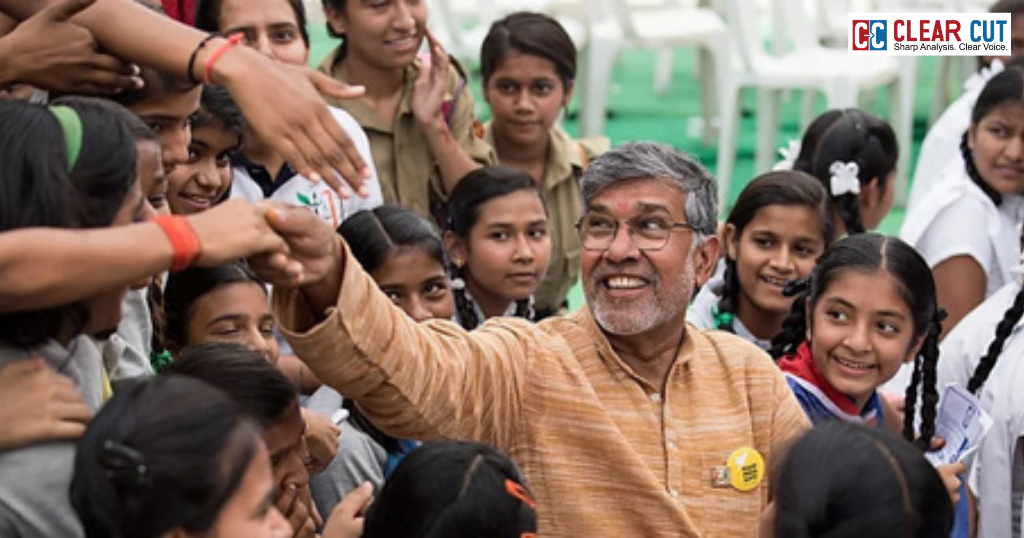
- Kailash Satyarthi dedicated his life to fighting child labour and rescuing children from trafficking and bonded labour after witnessing a child denied education outside a school.
- Through Bachpan Bachao Andolan, he has helped rescue over 90,000 children and led global campaigns for education, child protection, and human rights.
- Awarded the Nobel Peace Prize 2014, Satyarthi continues to advocate for a world where every child has the right to safety, freedom, and education.
There is a particular kind of anger that does not consume the person who holds it. It sharpens them instead. Kailash Satyarthi has carried that anger ever since. It is the same year he walked away from a promising career as an electrical engineer. He surrendered a steady salary and decided his life belonged to something far less comfortable. He was 26 years old. What unsettled him was not an extraordinary event. It was, painfully, an ordinary one.
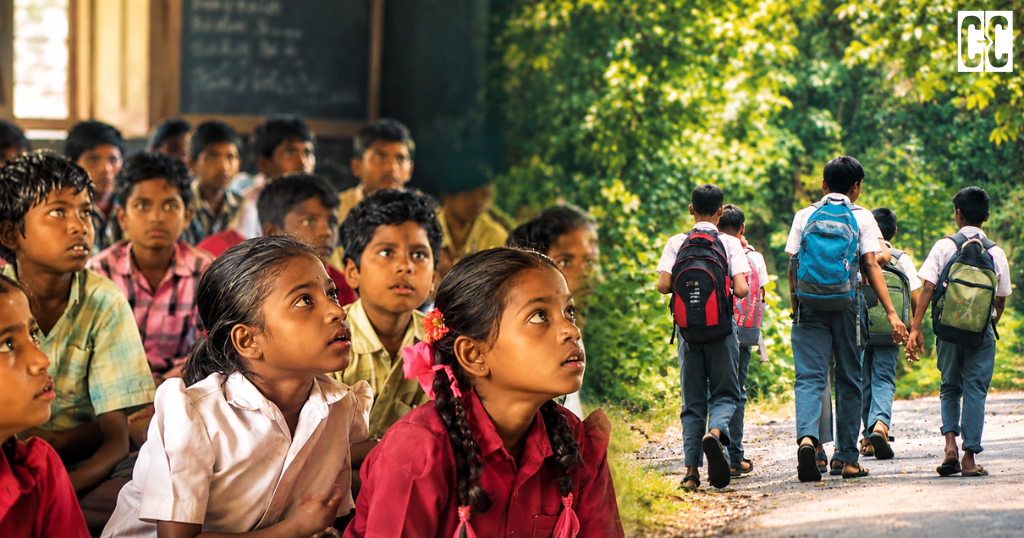
Once, he saw a child sitting outside his school, stitching a shoe in the cold. The child was not waiting for anyone. He was working. His father sat beside him, also stitching shoes. It was their livelihood. As Satyarthi thought, it was also closing of a door that the child was never told existed. That morning, he did not walk past. He walked toward the child and, ironically, has been walking in that direction ever since.
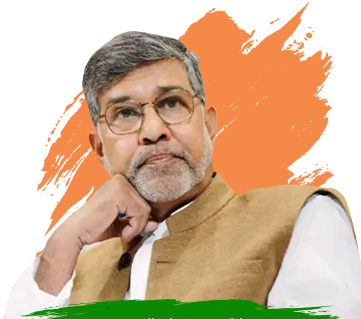
What followed was a reckoning. Satyarthi became the founding force behind one of the most sustained grassroots human rights movements in the modern history. He has personally helped rescue more than 90,000 children from bonded labour, trafficking, and forced servitude across India and beyond. He was awarded the Nobel Peace Prize, alongside Malala Yousafzai in 2014 (“I’m Urging You to Be Angry”: Kailash Satyarthi Live at TED2015 | TED Blog, n.d.). But the prize, as he himself would say with a quiet firmness, was never the point.
A Life Interrupted by Someone Else’s Pain
Kailash Satyarthi was born on January 11, 1954, in Vidisha, Madhya Pradesh. It was a town of modest means and deep-rooted tradition (Our Founder – Kailash Satyarthi Children’s Foundation, n.d.).
He grew up in a household where education was considered a doorway, not a luxury. He studied electrical engineering and, by his mid-twenties, had built a foundation for a respectable professional life. The mathematics worked. The future was close & visible.
But the child outside the school gate stayed with him. The image did not fade the way uncomfortable things usually do when life moves forward. It grew louder and louder. Satyarthi began reading, asking questions, tracing roots. He found a system that wasn’t broken by accident.
The bonded child labour in India was a structure, supported by poverty, caste hierarchy, illiteracy, and the simple human tendency to look away from what is inconvenient to see.
In 1980, he made his decision. He gave up his engineering career entirely. He founded Bachpan Bachao Andolan or in English “Save the Childhood” Movement (Kailash Satyarthi – NUHW, n.d.). He started with very little.
A small team, no institutional backing, and a plan built on moral conviction. He went into villages, into carpet factories, into quarries and fields. He negotiated, he confronted, documented, and when necessary, he placed his own body between a child and those who would keep that child in chains.
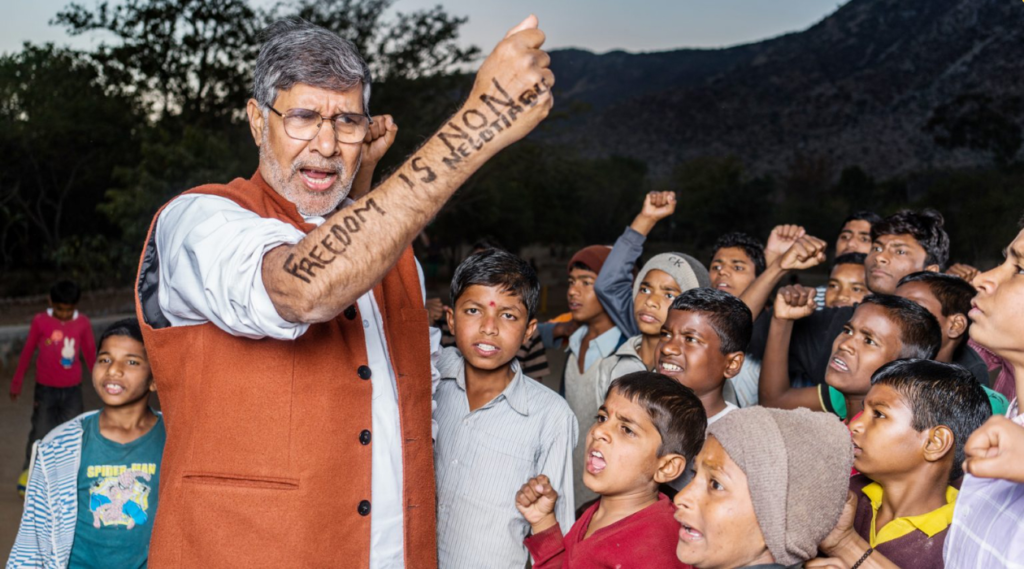
“Once you know that a child is suffering and you do nothing, you become a part of the system.”
The Carpet That Carried a Child’s Silence
India’s carpet industry in the Mirzapur-Bhadohi belt of Uttar Pradesh, was a place where thousands of children wove rugs through the 1980-90s. The buyers did not know, or perhaps did not ask, which hands made them. Satyarthi decided they would have to know.
He launched the Rugmark campaign in 1994 (later renamed as GoodWeave International) (1994: Founding of Rugmark – Stop Child Labor – The Child Labor Coalition, n.d.). It was a labeling and certification initiative that required carpet exporters to ensure the products were made without child labor.
The participating manufacturers agreed to random inspections. For the first time, a market mechanism was used to close a human rights loophole.
The consumers in importing countries could look at a label and know that no child had woven what lay beneath their feet. Good Weave has since certified over 150 million square feet of rugs, and rescued thousands of children from within the supply chain. It did not solve the problem entirely. But it proved something important. The market, with the right pressure could be made to listen. And a man with no institutional power had forced that conversation into existence.
The Raids, The Risk, The Reality
What is rarely mentioned in the ceremonial accounts of Satyarthi’s work is the physical danger it demanded. Raiding a factory where children are held as bonded labourers is not a bureaucratic act. The people who profit from that system are not passive.
Satyarthi and his Bachpan Bachao Andolan teams have been attacked, threatened, and beaten. In 2004, one of his close colleagues and a journalist accompanying a rescue operation were killed.
Satyarthi did not stop. He has said without dramatics, that the day he stops feeling afraid is the day he will stop respecting the danger. Fear for him, is a sign that the work is real.
He has documented over 80,000 cases of child labour and trafficking. He has mobilised communities, filed public interest litigation, and appeared before parliamentary committees. He does not work from a distance. He goes where the children are.
In 2016, he launched the 100 million campaign (ABOUT US | 100 Million Campaign, n.d.). It was a global initiative pushing for action against child labour, child marriage, and denial of education to 100 million vulnerable children worldwide. Over 12 million young people across 100 countries signed in as its advocates. This was not a petition. It was a movement with a specific demand that governments honour the commitments they had already made on paper but had not yet translated into the lives of children.
The Nobel and What Came After
The Nobel Peace Prize was awarded jointly to Kailash Satyarthi and Malala Yousafzai on October 10th of 2014, by the Norwegian Nobel Committee (The Nobel Peace Prize 2014 – Press Release – NobelPrize.Org, n.d.).
The Nobel Prize joint award clearly showed a deep significance, bringing together an Indian Hindu man and a Pakistani Muslim girl who both share a firm resolve that every child is entitled to the same level of protection and access to education.
When Satyarthi received his Nobel Prize at this year’s ceremony in Oslo, Norway, he told the audience he was not there for himself but for the children that are still out there waiting for their chance at happiness. He dedicated his award to those same children, and he returned to India and was again in field work within a very short period.
Receiving the Nobel Prize did not change his work schedule to be in the field with the children but did provide him with a new opportunity at a new level to reach out to heads of state, participate in global forums, and connect with large institutions that had previously looked upon him from a distance. Satyarthi utilized each of these unique opportunities.
In 2016, he led the World March Against Child Labour, walking 11,000 kilometres (Kailash Satyarthi: Fighting for Children’s Rights, One Step at a Time | The UNESCO Courier, n.d.). He met with children, parents, teachers, and policymakers at every stop.
When the march arrived in New York, it concluded with a special session at the United Nations. The outcome was a set of binding commitments from member nations to eliminate the worst forms of child labour by 2025. Whether those commitments hold is another question. That they at all is, in part, because Satyarthi walked every kilometre.
The Man Behind the Movement
There is a version of activism that is performed for an audience. Satyarthi’s is not that kind. Those who have worked alongside him describe a man who does not separate his public statements from his private conduct.
He has opened his own home to rescued children. His family has lived with the consequences of his choices, including threats, financial uncertainty, and the constant presence of a mission that does not take holidays.
His wife, Sumedha, has been beside him from the beginning. She leads programmes for rescued girls and women through the Bal Ashram Trust, a rehabilitation centre in Rajasthan that Satyarthi founded to house and educate children freed from bonded labour.
The Ashram does not merely shelter children. It restores them. It provides schooling, vocational training, counselling, and, as Satyarthi describes it, the experience of being treated as a person of worth. Children at Bal Ashram have gone on to become teachers, lawyers, activists, and engineers.
His son, Bhuwan Ribhu, is now a leading child rights lawyer and has argued landmark cases before India’s Supreme Court.
His daughter, Asmita, works in child protection. The Satyarthi family has not built a legacy in the conventional sense. They have built a practice, one that continues every day, without applause.
What the Numbers Cannot Say
There are statistics that frame Satyarthi’s work. Over 90,000 children rescued. More than 80,000 cases documented. Twelve million youth mobilised. 150 million square feet of certified carpets. These numbers matter. They are evidence that something real happened.
But the numbers do not hold the weight of individual stories. They do not hold the twelve-year-old who was weaving carpets in a locked shed for three years and who, after being freed, wanted first to see the sky without a roof over it.
They do not hold the girl rescued from domestic servitude who later stood up in a community hall and spoke, for the first time, about what had been done to her.
They do not hold the boy who, upon receiving a notebook and a pencil at Bal Ashram, held them for a long time before opening the first page. Satyarthi understands this distinction. He collects stories the way others collect evidence because, for him, they are the same thing. Each child is a case and each child is also a person, and no movement that forgets the second fact deserves to pursue the first.
Recognition That Followed the Work
The Nobel Peace Prize was neither the first nor the last acknowledgment of Satyarthi’s contributions. He has received the Defenders of Democracy Award from the Parliamentarians for Global Action, the Robert F. Kennedy Human Rights Award, the Aachener Friedenspreis from Germany, and the Alfonso Comin International Award from Spain.
He has been named one of TIME magazine’s 100 Most Influential People. The United States Congress has honoured him. The European Parliament has cited his work as a model of non-governmental human rights advocacy.
He has advised the United Nations, delivered addresses at the World Economic Forum in Davos, and testified before legislative bodies on multiple continents.
His organisation, Bachpan Bachao Andolan, has been recognised by the ILO and UNICEF as a leading force in the elimination of child labour in South Asia.
He has co-authored and championed legislation, including India’s strengthened Child Labour (Prohibition and Regulation) Amendment Act of 2016, which expanded protections and closed loopholes that had been exploited for decades.
In 2017, he was awarded the Champions for Change Award by the Clinton Global initiative. He has received honorary doctorates from multiple universities. Institutions that once ignored the problem he was describing now cite his methods in their own training programmes.
The Fire That Hasn’t Found Its End
Satyarthi is not finished. He will say so plainly if asked. There are an estimated 160 million child labourers in the world today.
The COVID-19 pandemic reversed two decades of progress in less than two years, pushing additional children into work as family incomes collapsed and schools closed. The numbers moved in the wrong direction for the first time in twenty years. He responded not with despair but with urgency.
He has expanded the Satyarthi Children’s Foundation to address not only child labour but the broader ecosystem that produces it: poverty, illiteracy, discrimination, and the absence of social protection systems.
He has expanded the Satyarthi Children’s Foundation to address not only child labour but the broader ecosystem that produces it: poverty, illiteracy, discrimination, and the absence of social protection systems.
He gives lectures. He meets students. He continues to file cases. And when a raid is needed, when a child is in a factory somewhere that cannot wait for a committee to convene, he still goes. At seventy years of age, he goes.
The Child Outside the School Gate
There is something quietly extraordinary about a life that holds its original image this long. Most people lose the picture that first changed them. It fades into the general business of living. Satyarthi has kept that child outside the school gate in clear focus for over four decades. Everything he has done has been, in some essential way, a refusal to walk past.
To understand him is to understand something about the moral weight of witnessing. He did not invent the problem of child labour.
He did not discover it. But he chose, at twenty-six, to stop treating it as someone else’s responsibility. That choice has freed more than 90,000 children. It has changed laws on multiple continents. It has shifted the conscience of industries that once preferred not to ask questions about their supply chains.
The boy stitching shoes outside that school in Vidisha never knew what he set in motion. He was simply doing what poverty had asked of him.
Kailash Satyarthi was simply doing what conscience had asked of him. The difference between those two responses is the story of a movement, a Nobel Prize, and a world that is, very slowly, learning to ask better questions about who gets a childhood and who does not.
Kailash Satyarthi was simply doing what conscience had asked of him. The difference between those two responses is the story of a movement, a Nobel Prize, and a world that is, very slowly, learning to ask better questions about who gets a childhood and who does not.
Clear Cut Child Protection, Education Desk
New Delhi, UPDATED: May 21, 2026 05:30 IST
Written By: Tanmay J Urs