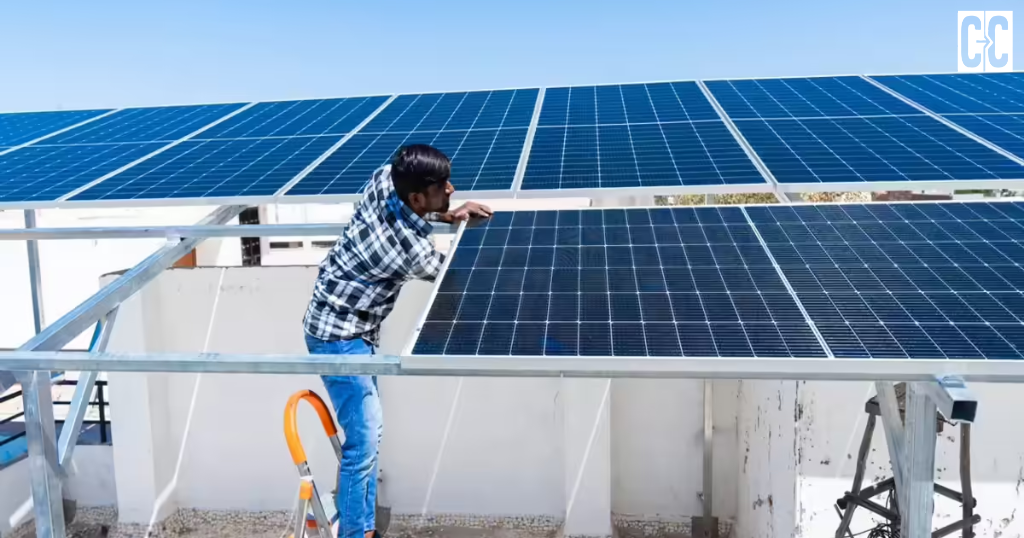
With PM Surya Ghar, they’ve added more rooftop solar in two years than the prior decade combined. The harder number to shift is who is benefiting.
India’s flagship rooftop solar scheme, PM Surya Ghar: Muft Bijli Yojana, had already achieved 50.06 lakh household installations as of early August 2026, the Ministry of New and Renewable Energy stated. The figure is significantly higher (more than six times) than the 7.94 lakh systems installed in the ten years before the launch of the PM Surya Ghar: Muft Bijli Yojana program in February 2024. The government is currently running the program with an allocation of 75,021 crore and has identified it as the world’s largest rooftop solar program.
Over time, there has been increased interest among people in the rooftop solar program, and installation rates have risen rapidly to almost 16,328 in July 2026 from merely 5,038 systems in October 2025. July 2026 alone marked a record installation of 5.06 lakh households, and, on average, one lakh households are now installed in six days.
The financial structure that enables that speed is direct, not secondary. 28,024 crores in subsidies have been transferred directly into bank accounts via Direct Benefit Transfer; 19 lakh households don’t pay anything for their electricity. 12 lakh more do better, together making 421 crores in 2024–25by selling excess power back to the grid, or an average of nearly 3,500/household/year. While this isn’t a fortune, it’s also a tiny but real power shift: a household that’s both the source and the customer of electricity.
Its ambition for distributive impact, too, isn’t shallow. Under the Utility Led Aggregation model for the scheme,1.6 lakh installations have already been provided to PMAY, BPL, and SC/ST households across four states, with the model sanctioned for deployment in a dozen additional states, backed by a concessional 5.75 percent credit line approved for over 21 lakh households’ applicants. But the gap the scheme intends to plug is far more, suggests some independent analysis.
Two household surveys in 2026 by the Council for Energy, Environment and Water (CEEW) observed that high-income households were engaged roughly 10 times more than low-income households, and that adopters typically had electricity bills around 50% higher than non-adopters. Indeed, as CEEW CEO Arunabha Ghosh recently noted, India’s solar growth needs to be fully realized for households as well as for low-income household aggregation.
Compared with other large residential solar markets, India’s success has less to do with scale and more to do with design. CEEW’s own comparisons indicate distributed solar capacity in China at 225 GW, Germany at 51 GW, and the USA at 47 GW. These levels are attributed much more to feed-in tariffs, tax credits, and net metering, which reward early capital investment and private roofing space above all else.
A recent study of low-income grid areas in the USA indicates that high-income adoption of rooftop solar has already led to 10% higher electricity costs for low-income households, as fixed grid expenses are distributed among fewer non-adopters.
India’s approach of delivering capital subsidies directly to bank accounts, with concessional credit and utility involvement targeted at PMWY, BPL, and SC/ST families, represents a far more deliberate effort to expand access than in other large markets. Whether it can keep pace with the demand-side gap it is trying to address is the truly exciting question beyond the 10GW milestone itself.
India has its own struggles with this race, Down To Earth points out, “Subsidizing rooftop haves while grid have-nots pay the price: unless targeting and transparency are both stepped up, India risks a future in which every net-metered consumer ‘pulls the grid cost’ on to those unable to set up a panel – namely non customers, tenants, all those in informal settlement areas and agricultural customers, with a few states moving to protect grid losses of distribution companies…” Maharashtra or Karnataka is already restricting what solar drinking houses will earn back via net metering and applying time-of-day rates; a total cross-subsidy effect isn’t even available in a nationwide assessment yet. Added complications arise when it comes to implementation gaps – the Institute for Energy Economics and Financial Analysis shows, that lot of delays is owed to the 30 days between commission to installation in the tender and then extending up to two to three and even 4 times as it is actually delayed owing to unavailability of meters; distribution companies and vendors aren’t on the same page; also domestic content panels cost close to double compared to foreign made panels which is forcing households to forgo subsidy to accelerate the installation.
The target, set by the government, is to reach a crore household by the end of FY 2026-27, nearly twice the existing number, in less than a year. Commentary on this milestone indicates the real bottleneck of the program has already shifted elsewhere-it’s no longer so difficult to get people to apply, but completing the whole pipeline from paperwork to power for each of these million-odd households still is. The real question around this milestone, still left unanswered, is whether it’ll be delivered to the kinds of households the aggregation models were designed for, rather than solely to the kinds of households that could have gone solar in the first place.
Clear Cut Climate Desk
New Delhi, UPDATED: August 10, 2026: 18:30 IST
Written By: Yatharth Pathak