
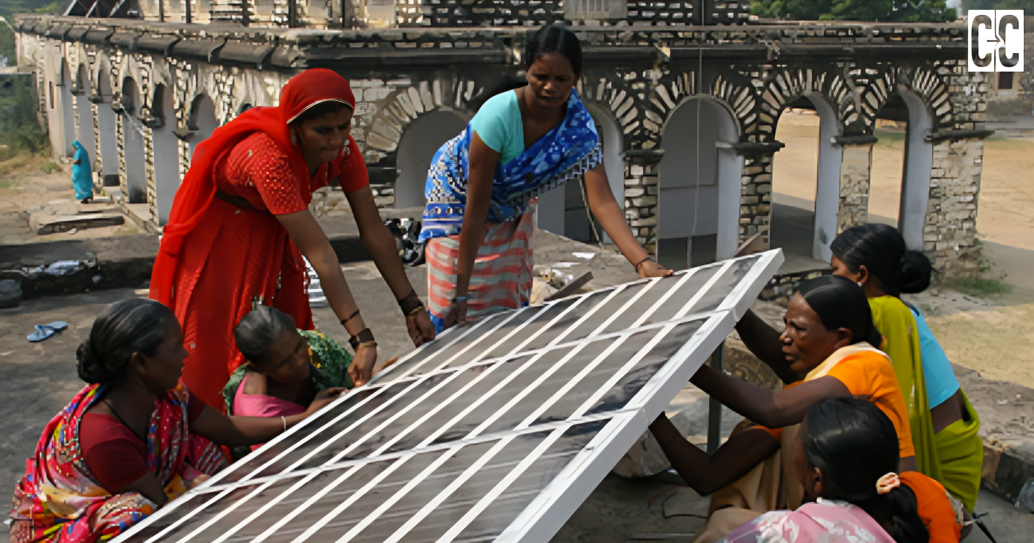
- Solar Mamas at Barefoot College are transforming rural women into trained solar engineers, helping expand clean energy and solar-powered lighting in remote communities.
- The six-month, hands-on training model promotes women empowerment, renewable energy, and greater energy access without requiring formal education or literacy.
- With Solar Mamas working across 93 countries, the model demonstrates how rural empowerment and decentralised renewable energy can support sustainable development.
The world’s credentialed engineers said it was technically impossible. You cannot teach an illiterate person to install, maintain, and repair solar-powered lighting systems. Certainly not in six months. Certainly not in a language they do not speak, or through diagrams they have never seen. Sanjit ‘Bunker’ Roy had heard this argument before. He had spent 50 years watching the Indian development establishment underestimate the intelligence and capability of rural communities, particularly rural women. In 2005,
in Tilonia, Rajasthan, began inviting people from some of the world’s poorest villages to train as solar engineers. By the start of 2025, 3,500 Solar Mamas from 93 countries had graduated. Between them, they have given 2.5 million more people access to solar-powered lighting.

Six months, sign language and colour codes
The Barefoot College Solar Engineer training runs for six months in Tilonia. Participants typically do not share a language with their instructors or with each other. They frequently cannot read. So, Roy’s team designed a training methodology built on visual pattern recognition, colour-coded circuit boards, sign language, and hands-on repetition rather than manuals, lectures, or literacy. Women learn to assemble and repair integrated circuit boards, install off-grid solar units generating up to 500 kilowatts per day, and train others in their home communities to maintain the systems once they return. The training works not despite its constraints but partly because of them: it was designed out of necessity to make complex knowledge accessible without the institutional filters that formal education typically imposes.
When husbands threatened divorce, and women became engineers anyway
Roy has described what happens when Solar Mamas return to their villages with a direct clarity that cannot be softened: ‘They come back like tigers. Their husbands told many; I will divorce you if you go to India. But when they returned as engineers who electrified the entire village, some told their husbands: I am better off without you.’ The empowerment is not primarily symbolic. A woman who returns with a skill that her entire village needs has materially altered her position in her community. The transformation is economic, social, and personal simultaneously.
175,000 solar systems and 50,000 homes lit in Africa alone
By the time of recent reporting, the Barefoot College network had installed 175,000 solar systems in remote villages across its operating geographies. In Africa specifically, Solar Mamas had electrified over 50,000 rural homes. It is a figure that represents approximately 1.4 gigawatts of solar power generated, equivalent in output to a small nuclear power plant. Barefoot College operates in 93 countries. Its Enriche programme has additionally empowered over 5,000 women through digital and financial literacy training. The model has been extended beyond solar to include water conservation, health, education, and traditional craft skills.
Night schools and the philosophy that built them
The Tilonia campus that Roy built is itself a demonstration of the Barefoot philosophy: solar-powered, designed by villagers, and running night schools for children whose days are spent working. Roy, a former Indian national squash champion who gave up a privileged urban career after confronting the 1967 Bihar famine as a young man, has spent five decades arguing a single, consistent point. ‘It is a myth,’ he says, ‘that just because you can read or write, you are educated.’ The night schools, the solar training, the water systems, and the health workers are structured around the belief that rural communities hold the expertise to develop themselves. The role of an institution like Barefoot College is to surface that expertise, rather than replace it with external credentials.
Conclusion Barefoot College’s Solar Mama model is, at its core, an argument against the development sector’s most persistent assumption: that capability flows from qualification, and that illiteracy disqualifies a person from technical mastery. 3,500 solar engineers from 93 countries have now made that argument empirically redundant. The policy implication for India is direct: the Ministry of New and Renewable Energy’s solar deployment targets, which require installation and maintenance capacity in hundreds of thousands of villages, should actively fund Barefoot-style decentralised training programmes that do not require literacy or formal credentials as entry conditions. This is not a fringe idea. It is a proven, cost-effective model that has been operating for 20 years. The credentialed engineers who said it was technically impossible were wrong, and Bunker Roy has 3,500 solar grandmothers to prove it.