- The PM Viksit Bharat Rozgar Yojana (PM-VBRY) aims to create over 3.5 crore formal jobs by providing financial incentives to both first-time workers and employers, encouraging long-term employment and social security coverage.
- With around 15 lakh jobs already created and ₹2,400 crore recently disbursed, the scheme focuses on bringing more workers into the formal economy through EPFO registration and documented wage employment.
- While the initial results are promising, the scheme’s success will ultimately depend on whether these workers remain in formal employment beyond the incentive period and contribute to sustained workforce formalisation.
A CHEQUE, A CROWD, A CALCULATION
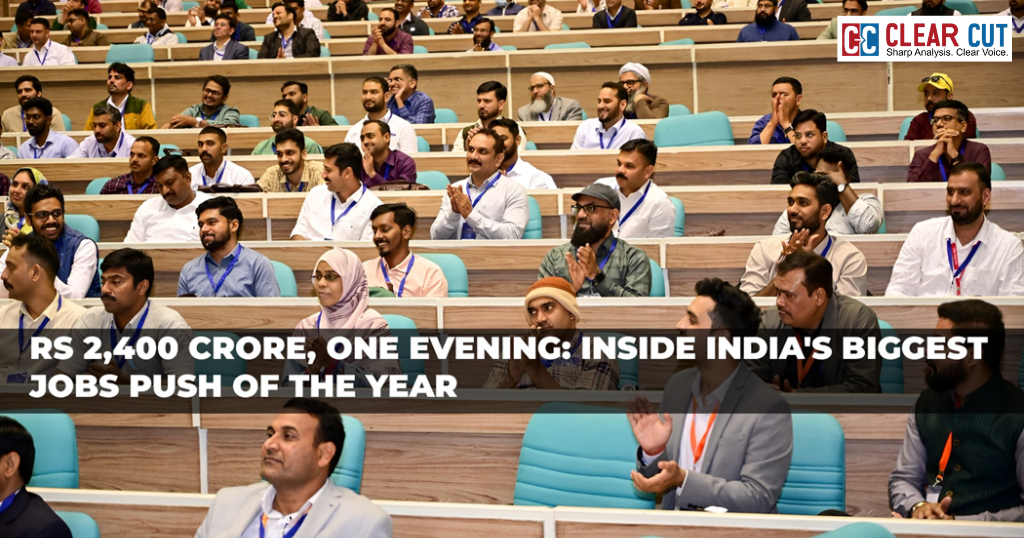
At 5 in the evening on June 19, 2026, Vigyan Bhawan in New Delhi filled with a crowd that doesn’t usually make front-page news. The first-time wage earners, apprentices, factory floor recruits, the kind of worker whose first salary slip is more meaningful than any headline. The Prime Minister was there to disburse around Rs 2,400 crore in incentives under the Pradhan Mantri Viksit Bharat Rozgar Yojana. The optics were ceremonial. The economics underneath them were not.
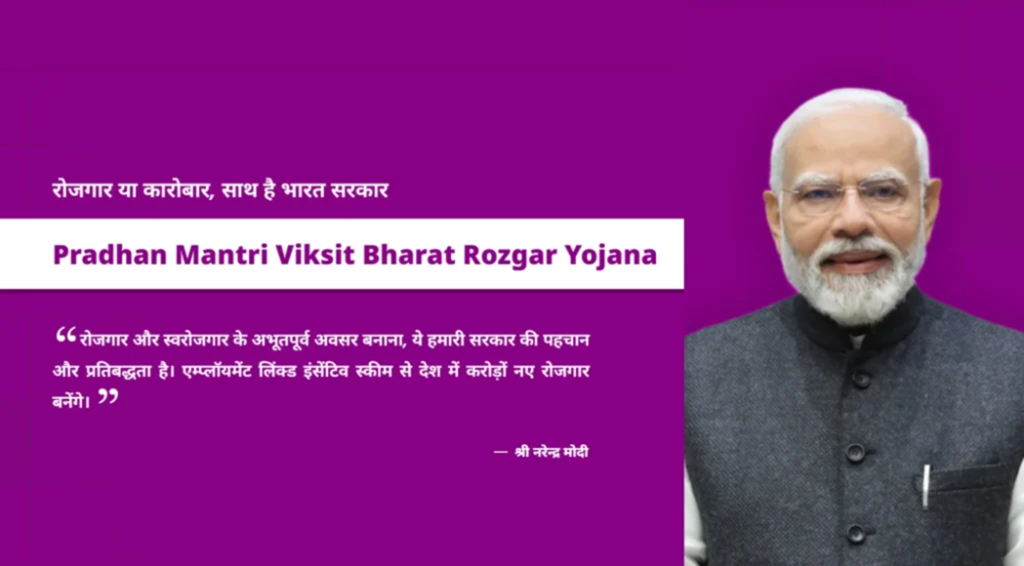
PM-VBRY is not a subsidy scheme dressed up as a jobs programme. It is a structured financial bet that paying both the worker and the employer to formalise a job will outperform simply hoping the job gets created. 20 lakh, 15 lakh, 25 lakh — the job-creation numbers in Indian policy discourse can blur together. This scheme asks a sharper question: how many of those jobs come with a provident fund account, a wage record, and legal protection attached?

HOW THE MONEY ACTUALLY MOVES
The scheme works on a dual-incentive design. A first-time employee entering the formal workforce becomes eligible for an incentive of up to Rs 15,000, paid in two instalments after 6 and 12 months of continuous service. It is a structure built deliberately to reward retention, not just hiring. Employers, on the other side of the transaction, receive up to Rs 3,000 per month for each additional employee they hire, with manufacturing-sector employers eligible for an extended incentive period of four years.
The scheme runs from August 1, 2025 to July 31, 2027, targeting the creation of more than 3.5 crore jobs. Of these, nearly 1.92 crore are expected to be first-time entrants to the formal workforce — a category the Indian labour market has historically underserved, since most entry-level hiring in India still happens informally, off the books, without social security coverage.
“Fifteen lakh jobs created. Rs 2,400 crore disbursed in one evening. The real test is whether these workers still have formal jobs in three years.”

WHY FORMALISATION IS THE REAL STORY
India’s informal economy still employs an estimated 80-90 per cent of its workforce, according to Periodic Labour Force Survey data. Informal jobs typically come without provident fund contributions, health insurance, or legal protection against arbitrary termination. PM-VBRY’s underlying ambition is not simply job creation. It is job formalisation, nudging employers toward EPFO registration and standard wage documentation through a direct cash incentive.
The Prime Minister, announcing the disbursement on social media, framed it explicitly as an effort to empower the country’s ‘Yuva Shakti’ — youth power — with a focus on job creation and social security expansion. That framing matters because India’s median age remains under 29; the country’s economic future is structurally tied to whether this specific generation finds formal employment in the next five years, not the next twenty.
WHAT ACCOUNTABILITY DEMANDS NEXT
15 lakh jobs in roughly 10 months of implementation is a meaningful start, but the scheme has 27 more months to reach its 3.5 crore target. This is a scale-up of more than twentyfold. The Ministry of Labour & Employment must publish monthly, sector-disaggregated job-creation data, not annual summaries, so that the public and Parliament can track whether the pace is accelerating or plateauing.
More importantly, retention data must be tracked beyond the 12-month incentive window. A worker who exits formal employment in month 13, once the incentive money has been paid, represents a policy failure dressed as a statistic. PM-VBRY’s real verdict will not be written in June 2026. It will be written in 2028, when this cohort of first-time workers either remains in the formal economy — or quietly disappears back into it.
Clear Cut Livelihood Desk
New Delhi, UPDATED: June 20, 2026 01:25 IST
Written By: Tanmay Urs