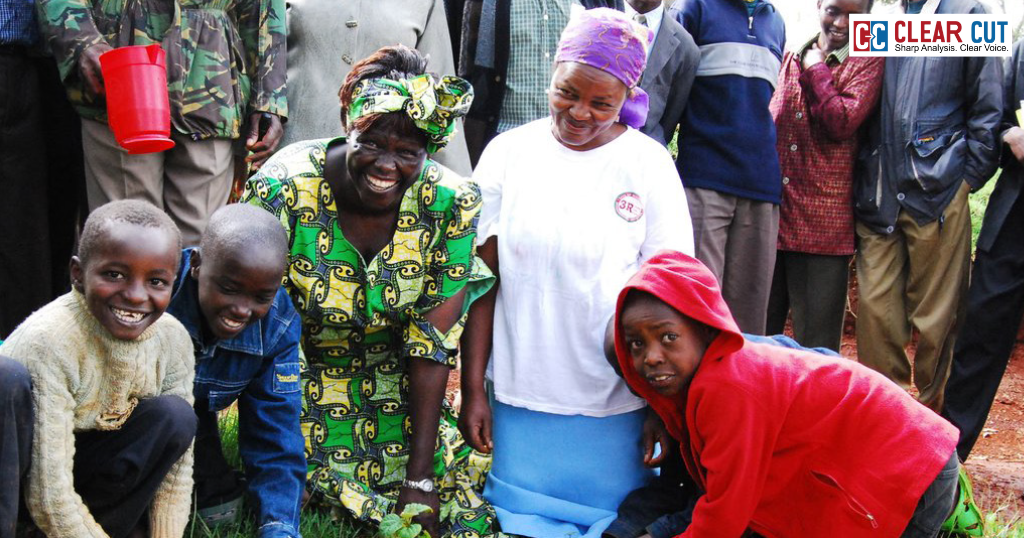
- Wangari Maathai transformed environmental conservation into a movement for social change, founding the Green Belt Movement in 1977, which has planted over 51 million trees and empowered thousands of women across Kenya.
- She linked deforestation to poverty, gender inequality, and poor governance, proving that environmental restoration can strengthen democracy, livelihoods, and community resilience.
- As the first African woman to win the Nobel Peace Prize (2004), Maathai left a lasting legacy, showing that protecting nature is essential for peace, sustainable development, and human rights.
Wangari Maathai, the Nobel Prize, and 51 million Trees
The Child Who Was Told Not to Disturb the Fig Tree
In the hills of Nyeri, in central Kenya, a fig tree grew near the home of a young girl’s family. Her grandmother told her it was sacred and must not be disturbed. As a child, she gathered water from springs whose banks were held in place by tree roots. The soil was dark and gave way to seeds easily. She did not know, then, that she was learning something that would take her forty years to fully articulate: that a forest is not merely a collection of trees. It is a community of relationships, a water system, a food system, an economy, and, when it is destroyed, a warning about what happens to the people who depend on it.
Wangari Maathai turned seven seedlings into a global movement — proving that planting trees can fight poverty, protect democracy, and reshape the meaning of peace.
That child was Wangari Muta Maathai, born on April 1, 1940, in Nyeri, Kenya. She would become the first woman in East and Central Africa to earn a doctoral degree, the first African woman to receive the Nobel Peace Prize, and the founder of a grassroots movement that would plant over 51 million trees across Kenya and inspire conservation programmes on five continents. She died on September 25, 2011, from ovarian cancer, in Nairobi. The movement she built outlived her.
The Education That Changed the Argument
Maathai’s path from Nyeri to a Nobel podium in Oslo ran through a series of institutional doors that very few African women of her generation were allowed to enter. She earned a scholarship to Mount St. Scholastica College in Atchison, Kansas, where she studied biological sciences, graduating
in 1964. She obtained a Master of Science from the University of Pittsburgh in 1966. She returned to Kenya, pursued doctoral studies at the University of Nairobi, and in 1971 became the first woman in East and Central Africa to receive a PhD. She joined the faculty of veterinary anatomy at Nairobi and
became the first woman to chair a department there.
Her academic credentials gave her a scientific framework that would define the Green Belt Movement’s argument: deforestation was not merely an environmental problem, it was a poverty problem, a public health problem, a women’s rights problem, and a governance problem. [Nobel Peace Prize Biography, NobelPrize.org]
She saw, in the degraded hillsides around Nairobi, a direct line between the disappearance of trees, the drying of rivers, the collapse of soil fertility, the hours women spent walking for firewood, the malnourishment of children, and the poverty that trapped communities. She also saw that the
solution was something ordinary people, specifically rural women, could implement themselves.
Seven Seedlings on World Environment Day
On June 5, 1977 — World Environment Day, Wangari Maathai planted seven trees in Nairobi’s Kamukunji Park with a small group of women from the National Council of Women of Kenya. That
planting was the founding act of the Green Belt Movement. [Green Belt Movement, greenbeltmovement.
org].
The name was literal. The strategy was to plant long rows of trees, green belts, across degraded land, reversing erosion, restoring water tables, and providing communities with firewood, food, and income from the nurseries they built and managed. The women who took part were paid a small amount per seedling that survived, creating an economic incentive tied to a conservation outcome.
Government foresters initially dismissed the approach, arguing that uneducated rural women could not successfully plant and maintain trees. They were wrong. By the time the Green Belt Movement
had been running for a decade, 5,000 grassroots nurseries were operating throughout Kenya. [Goldman Environmental Prize, goldmanprize.org]
Since 1977, the Green Belt Movement has planted over 51 million trees in Kenya. More than 30,000 women have been trained in forestry, food processing, beekeeping, and other income-generating skills. [Green Belt Movement Annual Data / Wikipedia, citing GBM reports]
The Political Inconvenience of Planting Trees
What no one anticipated in 1977 was that planting trees would become an act of political resistance. The Green Belt Movement’s insistence on planting trees in parks without government permission was read as a political threat under President Daniel arap Moi’s increasingly authoritarian government.

In 1989, when the government proposed the construction of a 60-storey development in Nairobi’s
most significant public green space called Uhuru Park, Maathai led as the opposition. She was vilified in parliament, forced to vacate the Green Belt Movement’s offices f 10 years with 24 hours’ notice. She was publicly dismissed by the government as a troublemaker. International investors, responding
to the sustained opposition, withdrew support for the project. However, the park was saved.
In 1992, she was beaten unconscious by police while participating in a hunger strike at Freedom Corner in Uhuru Park, demanding the release of political prisoners. She did not stop. She was jailed, harassed, and periodically placed under house arrest. She continued to plant trees and continued to demand democratic governance.
“Although initially the Green Belt Movement’s tree planting activities did not address issues of democracy and peace, it soon became clear that responsible governance of the environment was impossible without democratic space.”
[Wangari Maathai, Nobel Prize Lecture, December 10, 2004]
The Nobel Prize That Was a First in Three Ways
On October 8, 2004, the Norwegian Nobel Committee awarded the Nobel Peace Prize to Wangari Maathai ‘for her contribution to sustainable development, democracy and peace.’ She was the first African woman to receive the prize, the first person to receive it primarily for environmental work, and the first laureate whose award explicitly linked ecological conservation to peace and democracy. [Nobel Peace Prize, NobelPrize.org, 2004]
When the announcement reached her in Nairobi, she planted a tree. Within hours of learning of the award, she was in soil. Her Nobel lecture in Oslo described the Green Belt Movement not as an environmental project but as a project in democratic consciousness — teaching communities that they had rights, responsibilities, and the capacity to change their environment.
The UN Environment Programme’s Billion Tree Campaign, which aimed to plant one billion trees globally in 2007, was directly inspired by Maathai’s work and her call to action at the Nobel ceremony. [UNEP Billion Tree Campaign, cited by Yale University Reflections Journal]
platform expanded significantly. She met with heads of state, appeared at the World Economic Forum in Davos, and testified before legislative bodies in Europe and North America. She was elected to the Kenyan Parliament in 2002 and served as Assistant Environment Minister. She founded the Wangari Maathai Institute for Peace and Environmental Studies at the University of Nairobi. She wrote four books: The Green Belt Movement, Unbowed: A Memoir, The Challenge for Africa, and Replenishing the Earth.
The Legacy That Is Measured in Roots and Soil
Wangari Maathai’s death in 2011 did not end the Green Belt Movement. The organisation continues to operate across its four thematic pillars: tree planting and watersheds, gender livelihood and advocacy, climate change, and mainstream advocacy. The Pan African Green Belt Network, established in 1986, extended her model to other African nations. The Wangari Maathai Foundation continues her work in Kenya and internationally.
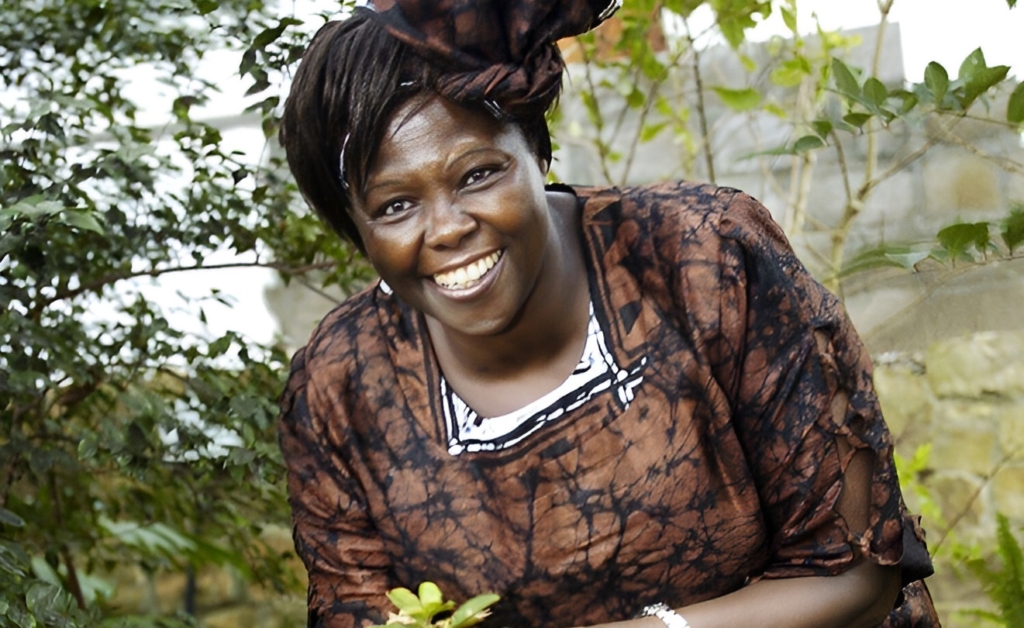
The connection between environmental restoration and conflict prevention that Maathai articulated is now a documented framework in peace studies and environmental security research. [IPBES / UNEP Post-Conflict Environment Programme] She is still, 15 years after her death, the most cited African woman
in the history of environmental scholarship. The trees she planted are still growing. The rivers they protect are still flowing. The women she trained still run nurseries. The argument she made that democracy, environmental sustainability, and women’s empowerment are not separate problems with separate solutions, but one problem with one solution, is still being proven right.
Conclusion
The world in 2026 is far more deforested, far more climate-unstable, and far more unequal than the world Wangari Maathai walked into in 1977. It is also, in at least one important way, more prepared: the conceptual vocabulary she spent a lifetime building — linking tree cover to water security to gender equity to democratic governance — is now standard language in climate diplomacy, development economics, and environmental law. She did not live to see it become standard. She did the work that made it possible.
The instruction she left is specific: start where you are, with what you have. Seven seedlings on a patch of Nairobi Park became 51 million trees across a continent. The fig tree her grandmother told her not to disturb became a metaphor that reshaped the Nobel Prize’s definition of peace. Plant the tree,
she said. Not as a metaphor. As an instruction. The 51 million trees still growing across Kenya are the most literal proof that she was right.
Clear Cut Climate Desk
New Delhi, UPDATED: June 15, 2026 01:00 IST
Written By: Tanmay Urs