

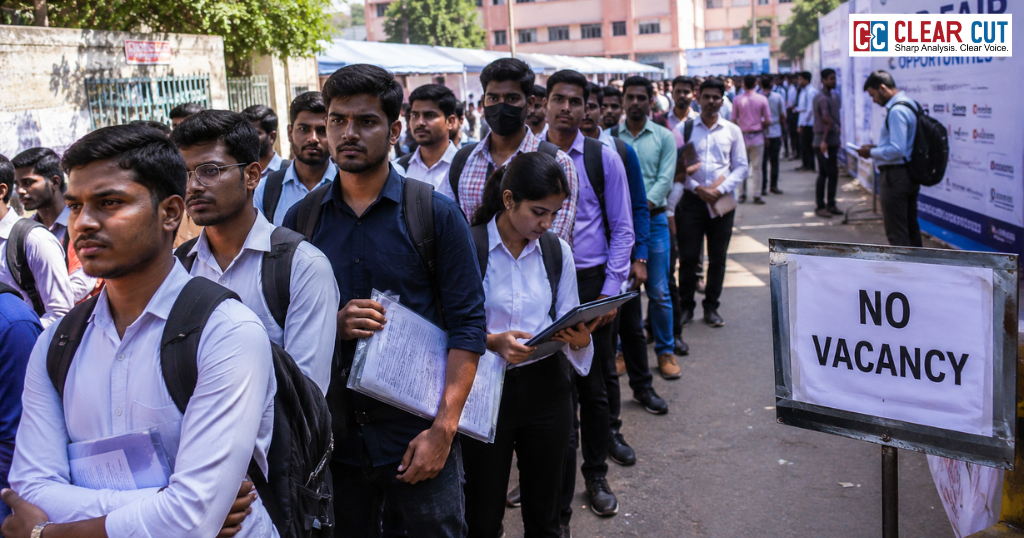
- Despite India’s low overall unemployment rate of 3.2%, graduate unemployment remains significantly higher, highlighting a growing disconnect between higher education and available job opportunities.
- Many young graduates face stagnant salaries, skills mismatches, and limited formal-sector jobs, leading some to choose gig work or even apply for lower-skilled government positions for financial stability.
- The article explores how rising educational aspirations, changing workforce expectations, and a rapidly evolving economy have created an employment paradox affecting millions of India’s educated youth.
Rahul has a degree. He has sent 200 applications. He is twenty-three years old, and he is still at home in Indore, waiting for the market to catch up to what he was told he was worth.
According to PLFS (2023-2024), India’s overall unemployment rate is 3.2%, which, by global standards, sounds like progress. But pull that number apart by education level and something uncomfortable surfaces: among graduates, unemployment is 13% as per PLFS 2024. Among people with no formal education, it is nearly zero.
Don’t read that as the system working for them. The illiterate are employed because they cannot afford not to be. Casual labour, farm work, domestic help, whatever is available on a given morning. The graduate’s unemployment, perversely, is a sign of being able to hold out for something better. The queue is a privilege. And that privilege is precisely what makes this paradox so difficult to solve.
The Waiting Game
Rahul’s parents don’t quite understand why he won’t just ‘take something.’ There’s a data centre being set up at the edge of town. There’s always the family shop. But Rahul has a degree. He has a salary number in his head. And he has seen enough LinkedIn posts to know what people like him are supposed to be earning.
Economists call what Rahul is doing ‘queuing.’ Educated workers hold out for formal-sector jobs that match their qualifications, unwilling to step into manual or informal work. The formal sector, meanwhile, creates far fewer positions than the number of graduates chasing them. So the queue grows, and the waiting becomes its own kind of full-time occupation.
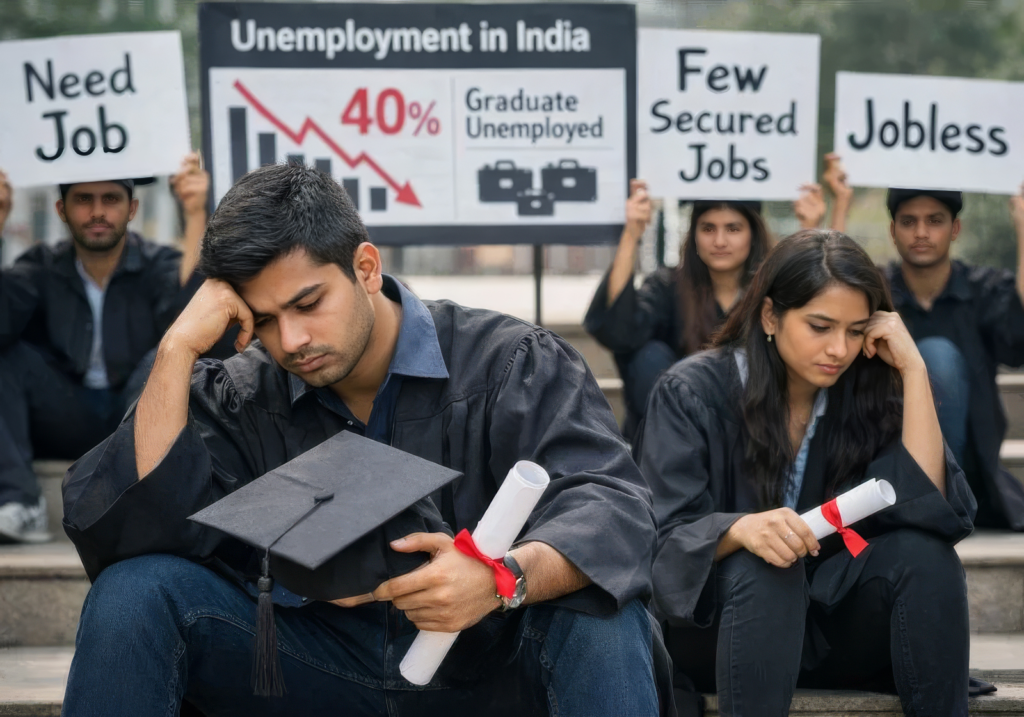
This isn’t new. Between 1983 and 2023, graduate unemployment in India remained stubbornly between 35–40%, as per Azim Premji University Report. What has changed is the scale — and the awareness. Rahul’s father didn’t have Instagram reels telling him what a ‘fair salary’ looks like. Rahul does. The gap between expectation and reality has always existed. Now it has an audience.
This is Indore’s reality. But talk to graduates in Coimbatore, Patna, Bhopal, or Surat, and you’ll hear the same story with different accents. The Tier 2 city is where the paradox is sharpest — educated enough to know what the metros pay, too far away to easily access it, and too qualified to go back.
The Salary That Doesn’t Add Up
Six months ago, Rahul got an offer. It was from a small logistics firm — an operations role, decent enough on paper. The salary was ₹14,000 a month. He turned it down.
His relatives called it arrogance. His friends, who’d done the same calculation, called it sense.
73% of undergraduate students expect starting salaries above ₹5 lakh per annum. Only 40% actually get there. In cities like Bengaluru, Mumbai, or Delhi, a salary of ₹18,000 a month after four years of college fees doesn’t cover rent, food, and a commute. In Indore, it covers more — but not enough to justify the degree that cost the family what it did.
The deeper wound is structural: average graduate salaries in India have remained stagnant at ₹3–4 lakh per annum for nearly a decade. The cost of the degree has not been so patient. Tuition fees, hostel rent, coaching centres, the years of a parent’s savings — all of it has gone up. The return on investment of an Indian college education is quietly, steadily deteriorating, and the graduate feels it before any economist bothers to write about it.
There’s a difference between wanting too much and knowing exactly how little you can survive on. And professionals across India today expect salary hikes of 30–50% when switching jobs not out of greed, but because a decade of stagnant real wages and rising urban costs means anything less feels like going backwards. The aspirations were never too big, the market just never grew tall enough to hold it.
The Degree That Lost Its Address
Rahul’s story stops feeling like a personal problem the moment you look at what’s happening at scale.
The Economic Survey 2024-25 tabled in Parliament found that only 8.25% of Indian graduates are working in roles that actually match what they studied. Over half are in jobs classified as elementary or semi-skilled. Not struggling to climb the ladder. Working nowhere near it.
This is what researchers call a dual crisis: graduates who cannot get hired at all, and graduates who get hired but into work that has nothing to do with the years they spent earning a degree. Both outcomes do the same quiet damage. Wages stay low, productivity stagnates, and the question that nobody wants to say out loud starts getting louder: was any of this worth it?
The answer, for a lot of people, is arriving in unexpected ways. Over 46,000 graduates and postgraduates applied for sanitation worker positions in Haryana. In Rajasthan, 12,000 professionals lined up for 18 peon posts. These weren’t acts of desperation. They were acts of calculation. A government job, any government job, offers something the private sector stopped pretending to guarantee a long time ago: stability. When the alternative is a white-collar role that pays ₹15,000 a month and describes itself as a growth opportunity, the peon post starts making a lot of sense.
When the Bike Pays Better Than the Business Card
Three weeks ago, a friend of Rahul’s started delivering for a quick-commerce platform. Same city, same degree, same frustrated year of applications. He now earns ₹28,000 in a good month, sets his own hours, and is, by most visible measures, doing fine.
Rahul hasn’t joined him yet. But the thought has crossed his mind more than once.
He isn’t an outlier in that hesitation. WorkIndia report states that blue-collar gig hiring in India grew 92% in 2024, pulled along by last-mile logistics and the relentless expansion of quick-commerce. Gig applications surged 63% in the same period, and the sharpest spike didn’t come from school dropouts looking for anything. It came from graduates who had looked at everything and made a choice.
The choice, when you run the numbers, isn’t hard to understand. A delivery executive putting in consistent hours across a mid-size Indian city takes home ₹25,000 to ₹35,000 a month with the freedom to log off when the shift ends. The career-track fresher role at a small IT firm or an HR consultancy offers ₹18,000, a nine-hour day, no flexibility, and a manager who uses the phrase “learning curve” in place of an actual raise. The bike wins. Not glamorously, not aspirationally, but financially, which is the only column that pays rent.

In smaller cities especially, delivery work has stopped being something people do between real jobs. It has become the job. The gig economy didn’t set out to absorb India’s graduate workforce. It just kept showing up with better numbers than the alternative, and eventually people noticed. It pays today. The career-track role pays in the future, in a currency called potential, and for a generation that watched their parents spend decades cashing that cheque with diminishing returns, the future is a harder thing to bet on.
The problem was never that people chose the gig. The problem is that the other option couldn’t make a better argument for itself.
The Number That Doesn’t Lie, Just Doesn’t Tell the Whole Story
Rahul will probably find something. The data suggests as much. Graduate unemployment mellows with age, as people build networks, quietly recalibrate what they were willing to accept, and eventually land somewhere. The queue doesn’t go on forever. It just goes on long enough to cost something.
India’s 3.2% will keep appearing in budget speeches and investor decks, doing what headline numbers do best: giving a shape to something too large and too complicated to hold in one sentence. The 13% among graduates sits inside it, averaged out by hundreds of millions of people who never had the option of waiting. The daily wage worker is employed. The postgraduate who applied for a sanitation job and got it is employed. Rahul, when he eventually signs an offer letter, will be employed too.
The number won’t be wrong. It just won’t be the whole story.
What it won’t capture is the distance between what a degree promises and what the market is currently able to deliver. That distance is not a political failure or anyone’s deliberate design. It is the lag between a country educating its people faster than its economy has built places for them, a gap that exists in some form in almost every fast-growing developing nation, and that India is now confronting at a scale few others have had to.
Rahul’s frustration isn’t evidence that something went wrong. It’s evidence that something is mid-way through going right, and that the in-between, which is where he’s been living for the better part of a year, is harder than anyone’s growth projections tend to account for. The queue will shorten. The jobs will come. The question is just whether they arrive before an entire generation decides the wait was never worth it.
Clear Cut Livelihood Desk
New Delhi, UPDATED: June 15, 2026 05:45 IST
Written By: Darshana Sharma