

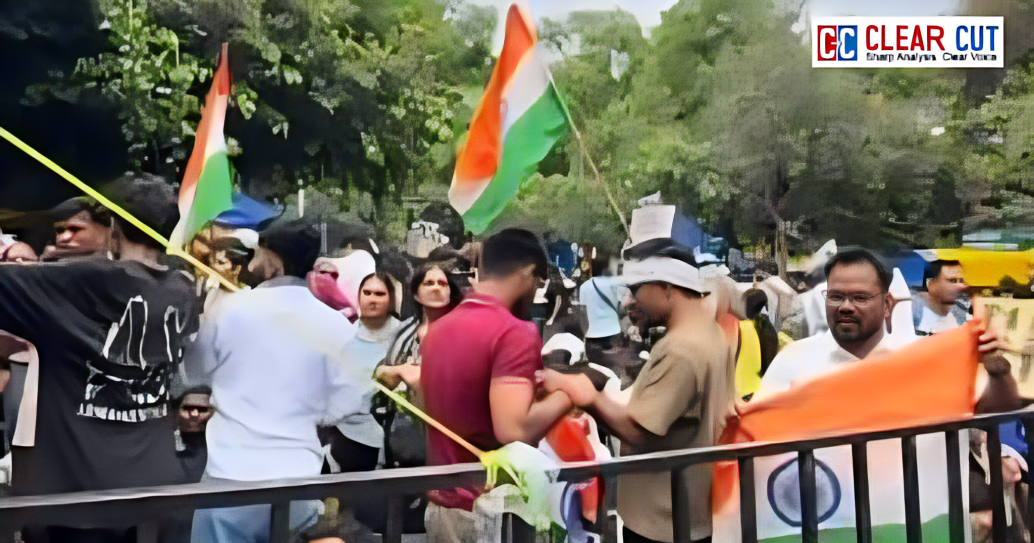
- The Jantar Mantar hunger strike has emerged as a major protest against the alleged NEET-UG 2026 paper leak, highlighting long-standing concerns over transparency and fairness in India’s examination system.
- The movement calls for stronger exam security, institutional reforms, compensation for affected students, and greater accountability to restore trust in national and state-level public examinations.
For weeks, the stretch of pavement around Jantar Mantar in New Delhi has looked less like a historic observatory and more like an open-air classroom turned protest camp. Students in college uniforms, parents carrying folding chairs, and volunteers distributing water bottles have gathered under makeshift tents, their placards demanding one thing: accountability for a paper leak that upended the medical entrance exam and, with it, the futures of lakhs of young Indians. At the centre of the agitation sits a hunger strike that has drawn in a well-known social activist, hospitalised at least one prominent figure, and pulled thousands of students into a march toward Parliament.
Who Actually Conducts India’s National Exams
Most of India’s big-ticket entrance tests, including NEET-UG for medical admissions, JEE-Main for engineering, CUET for university admissions, and UGC-NET for teaching and research eligibility, are conducted by the National Testing Agency (NTA).
The NTA was approved by the Union Cabinet in November 2017 and set up as an autonomous, self-sustained body registered under the Societies Registration Act, 1860, functioning under the Ministry of Education. Before its creation, individual bodies such as the University Grants Commission, the Central Board of Secondary Education, and central universities like Delhi University and Jawaharlal Nehru University ran their own entrance tests. The NTA took over these exams in phases starting in 2019, with the stated goal of standardising testing through computer-based formats and reducing the administrative load on universities and boards.
Beyond NTA-run exams, a separate universe of recruitment tests, for state police forces, teacher eligibility, and public service commissions, is conducted by state-level boards under their own laws, such as the Rajasthan Public Examination Act, 2022, and the Uttar Pradesh Public Examinations Act, 1998. This fragmented structure means that while the Centre owns the NEET-UG controversy, several of the leaks over the past five years trace back to state-run recruitment and eligibility tests instead.
Five Years of Leaks: A Pattern, Not an Aberration
Government data placed before state legislatures and reported by national dailies shows that paper leaks have been a recurring feature of India’s exam calendar, not an isolated incident:
- 2021–22 — Rajasthan’s REET teacher eligibility test, held for roughly 16 lakh candidates competing for about 31,000 posts, was hit by leak allegations that triggered internet shutdowns and a later reorganisation of the state recruitment board.
- 2021 — The Uttar Pradesh Teacher Eligibility Test (UPTET) was cancelled on exam day itself after the paper circulated on WhatsApp.
- 2022 — Rajasthan recorded ten major paper-leak cases in a single year, according to a state government reply in the assembly; the RPSC’s second-grade teacher exam was cancelled after 44 arrests, including the alleged mastermind, hours before the test.
- 2022 — Bihar’s BPSC preliminary examination was cancelled following a leak, with more than 200 arrests in connected networks.
- 2023 — The Telangana Public Service Commission paper leak affected over 25,000 candidates.
- February 2024 — The Uttar Pradesh Police Constable recruitment exam, taken by roughly 48 lakh candidates for over 60,000 posts, was cancelled and later re-conducted after leak allegations.
- May–June 2024 — NEET-UG 2024, taken by about 24 lakh candidates, became the subject of a Bihar Police investigation confirming a leak; the UGC-NET exam was cancelled a day after being held once the Education Ministry confirmed the paper had surfaced on the dark web.
- 2026 — NEET-UG 2026 became the trigger for the current protest wave, with the same allegations of leaked papers and, this time, added anger over irregularities in CBSE’s on-screen evaluation process.
Independent estimates cited by legal researchers and news outlets put the tally at 50 to 70-plus confirmed paper-leak incidents since roughly 2015, affecting well over a crore aspirants across central and state examinations. Parliament responded in February 2024 with the Public Examinations (Prevention of Unfair Means) Act, which created criminal penalties for leak-related offences, though enforcement still largely depends on state police.
What Paper Leaks Actually Cost
The consequences extend well past a cancelled exam date. Re-tests delay academic calendars by months, sometimes pushing candidates past age-eligibility limits for the jobs or courses they are competing for. Coaching and travel expenses, often significant for families from smaller towns, are sunk the moment a paper is compromised. Courts are frequently pulled in: the NEET-UG 2024 matter reached the Supreme Court, which had to weigh whether to order a re-test for all 24 lakh candidates or a more limited remedy.
The human toll has also become part of the public conversation. Following NEET-UG 2024 and the subsequent controversies, reports of student suicides linked to exam-related distress have featured prominently in protest messaging, including at the current Jantar Mantar demonstrations, where compensation for the families of aspirants who died has become an explicit demand. Beyond individual hardship, repeated leaks erode confidence in merit-based selection itself, a concern the government’s own 2024 High-Level Committee, headed by former ISRO chairman K. Radhakrishnan, was tasked with addressing through recommended reforms to NTA’s structure and data-security protocols.
The Jantar Mantar Hunger Strike, Explained
The current agitation is led by the Cockroach Janta Party (CJP), a youth-driven movement founded on 16 May 2026 by political communications strategist Abhijeet Dipke, in response to a remark by Chief Justice of India Surya Kant that likened unemployed youth to “cockroaches” and “parasites of society.” What began as satire quickly absorbed the growing anger over NEET-UG 2026 and CBSE’s evaluation irregularities.
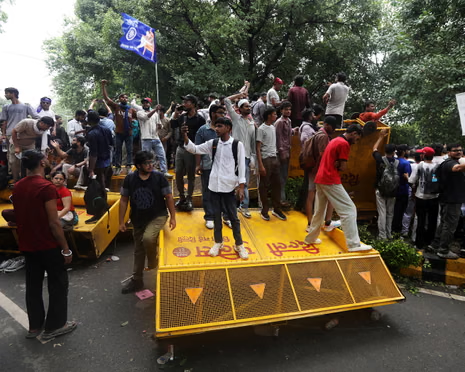
The group’s first physical demonstration at Jantar Mantar took place on 6 June 2026. Protests then travelled to Pune, Jaipur, Lucknow, and Bengaluru before returning to Delhi. On 20 June, at a second Delhi rally, Ladakh-based engineer-activist Sonam Wangchuk, who had voiced support for the movement, announced he would begin an indefinite hunger strike if Union Education Minister Dharmendra Pradhan did not resign. Wangchuk went on fast on 27 June and was later forcibly removed from the protest site; Dipke subsequently began his own hunger strike. The agitation escalated on 20 July, when thousands marched toward Parliament during the Monsoon Session, resulting in a police crackdown involving tear gas and lathi charges that left more than 100 people injured, according to reporting from the scene.
What the Protesters Are Demanding
CJP’s charter operates on two tracks. Its broader “exam manifesto,” unveiled in Pune, lists five structural demands: a flat ₹10,000 compensation for students affected by any paper leak; a mandatory backup exam within 72 hours of a compromised test; independent audits of paper-setting and checking processes; automatic age-limit extensions when exams or results are delayed; and government-funded travel for candidates required to appear at distant exam centres.
Layered on top of this is a narrower, more immediate set of demands tied directly to the Delhi stand-off: the resignation of Education Minister Dharmendra Pradhan, the release of Sonam Wangchuk, and roughly ₹1 crore in compensation for the families of NEET aspirants who died by suicide. As of late July 2026, the government has held preliminary talks, including a meeting between a CJP delegation and BJP president J.P. Nadda, but has not agreed to Pradhan’s resignation, and Dipke has said the protest will continue.
A Story Still Unfolding
The Jantar Mantar hunger strike sits at the intersection of two long-running Indian anxieties: the fairness of a mass examination system that decides the fate of tens of millions of young people every year, and the accountability of the institutions built to run it. Whether the current agitation produces structural reform, a ministerial resignation, or simply another cycle of protest and negotiation remains, at the time of writing, an open question.
Clear Cut Education Desk
New Delhi, UPDATED: July 22, 2026 02:40 IST
Written By: Mohita Bansal
Designation: Assistant Manager – MLE at Devinsights