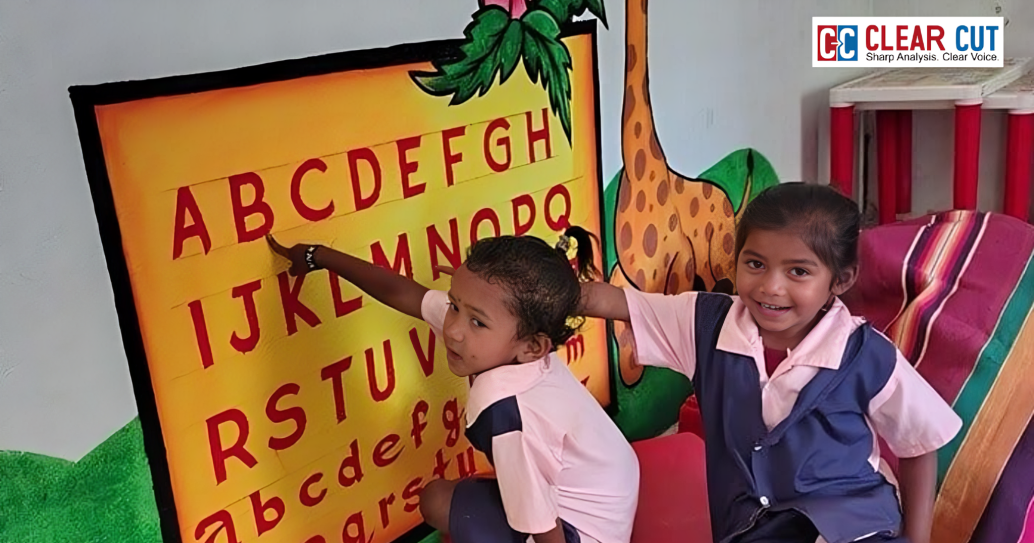
- Paikmal’s Anganwadi Model is transforming childcare centres into interactive learning spaces to improve foundational literacy and numeracy.
- The initiative, under the Aspirational Blocks Programme, strengthens coordination between government departments to ease the transition from preschool to primary school.
- It addresses persistent challenges in India’s Anganwadi system, including inadequate training and poor early learning outcomes.
- Odisha’s progress, backed by initiatives like NIPUN Bharat, demonstrates the impact of targeted early childhood education reforms.
- The article argues that the Paikmal model could serve as a scalable blueprint for improving foundational learning across India.
In Paikmal block of Odisha’s Bargarh district, a quiet renovation is underway. Anganwadi centres — the community childcare that anchor India’s early childhood system — are being repainted with alphabet murals, fitted with interactive number walls, and stocked with teaching-learning materials, NITI Aayog said in a July 18 update on the initiative. The upgrade sits inside the government’s Aspirational Blocks Program (ABP), and it depends on an unglamorous mechanism: three separate arms of government — the Women & Child Development Department, the School & Mass Education Department, and the block administration — working off a single shared plan.
The ABP itself is just three years old. It was rolled out by PM Modi on January 7, 2023, at the second National Conference of Chief Secretaries, and now covers 513 blocks identified as laggards in health, education, agriculture, and infrastructure. 40 of these are in Odisha. The ABP is a break down version of the 2018 Aspirational Districts Program and operates on three pillars: convergence of various schemes, cooperation among officials, and competition to drive progress. The Anganwadi reform at Paikmal is a theory put into practice to address a minor setback: the transition from Anganwadi to Class 1.
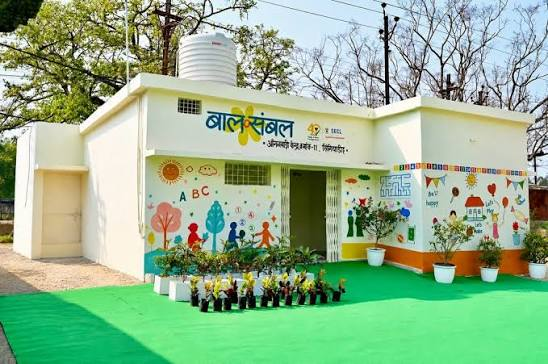
The handoff, though, is not a local problem; it is a national issue. India’s nearly 1.4 million Anganwadi workers cater to approximately 158 million beneficiaries. Still, more than 60% have received no training in playful teaching, and as of June 2025, almost 11,000 centres across the country remained operational for less than a fifth of their working days (a number drastically down from last year). And that effect goes all the way down to learning outcomes: this year’s Annual Status of Education Report for 2024 said less than a quarter of third-grade government school children can read a second-grade textbook, even after recovering from the pandemic.
Compared with other states, Odisha has done relatively well – it is the only state in the region to have universal access to pre-primary schooling, and its Class 3 children have had the largest gains in reading levels, from 8 to 10 points since 2022. For economists, the terms for what is at stake are blunter than “school readiness.” The Nobel laureate James Heckman has found that good early-years programs targeted to poor children deliver almost 13% returns per year, on a par with long-term equity returns, on the back of skills developed before age six, which snowball through all future stages of education. The gains in India’s early learning have tracked, in a real sense, the recent years of national concentration, through programs such as the Mission NIPUN Bharat (a mission to improve basic literacy and numeracy, and the mother project of Odisha’s Utkarsh state initiative) – which has shown children such as those depicted on the murals in Paikmal.
Set in the context of global data, the aspiration appears even more long overdue. Around half of all children aged three to six in the world do not attend pre-primary schooling; one in five in low-income countries has access to even a single preschool, according to World Bank data. As a Vietnam-equivalent of similar income levels shows, full-day pre-schooling for children aged five reached 84% within four years, from 66%, with steady and specific investment of 6.2 percent of the GDP on preschool, well above the OECD countries, and almost covered that entire age cohort by 2017. India’s own Anganwadi system, which already serves 150 million + beneficiaries, hasn’t been shy on scale.
Whether that bet actually pays off will mean more than one block’s improvement. When researchers matched district-level data from ABP’s predecessor, the Aspirational Districts Program, their peer-reviewed study found statistically significant health improvements in similarly structured districts following this convergence model-real evidence that this form of governance actually produces outcomes, and not just ranking changes. It is the difference that, for the children who are now trying to trace the alphabet onto Paikmal’s brand-new walls, will eventually prove more significant than any press release, any photo op- the difference between a program that looks good and one that improves what a 7-year-old can spell.
Clear Cut Climate Desk
New Delhi, UPDATED: July 23, 2026 06:30 IST
Written By: Yatharth Pathak