- Historic Milestone: BRICS officially recognized traditional medicine in its health agenda.
- Research Focus: Member nations pledged scientific research and clinical validation.
- AI & Digital Health: Countries will promote AI and digital knowledge sharing.
- Better Healthcare Access: Initiative supports safe, accessible, and evidence-based care.
- Global Cooperation: New expert groups will drive future TCIM collaboration.
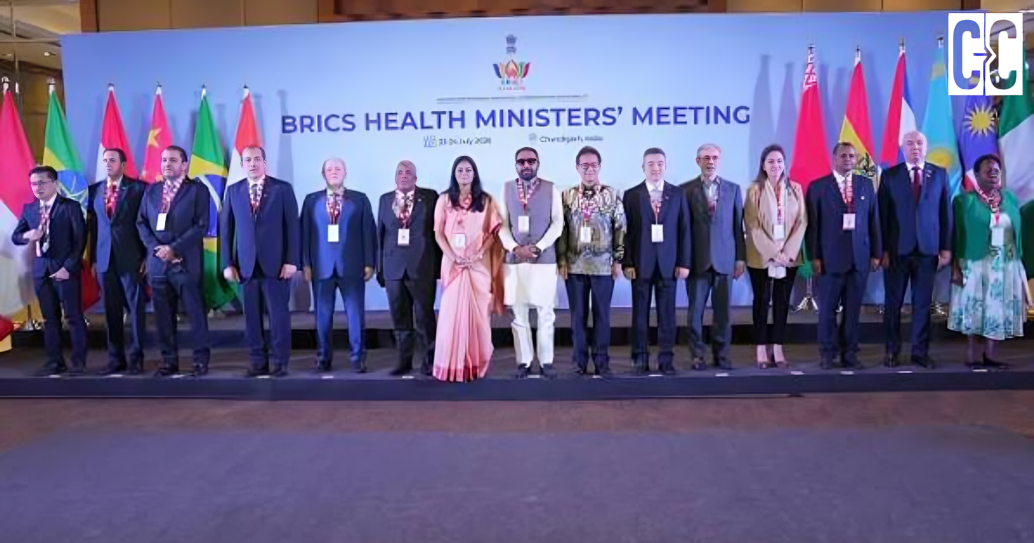
At the 16th BRICS Health Ministers’ Meeting in Chandigarh on 23-24 July 2026, health ministers of BRICS states passed a historic step for the first time in BRICS health cooperation, they drafted a section on traditional, complementary and integrative medicine (TCIM) in the BRICS Health Ministerial Declaration and established new expert working groups for the future – something the WHO terms “the largest high-level political validation that the traditional medicine sector has been given in BRICS to date”.
The declaration commits the bloc’s 11-member countries (Brazil, China, Egypt, Ethiopia, India, Indonesia, Iran, Russia, Saudi Arabia, South Africa, United Arab Emirates) to “cross-country multinational studies” on TCIM, “standardization of scientific approaches,” “demonstration of best practices,” and “clinical validation studies.” It further calls for cooperation on issues of quality assurance, safety evaluation, and adverse event surveillance, and advocates that governments submit their TCIM trials for inclusion in the WHO International Traditional Medicine Clinical Trial Registry. “Digitization,” is one of the keywords threaded throughout the declaration: countries also committed to “sharing platforms of knowledge-sharing relevant to the WHO’s Global Library of Traditional Medicine,” and “learning about the application of Artificial Intelligence (AI) for TCIM research, education and services, based on the WHO Global Traditional Medicine Centre and the WHO Global Traditional Medicine Strategy 2025-2034.”
“This decision was agreed to unanimously”, confirmed the Union Minister of State for Ayush, Pratap Rao Jadhav, in his on-the-side-lines address to the press, highlighting that the Ayush sector, which has seen India’s exports increase almost tenfold in just a decade, can count on global demand. In more of a social framework, the Union Minister of State for Health and Family Welfare, Anupriya Patel, positioned the decision among the bloc “which includes close to half the population of the world and 40 percent of the GDP”, stating that access to healthcare is “not a luxury, but a right”.
Such framing mirrors the rhetoric of WHO’s own leadership on traditional medicine, which has been communicated to policymakers for years. “For many people around the world, traditional medicine is either the first line of, or the only accessible or available care options available as the global reality indicates that 50% of the population does not have access to basic health care services,” said Shyama Kuruvilla, director of the WHO Global Traditional Medicine Centre, at a UN briefing before the Second WHO Global Summit on Traditional Medicine held last December. In December 2023, data shows, WHO member states report that 40-90% of their people use traditional medicine in one form or another, and traditional medicine is present in 170 countries globally, while receiving less than 1% of worldwide health research funding – a discrepancy the BRICS working group seeks to diminish.
But the equity situation works both ways. ‘If increased availability is to be achieved with the necessary controls and safeguards in place, policy reforms that address traditional health knowledge claims will be critical. An adequate framework will need to be developed to respect indigenous claims to traditional health knowledge, while considering existing variations in international regulations and the shortage of research that appropriately addresses the evaluation of non-biomedical systems. Nearly 40% of pharmaceuticals developed to date are derived from or based on natural products, researchers at the WHO Global Traditional Medicine Centre noted in a policy analysis published in the Bulletin of the World Health Organization.
Whether the Chandigarh declaration formalises this gap and may even widen it, or does something about it, would depend on what this new expert working group finally produces ahead of the BRICS heads of state meet under PM Narendra Modi in New Delhi between September 12-13. For now, it ensures that the evidence creation, safety regulation, and knowledge sharing of traditional practices on a conventional basis will take precedence over it being merely a ‘heritage’ of its member states- Something, which will matter a lot more to those hundreds of millions residing in member states without easy access to conventional treatments.
Clear Cut Health Desk
New Delhi, UPDATED: July 28, 2026 13:30 IST
Written By: Yatharth Pathak