
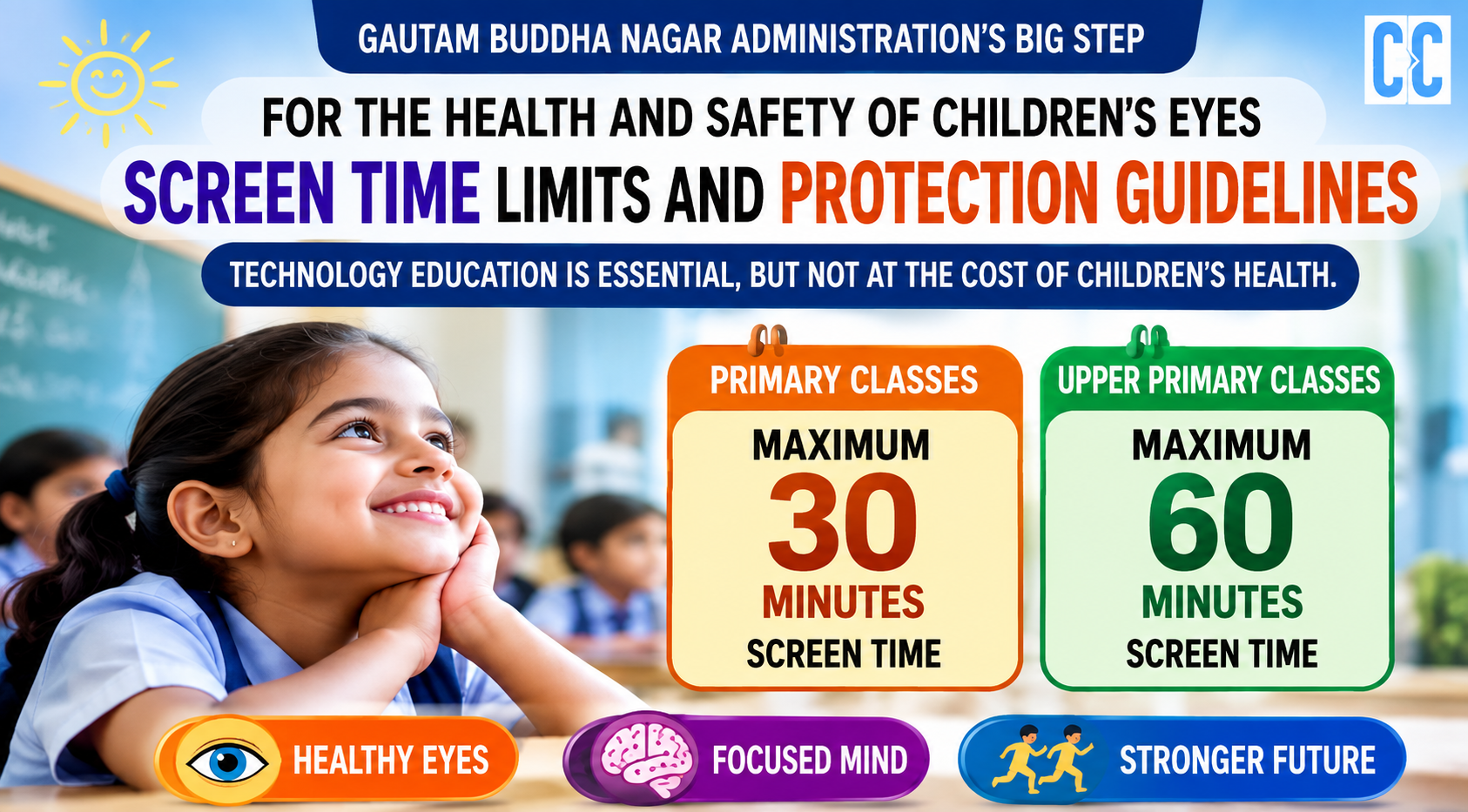
The District Administration has fixed exposure of 30 mins per day of digital board for students of primary classes and 60 minutes for upper primary classes, following a report of exposure of students up to five hours in class.
NOIDA: The Gautam Buddh Nagar district administration has ordered every school in Noida and Greater Noida government, government-aided, and private to sharply cut down students’ daily exposure to smart and digital classroom boards, restrict use at 30 minutes for primary classes and 60 minutes for upper-primary classes. The directive, issued on August 13, follows complaints from parents’ associations that children in several schools were spending four to five hours a day in front of digital screens during school hours.
Independent reporting on the administration’s statement confirmed that the new caps apply uniformly across all school types in the district, with designated magistrates and nodal officers responsible for tracking compliance by individual schools.
The Health Case Behind the Cutback
The order is in line with the recommendations of the World Health Organisation, the Indian Psychiatric Society, the Indian Academy of Paediatrics, and the NCERT. It identifies various risks associated with prolonged screen time, such as eye strain, myopia, headaches, and decreased concentration. But that’s not a fictional phenomenon India’s school-going student could end up experiencing someday – the prevalence of myopia amongst urban Indian school students (5-15 years of age) had gone up from 4.15 % in 1999 to 21% a year back. Experts say there is likely to be an increase of close to 50% by 2050 if we do nothing.
A prospective study that tracked more than 10,000 school children in Delhi found that heavier near work — reading, writing, and screen use — was linked to faster progression of myopia, while more time spent outdoors had a protective effect. Separately, a review of children under five found more than half of those with extended screen exposure showed symptoms of digital eye strain — including fatigue, headaches, and disrupted sleep. WHO’s own guidance recommends no screen time at all for children under two, and no more than an hour a day for those aged two to four, with less being better.
What Changes in the Classroom
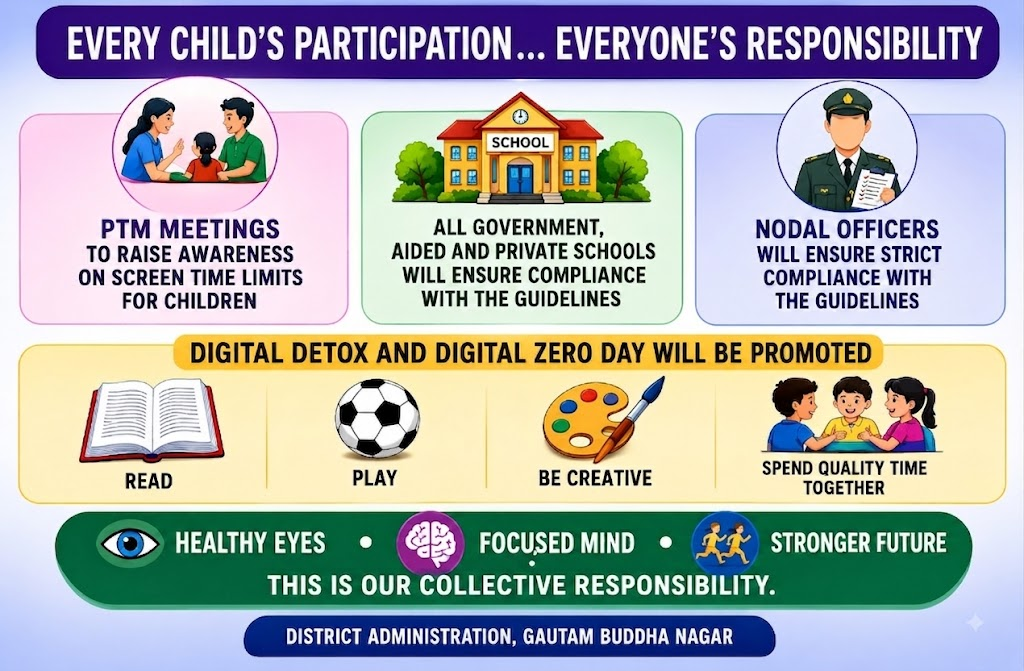
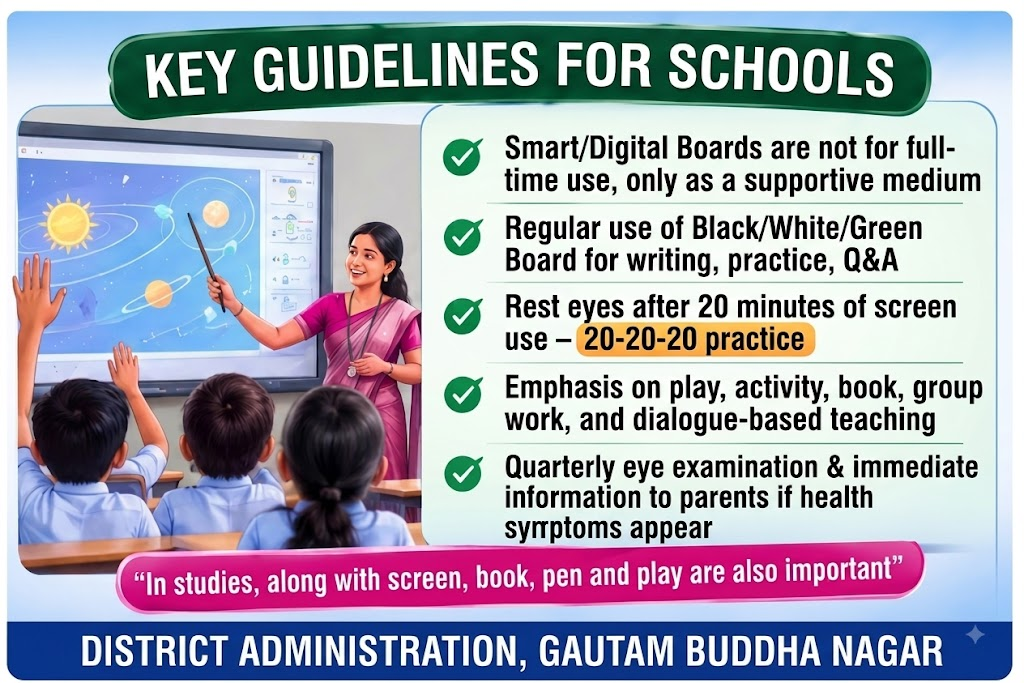
Under the new rules, smart and digital boards are to be used mainly to explain difficult concepts and display images, videos, and reference material — not for writing, practice, or question-answer sessions, which must return to the blackboard, whiteboard, or green board. Screens are to be dimmed to match classroom lighting, students seated at a safe distance, and a break built in after roughly every 20 minutes of use, echoing the “20-20-20” principle long promoted in the NCERT’s Pragyata guidelines for digital education — looking at an object 20 feet away for 20 seconds after every 20 minutes on screen. Schools have also been told to arrange quarterly eye check-ups for students and to alert parents immediately if a child reports eye irritation, headaches, or blurred vision.
Parents Get a Seat at the Table
The order mandates that screen time be an “agenda of discussions” in Parent-Teacher Meetings, requiring schools to discuss it with parents and to provide minutes of the School Management Committee meeting on screen time. Schools are also instructed to introduce no-digital-screen periods, “Digital Zero Days,” and Digital detox events, with a push to encourage reading, sport, art, and community involvement. The order has called for the observance of screen time compliance by designated Magistrates and nodal officers, directing the said reports to be submitted through the District Inspector of Schools, Gautam Buddh Nagar.
Noida Joins a Global Retreat From Screens — With a Catch
Gautam Buddh Nagar is catching up with a global trend. Global Education Monitoring report by UNESCO observed that the share of education systems adopting the ban on smartphones in schools had increased between 30 percent and 40 percent from 2023 up to early 2024. France has imposed a ban on students’ smartphone use, while other countries, including Italy, Finland, and the Netherlands, have followed suit with bans or strict regulations.
But as the UNESCO report points out, there is a crucial counterpoint to any “screens are bad” discussion. At least half a billion students have been denied access to schooling altogether since schools shuttered during the pandemic (especially disadvantaged children in rural and low-income families). In essence, screens are both an equity issue and an oversupply issue.
That tension shows up close to home. Even as Gautam Buddh Nagar dials back smart-board dependence, Delhi’s government this year approved more than Rs 900 crore to install nearly 19,000 additional smart boards, explicitly to bring digital classrooms to underserved neighbourhoods such as Najafgarh, Narela, and Seemapuri that had almost none before — just 799 smart boards were installed in Delhi’s government schools between 2014 and 2024. Those came through corporate donations rather than state funding. The two policies aren’t really in conflict; they’re aimed at different problems — one at unchecked digital dependence in schools that already have the technology, the other at digital access in schools that don’t.
For now, the burden of proving compliance falls on schools and the officials assigned to watch over them. Gautam Buddh Nagar’s information department has summed up its intent for parents in one line: less screen, more health.
Clear Cut Education Desk
New Delhi, UPDATED: August 18 2026 18:00 IST
Written By: Yatharth Pathak