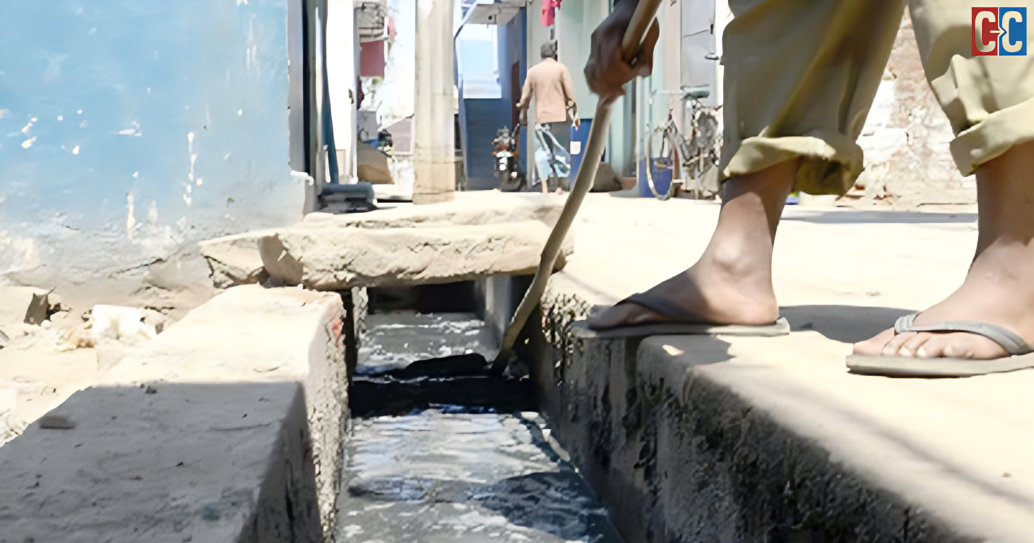
- NAMASTE Scheme has validated 89,915 sewer and septic tank workers across India and provided safety, health insurance and entrepreneurship support.
- Through Swachhta Udyami Yojana (SUY), sanitation workers like Dharmendra Kumar Ray have received financial support to start mechanised sanitation businesses.
- Despite these efforts, disputed worker-death figures raise questions about whether the scheme is actually reducing hazardous sanitation work deaths.
More than 89,000 sewer and septic tank workers have been formally validated under India’s principal sanitation-worker welfare scheme since 2023, and official profiling data indicate that over 90 per cent of those identified belong to Scheduled Caste, Scheduled Tribe, or Other Backwards Class communities — underscoring sanitation work’s long-documented association with caste in India. Against this backdrop, the Ministry of Social Justice and Empowerment, on September 9, publicised the case of one worker whose transition into entrepreneurship it is holding up as proof that the scheme is delivering.
Manual scavenging has been illegal in India since 1993, and hazardous sewer cleaning without protective equipment carries criminal penalties under the Prohibition of Employment as Manual Scavengers and their Rehabilitation Act, 2013. NAMASTE, launched by the Ministry of Social Justice and Empowerment together with the Ministry of Housing and Urban Affairs in 2023-24, was designed to enforce that ban in practice by profiling every worker still doing the job, equipping them with safety gear, and — through its Swachhta Udyami Yojana (SUY) component — helping some acquire machines of their own.

Shri Dharmendra Kumar Ray, a 39-year-old sanitation worker from Bihar who studied only up to the sixth standard, has run his own mechanised sanitation business in Greater Noida since receiving support under SUY, according to the ministry’s release. Ray spent nearly four years as a helper and machine operator for a private company in Noida before NAMASTE financed a Jetting Cum Graver Machine and a Mahindra Maxx City vehicle for him — a ₹14,77,500 project split evenly between a bank loan and a government capital subsidy of ₹7,38,750 each. His monthly income has risen by roughly ₹25,000 to ₹30,000 since, enough, the ministry said, for him to bring his wife and two children from Bihar to Noida and enrol them in school.
Ray is one of nearly 90,000 sewer and septic tank workers the government says it has validated nationwide since NAMASTE’s launch, alongside more than 2.8 lakh waste pickers added to the scheme since June 2024. The programme has disbursed ₹34.17 crore in capital subsidies for self-employment ventures like Ray’s, according to an earlier ministry progress update. Union Minister Dr Virendra Kumar has called the scheme a reflection of “the Government’s strong commitment to ensuring dignity, safety and economic empowerment for sanitation workers.”
| NAMASTE Scheme — National Snapshot | Figure |
| Sewer & septic tank workers (SSWs) validated nationwide | 89,915 (as of Jul 2026) |
| Waste pickers validated nationwide | 2,81,117 (as of Jul 2026) |
| PPE kits distributed to SSWs | 87,037 |
| SSWs covered by health insurance | 76,845 |
| Capital subsidy disbursed under SUY | ₹34.17 crore (as of Apr 2026) |
| Worker deaths in hazardous cleaning, Jan 2021–Jun 2026 | 332 — Government figure (Parliament reply) |
| Worker deaths in 2026 alone, by mid-year | 593 — Safai Karamchari Andolan estimate |
Figures compiled from Ministry of Social Justice & Empowerment / PIB releases (Apr. 2026) and DD India (Jul. 2026); death-toll figures from Parliament records and The Wire (Jul. 2026).
The same ministry’s figures on worker deaths, however, are contested. The government told Parliament in July that 332 sanitation workers had died during hazardous sewer and septic tank cleaning between January 2021 and June 2026. The Safai Karamchari Andolan, a civil-society organisation that has tracked such deaths for decades, says its own count for 2026 alone had already reached 593 by midyear — more than the government’s five-and-a-half-year total. Bezwada Wilson, the organisation’s founder and a 2016 Ramon Magsaysay Award laureate, has said the government must acknowledge the scheme’s shortcomings, arguing that fatalities have risen rather than fallen since NAMASTE took effect.
India is not alone in this gap between registration and protection. A 2019 assessment by the International Labour Organization, World Health Organization, World Bank and WaterAid, which examined sanitation workers’ conditions in nine countries, including India, urged governments to “recognise, formalise, organise” informal sanitation labour — broadly the model NAMASTE’s SUY arm attempts by converting workers like Ray into licensed, vehicle-owning entrepreneurs rather than leaving them as unprotected daily-wage labour.
Ray’s story, based on the ministry’s own account, cannot, by itself, show whether mechanisation is reducing sewer deaths nationally — a claim disputed by the government and the workers’ movements the scheme is meant to serve. What NAMASTE has verifiably done in three years is register tens of thousands of workers and part-fund equipment for a fraction of them; whether that is translating into fewer deaths in India’s sewers remains a question the government and its critics answer very differently.
Clear Cut Livelihood Desk
New Delhi, UPDATED: September 10, 2026 19:30 IST
Written By: Yatharth Pathak