
New Delhi – India’s demographic dividend is at a crossroads. While the nation’s youth are more educated than ever, a stark reality is emerging from the latest State of Working India (SWI) 2026 report: a university degree is no longer a guaranteed ticket to a career.
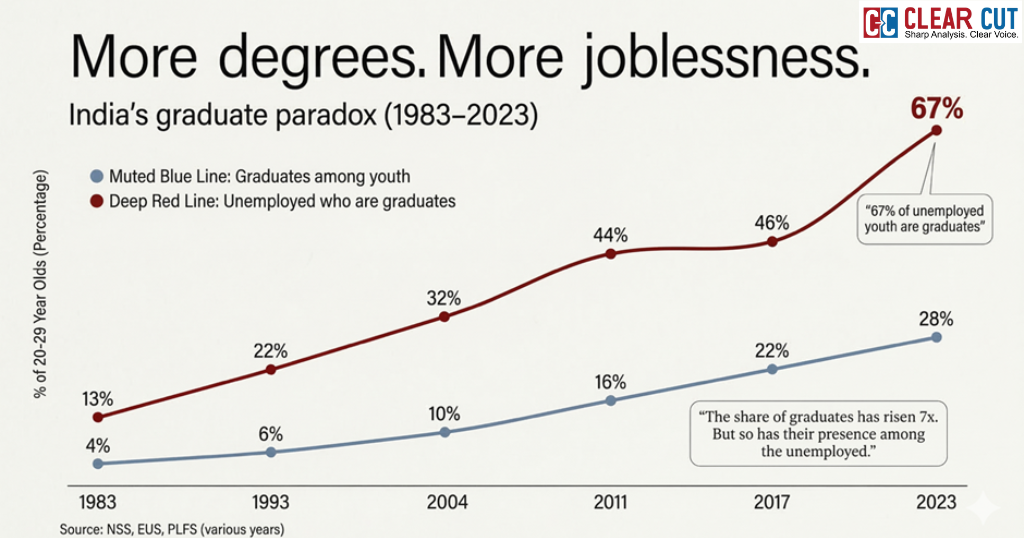
In fact, for many, it is becoming a marker of “educated unemployment.” The report, titled “Youth in the Labour Market: Pathways from Learning to Earning,” released by Azim Premji University, paints a sobering picture of the transition from the classroom to the cubicle. The most jarring statistic reveals that in the age group of 25–29, two out of every three graduates who are looking for work remain unemployed.
The Graduate Paradox
For decades, the Indian dream was built on the foundation of higher education. However, the SWI 2026 report highlights a “Graduate Paradox.” While the overall national unemployment rate has stabilized around 4.9% as of early 2026, the burden of joblessness is not shared equally. The report finds that unemployment rates increase with educational attainment. Among the illiterate population, unemployment is nearly non-existent (as they often must take any available manual work to survive). In contrast, nearly 40% of graduates aged 15–25 are unemployed. As they move into the 25–29 age bracket, the “open unemployment” rate remains alarmingly high, reflecting a massive mismatch between student aspirations and market reality.
Where Are the Jobs?
The report identifies a “missing middle” in India’s economic structure. While young workers are exiting the agricultural sector faster than their parents did, they aren’t necessarily landing in high-value manufacturing or service roles.
- The Agriculture Trap: Of the 83 million jobs added between 2021 and 2024, nearly half (40 million) were in agriculture. This “return to the farm” is often a distress signal rather than a choice.
- The 7% Club: Stability is the rarest commodity. Only 7% of graduates manage to find a permanent salaried job within one year of finishing their studies. The rest are pushed into the gig economy, casual labor, or “own-account” self-employment.
- The Gender Gap: While women’s participation in the labor force has risen to 41.7%, much of this growth is concentrated in self-employment or unpaid family work. For female graduates, the hurdle is twice as high, with many facing societal barriers alongside a lack of formal roles.
A Narrowing Window
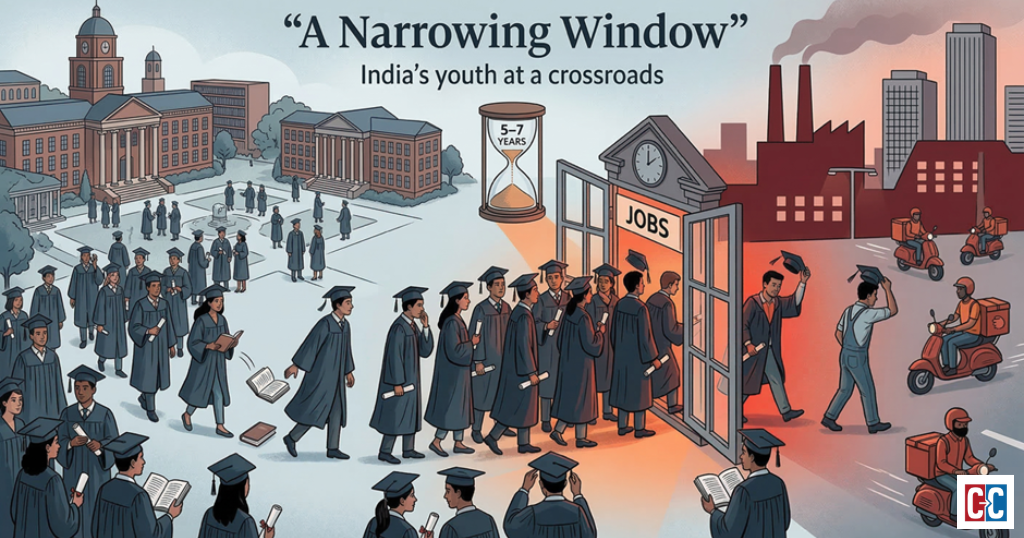
India is currently home to approximately 367 million people aged 15–29—nearly a third of the workforce. However, the report warns that this “youth bulge” will begin to shrink after 2030. This marks the final phase of India’s demographic dividend, after which the share of the working-age population will begin to decline as the population ages.
“The next five to seven years are critical,” says Rosa Abraham, the report’s lead author. “If we cannot productively absorb this aspirational cohort now, the demographic dividend risks becoming a demographic liability.” The scale of the challenge is immense—not only because of the size of the youth population, but also because this is the most educated and connected generation India has ever produced. Yet, their transition from education to employment remains uncertain and uneven.
Economic pressures are already forcing a retreat from the classroom. The share of young men in education dropped from 38% in 2017 to 34% in late 2024, with 72% of those who dropped out citing the urgent need to support household income as the primary reason. This reflects a deeper structural issue—education is expanding, but the economic returns are neither immediate nor assured, pushing many into the labour market prematurely.
At the same time, a significant proportion of youth—over 260 million—are already outside the education system and constitute the potential workforce. The pace and quality of job creation for this cohort will determine whether India can translate its demographic advantage into sustained economic growth. Without sufficient opportunities in productive sectors, the window to harness this demographic dividend may close before it is fully realised.
The Clear Cut Take
The key takeaway of The State of Working India 2026 report is: India is producing degrees, but the question is: are these degrees jobworthy? The crisis isn’t just about a lack of work—it’s about the quality of work. When two out of three graduates in their late twenties are out of work, it’s a sign that school isn’t preparing them for the real world. We need to stop prioritizing general degrees and start teaching skills that actually get people hired. By growing the manufacturing sector, we can create the middle-management jobs we’re missing, while a basic safety net would protect those stuck in the gig economy. If we don’t fix this, the “Indian Dream” will stay out of reach for the very people trying to build it.
Clear Cut Research, Education, Livelihood Desk
New Delhi, UPDATED: March 18, 2026 01:00 IST
Written By: Paresh Kumar