

Rising ocean temperatures are bleaching coral reefs and pushing fish stocks away, threatening food security for billions—especially in vulnerable coastal communities. Despite the scale of the crisis, funding and policy responses remain far too limited to address the growing climate-driven inequality.
The Measurement and What It Means
The Copernicus Climate Change Service, backed by the EU, confirmed that 2024 marked the hottest year for global ocean surface temperatures. This pattern isn’t new, it’s been sixteen straight months of record heat by early 2025. Digging deeper, ocean heat content, which gauges warming throughout the water column and not just at the surface, also hit new highs in 2024, as reported by the International Institute for Applied Systems Analysis.
Oceans absorb about 90 percent of the extra heat caused by greenhouse gas emissions, making them the climate’s main shock absorber. This system is straining. When that buffer heats up like it is now, the fallout becomes very real: biological disruptions, economic impacts, no longer just abstract numbers.
Take the Great Barrier Reef. In the 2023-24 summer, it suffered its most widespread bleaching event ever recorded. The Australian Institute of Marine Science found that 73 percent of surveyed areas showed bleaching. The reef isn’t just a scientific curiosity—it’s an economic powerhouse, supporting around 64,000 jobs and contributing $6.4 billion each year, according to Deloitte Access Economics data cited by the Great Barrier Reef Foundation.
Other reefs, scattered in the Pacific Islands, the Indian Ocean, and the Caribbean, prop up the food security and coastal protection of communities with nowhere near Australia’s resources. There, equivalent or even worse bleaching events happen, with minimal monitoring and hardly any economic safety net.
Where the Consequences Land
The sharp edge of ocean warming cuts through three tightly linked areas: coral reef degradation, shifting fish stock distributions, and coastal community food security. Coral reefs serve as nurseries for about a quarter of all marine species. Many of those fish are vital for the diets of low-income coastal communities. When reefs bleach and die, those nurseries collapse. Fish numbers drop, locally and quickly. Communities that have fished the same reefs for generations see their food vanishing.
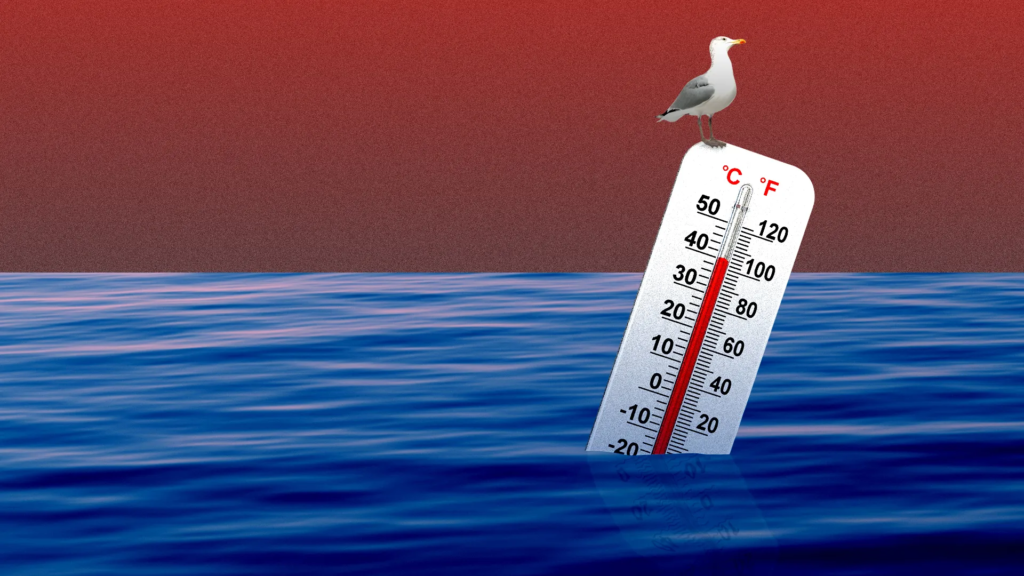
Meanwhile, warming oceans push commercial fish stocks toward cooler, higher latitudes. A 2023 Science study found fish catch potential has moved poleward about 70 kilometres each decade since 1990. Fishing communities in tropical, low-income countries sit right where the fish are leaving. For them, this isn’t just a statistic—it’s an economic and nutritional crisis, one that doesn’t fit neatly in existing policy language. They aren’t losing fish because they overfished, but because of emissions largely produced by distant, wealthy economies.
FAO’s 2024 State of World Fisheries and Aquaculture report estimates that 3.3 billion people rely on fish as their main protein source, especially in Southeast Asia, Sub-Saharan Africa, and Pacific Island nations. These are the places where ocean warming hits hardest. The problem? They have the fewest tools—alternative protein sources, financial buffers, climate funding—to adapt.
What the Corporate and Policy Response Has Not Addressed
When it comes to climate finance, ocean warming usually gets attention in the form of mitigation: emissions cuts, carbon taxes, renewables. All necessary, but they don’t help the fishing family in Kiribati or Mozambique watching their catch dwindle right now because the coral is fading right now.
Adaptation finance for helping coastal, low-income communities cope is deeply underfunded. The Loss and Damage Fund, created at COP27 and launched at COP28, was supposed to fix this, offering compensation to communities suffering from climate impacts they didn’t cause. As of early 2025, it holds about $700 million. The UN Environment Programme’s Adaptation Gap Report puts annual loss and damage costs in vulnerable countries at hundreds of billions. That’s the pattern: big framework, little cash.
Corporate “ocean” efforts tend to focus on plastic waste, sustainable seafood labels, and marine protected area donations. These help, but none address coral thermal stress, the real problem tied to atmospheric emissions. No seafood certification reverses that. The companies whose emissions drive ocean warming aren’t required to spell out their impact on coral bleaching and food insecurity in their ESG disclosures. The Taskforce on Nature-related Financial Disclosures is trying to build a framework for that kind of reporting, but so far it’s voluntary everywhere.
Conclusion
The ocean’s hottest year brought a clear cascade of consequences: bleached reefs, fish stocks shifting poleward, and low-income coastal communities facing a food crisis caused by emissions they didn’t make. The Loss and Damage Fund is meant to address this climate injustice. It has $700 million. The price tag for annual climate loss in vulnerable regions sits in the hundreds of billions. That gap—between what’s promised and what’s delivered—defines most of the global climate effort: problems named, solutions drafted, but funding always lagging, leaving those with the least to bear the brunt.
Clear Cut Climate Desk
New Delhi, UPDATED: April 30, 2026 03:00 IST
Written By: Jay