
India’s women empowerment narrative is strong in policy and rhetoric, but real outcomes remain unequal due to flawed system design, data gaps, and ignored structural constraints like unpaid care work. True empowerment requires redesigning policies around evidence, accountability, and women’s lived realities—not just participation or intent.
India speaks the language of women’s empowerment fluently. does so in policy documents, CSR reports, election manifestos, and global forums. From the Sustainable Development Goals to G20 declarations, from “Nari Shakti” campaigns to corporate diversity pledges, empowerment has become a familiar refrain. Yet the outcomes remain stubbornly uneven. Women continue to work less, earn less, own less, decide less, and carry more unpaid labour than men.
The problem is not intent. India has no shortage of schemes, missions, and commitments directed at women. The failure lies in architecture: in how systems are designed, what they measure, how budgets are allocated, and where accountability is placed. Women remain peripheral to the design logic of institutions that claim to empower them,
It’s a high time we should interrogate where empowerment breaks down, not rhe-torically, but structurally; and what evi-dence-led redesign would actually look like.
The Promise vs the Proof
India’s official narrative on women’s empower-ment is expansive and self-assured. The Constitu-tion guarantees equality before the law. Flagship schemes promise education, nutrition, livelihoods, financial inclusion, and political participation.
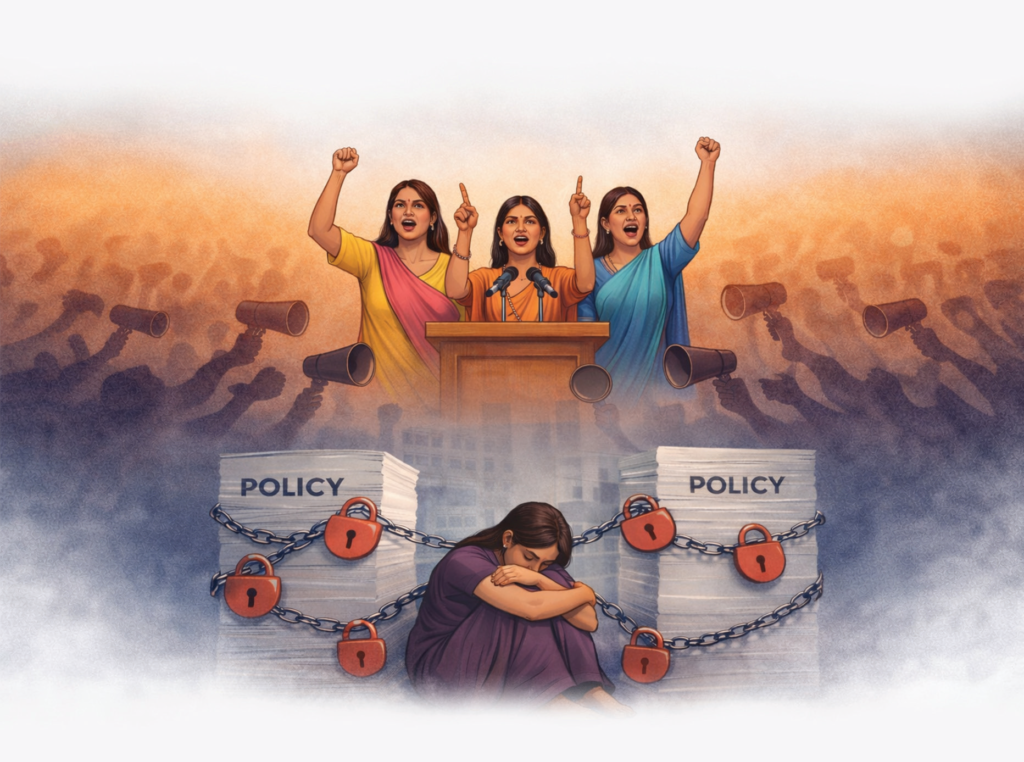
Excluded in Design: Policies Still Fail Women
At international forums, India positions itself as a champion of women-led development, framing gender equity as both a moral imperative and an economic strategy. The language is confident, even celebratory. Yet when rhetoric is tested against measurable outcomes, the picture becomes markedly more restrained
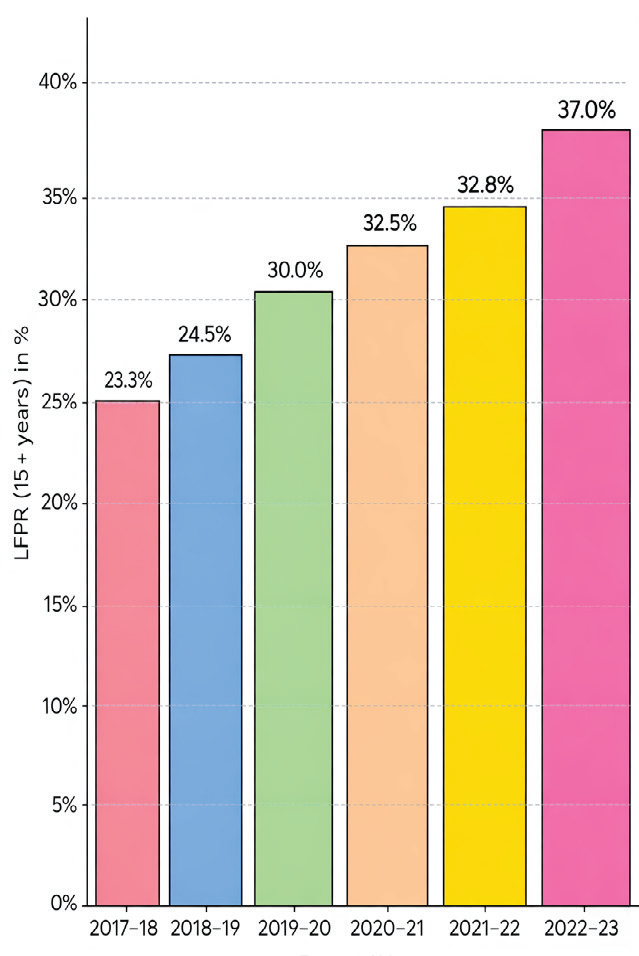
Let’s start with the Labour force participation: the headline contradiction. India’s female labour force participation rate (FLFPR) remains among the lowest globally. According to the Periodic Labour Force Survey (PLFS) 2022-23, women’s labour force participation stood at 37%, rising from 23.3% in 2017-18, a jump frequently cited as evidence of progress (PLFS, 2023). However, these figures remain well below global averages and significantly lower than those of many countries at comparable income levels (World Bank, 2024).
More importantly, the composition of this increase complicates the celebration. Much of the rise reflects unpaid family labour, marginal self-employment, and distress-driven participation. Women are entering work because household incomes have fallen, not because decent jobs have expanded. Regular wage employment for women remains limited, particularly in urban areas, and gender wage gaps persist across sectors, ocсира-tions, and educational levels (PLFS, 2023). Participation, in this context, does not automatically translate into economic security or autonomy.
Then comes the unpaid care burden. The Time Use Survey (TUS) ex-poses the invisible architecture un-derpinning these outcomes. Indian women spend over five hours a day on unpaid domestic and care work, while men spend less than two hours (Time Use Survey, 2019). This im-balance cuts across class, caste, and geography, but it is most acute for poorer women who lack access to childcare, piped water, clean cook-ing fuel, and reliable sanitation.
Unpaid care work is not a periph-eral issue; it is a binding constraint. It limits women’s ability to pursue education, engage in paid employ-ment, upskill, travel safely, or par-ticipate in public life. Yet despite its scale and economic significance, unpaid care remains largely absent from macroeconomic planning, in-frastructure investment decisions, and public budgeting. What is treat-ed as “natural” or “private” is effec-tively excluded from policy calculus.
And when it comes to representation of women in politics, let’s not forget that it also bring itself without redis-tribution of power. India has made genuine gains in women’s political representation at the grassroots lev-el, largely due to constitutional res-ervations. Women now constitute over 46% of elected representatives in Panchayati Raj Institutions (Min-istry of Panchayati Raj, 2023). Evi-dence suggests that women leaders often prioritize public goods such as water, sanitation, and education.
However, representation thins rapidly as one moves up the decision-making hierarchy. Women account for only 14% of Members of Parliament in the Lok Sabha (Inter-Parliamentary Union, 2024). In senior bureaucra-cy, women remain underrepresented in key economic and infrastructure ministries that shape budgets, data priorities, and national develop-ment trajectories (Department of Personnel and Training, 2022).
Empowerment framed as aspiration sounds impressive. But empower-ment measured as a public outcome like work, time, income, and pow-er reveals a far more uneven reality.
The Data Gap that Shapes Destiny
Policy design follows data. What is measured gets managed; what re-mains invisible is treated as inciden-tal. India’s gender data gaps are not accidental, they are structural. They are embedded in how surveys are framed, how administrative systems record information, and how success.

is defined. These gaps do not mere ly reflect inequality; they actively reproduce it by shaping what poli-cymakers see, prioritize, and fund.
India conducted its first comprehen-sive national Time Use Survey only in 2019. It was decades after many coun-tries had institutionalized time-use ac-counting as a core input into economic planning. The findings were unam-biguous. Women performed nearly 80% of all unpaid domestic work and nearly 70% of unpaid care giv-ing, while men dominated paid mar-ket work (Time Use Survey, 2019).
This was not a marginal insight. It quantified the single largest constraint on women’s economic participation. Yet the policy response has been strikingly muted. Time-use data re-mains cited in academic papers and gender reports, but rarely integrated into mainstream policy design. Infra structure planning proceeds as if care work does not exist. Urban transport systems are designed around peak-hour commuting, not the multi-stop, time-intensive mobility patterns that define women’s daily lives. Employ-ment schemes assume flexible la bour availability, ignoring the rigid care schedules that women navigate.
Budgets, in particular, remain care-blind. Public expenditure frame-works do not account for time pov erty, despite strong evidence that time scarcity is one of the most powerful predictors of women’s labour market exit and limited earn-ings (UN Women, 2023). By treating unpaid care as a private issue rath-er than a public constraint, policy effectively shifts the cost of social reproduction onto women’s time.
When it comes to urban design, it is more like safety without gendered evidence. Urban safety debates in India are often reduced to policing, surveillance, or reactive crime con-trol. Yet for women, safety is fun-damentally an outcome of design. Street lighting, footpath continuity, last-mile connectivity, public toilets, mixed land use, and housing density all shape whether women can move freely and predictably through cities.

but is also embedded in health re-search itself. Historically, medi-cal research has been male-centric. Women have been underrepresented in clinical trials, and sex-disaggre-gated analysis is often absent, lead-ing to gaps in understanding how diseases present, progress, and respond to treatment in women (World Health Organization, 2022). Nutrition policy reflects a similar nar-rowing of vision. NFHS-5 reports that 57% of women aged 15-49 are anae mic, a deterioration from previous rounds (NFHS-5, 2021). Yet nutrition interventions remain overwhelming-ly concentrated around pregnancy and early motherhood. Adolescent girls, working-age women outside maternity, and older women are treat-ed as secondary categories, despite evidence that anaemia, micronutri-ent deficiencies, and rising obesity affect women across the life course.
Climate change is another domain. where gendered impacts are widely acknowledged but poorly measured. Women, particularly in agriculture-de-pendent and resource-constrained households, face higher exposure to heat stress, water scarcity, food in-security, and livelihood disruption. (United Nations Development Pro-gramme, 2022). Yet India’s climate vulnerability assessments and adap-tation plans rarely use gender-disag-gregated data in any systematic way. Women appear in policy documents as “vulnerable groups” or “bene-ficiaries,” not as economic actors, farmers, or decision-makers. Their adaptive strategies, labour contribu-tions, and knowledge systems remain largely invisible in official datasets.
Despite this, India lacks systemat ic, gender-disaggregated data on ur ban mobility and safety. Transport surveys typically assume a linear home-to-work commute, mirroring male employment patterns. Wom-en’s travel being characterized by shorter trips, multiple stops, off-peak hours, and care-related jour-neys, remains undercounted or misclassified (World Bank, 2020),
The consequences are visible. Ur-ban transport investments pri oritize long-distance, peak-hour travel, while neglecting safe last-mile connectivity and non-motor-ized infrastructure. Women ad-just by restricting their movement, choosing closer but lower-paying jobs, or exiting the workforce alto-gether. This is not a failure of behav ior, it is a failure of measurement.
Sanitation data offers another illus-tration. While toilet coverage ex panded significantly under Swachh Bharat Mission, NFHS-5 shows that women continue to face safety, pri vacy, and dignity concerns, espe cially in informal settlements andru-ral areas. Counting toilets without capturing usability and safety pro duces an illusion of progress while leaving lived risks unaddressed. When we further look into the health research and nutrition norms, we find that gender bias in data is not confined to infrastructure,
“Across sectors – care, cities, health, nutrition, climate – the pattern is consistent. What is not counted does not count-Gender data gaps are not technical oversights; they are political and institutional choices that determine whose lives are legible to the state. The consequence is clear and recurring: what is invisible in data becomes invisible in policy, and what is invisible in policy remains structurally unchanged.“
Policy Design: Gender-Neutral is Not Gender-Just
Many Indian policies claim neutrality and are seemingly designed for “cit-izens,” “households,” or “workers.” On paper, neutrality appears fair. In practice, neutrality in deeply unequal contexts reproduces inequality. When gendered constraints shape access to time, mobility, income, and power, policies that ignore these differences inevitably advantage those already better positioned most often men.
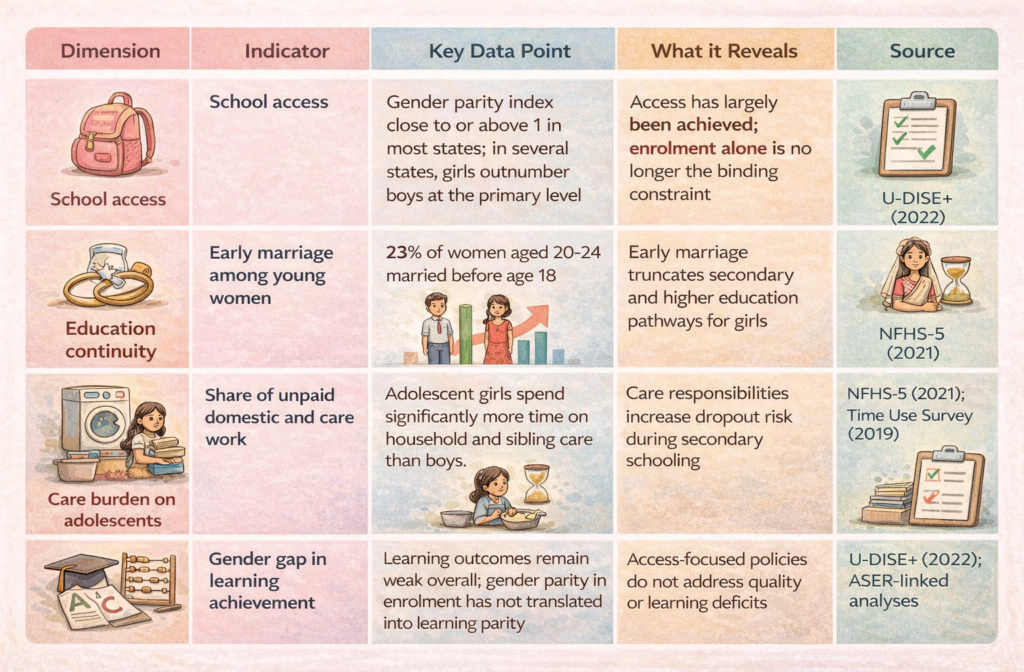
When education is all about access without outcomes, it cancels the very reason of why it all was first initiated. India has made substantial progress in girls’ enrolment. Gender parity has largely been achieved at the primary level, and in some states girls now outnumber boys in school enrol-ment (U-DISE+, 2022). This success is frequently cited as proof that the education gender gap has been closed.
Yet enrolment parity masks deeper structural problems. Learning out-comes remain weak across the board, but girls face additional barriers that are not addressed by access-focused policy. Early marriage continues to truncate education pathways: 23% of women aged 20–24 were married before 18, with direct consequenc-es for secondary and higher edu-cation continuity (NFHS-5, 2021). Care responsibilities like sibling care, household work and elder sup port disproportionately fall on ad-olescent girls, increasing dropout risks during secondary schooling.
Digital access further com-pounds inequality. Schooling increasingly relies on digital tools, yet women and girls are significant-ly less likely to own smartphones or have independent internet access (World Bank, 2023). Safety concerns like long travel distances, inadequate transport and harassment also shape parental decisions about girls’ ed-ucation beyond the primary level.
Despite this, scholarships and in-centives remain heavily skewed toward enrolment targets. Few pro-grammes systematically track reten-tion, learning quality, or transitions from school to higher education and employment. Gender-neutral educa tion policy assumes that once access is provided, empowerment will fol-low. Evidence repeatedly shows that access without supportive design does not dismantle structural barriers.
Livelihood Missions vs Care Constraints
Livelihood programmes represent one of India’s most visible investments in women’s empowerment. Initiatives such as the National the National Rural Liveli hoods Mission (NRLM) have mobil-ised millions of women into self-help groups, expanding financial inclu-sion, collective bargaining power, and social networks (World Bank, 2023).
Yet the design logic of most liveli hood interventions assumes a worker unencumbered by care responsibili ties. Training schedules, work loca-tions, credit cycles, and repayment timelines are rarely aligned with women’s time constraints. As a result, women’s enterprises tend to remain small, home-based, and low-return. Men, with greater mobility and few-er unpaid care obligations, dominate asset-intensive and scalable activities.
This is not a failure of entrepreneur-ship; it is a failure of design. Without childcare support, flexible training formats, safe transport, and market linkages, women’s economic partic-ipation remains circumscribed. Fi-nancial inclusion does not automat-ically translate into financial power.
Mahatma Gandhi National Rural Employment Guarantee Scheme (MGNREGS) illustrates a similar patters. Women’s participation rates are relatively high, reflecting the programme’s importance as a fall back employment option. However, the absence of functional childcare facilities at worksites, rigid work norms, and delayed wage payments limit women’s ability to engage consistently and productively (Min-istry of Rural Development, 2022). Participation numbers look gon-der-equal; lived experience does not.
India’s public health system has largely approached women through a maternal lens. Reproductive, mater-nal, newborn, child, and adolescent health (RMNCH+A) programmes have delivered real gains, most nota-bly in institutional deliveries and re-ductions in maternal mortality. How-ever, this focus narrows women’s health to reproduction. Mental health, occupational health, non-communi-cable diseases, and ageing-related conditions remain under-prioritized. NFHS-5 data reveal persistently high levels of anaemia, alongside rising rates of obesity and hypertension among women which are consid-ered as signals of a complex, evolv ing disease burden that cannot be addressed through maternal health interventions alone (NFHS-5, 2021).
Nutrition policy reflects the same fragmentation. Women are prior-itized when pregnant or lactating, then largely disappear from the pol-icy radar. Adolescent girls, work-ing-age women outside maternity, and older women are treated as pe ripheral, despite evidence that nu tritional deficits and health risks accumulate across the life course.
Gender-blind health design assumes women’s needs begin with pregnancy and end with childbirth. This assumption leaves millions undeserved and reinforces the idea that women’s health matters primarily in relation to child outcomes. not as an intrinsic public good.
Across education, livelihoods, and health, the pattern is consistent. Pol-icies that claim neutrality ignore the unequal distribution of time, care, mobility, and power. By treat ing households as homogenous units and citizens as interchange-able actors, policy design quiet-ly embeds male norms as default.
is not gen der-just policy. Without explicit-ly accounting for structural con-straints, even well-intentioned programmes reproduce the very inequalities they seek to address.
CSR and the Comfort of Safe Empowerment
Corporate social responsibility has become one of the most visible arenas of women’s empowerment rhetoric in India. Annual reports are filled with images of women at training centres, entrepreneurship fairs, and leader- ship workshops. Skilling, self-em- ployment, and confidence-building dominate CSR portfolios, offer ing corporations a low-risk way to demonstrate social commitment while aligning with gender equal-ity narratives. Yet despite scale and spending, the impact of many such interventions remains shallow. The problem is not effort or fund-ing. It is the preference for safe empowerment interventions that are visible, non-confrontational, and unlikely to disrupt existing eco nomic or organizational structures.
A large share of CSR spending on women focuses on skilling pro grammes. These are typically short-term, modular trainings aimed at improving employability. However, many such programmes stop at certi-fication. They do not build clear path-ways into jobs, apprenticeships, or sustained income opportunities. Evi dence consistently shows that training alone has limited impact on women’s earnings unless it is combined with placement support, employer engage-ment, and post-training handholding According to the International Labour Organization, skilling interventions without placement mechanisms pro-duce weak income gains for wom-en, particularly in non-traditional or male-dominated sectors (ILO, 2021). The choice of skills is also telling. Women are disproportionately trained in stereotypically “feminine” activ ities like tailoring, beauty services, food processing, handicrafts. These sectors are characterized by satu-rated local markets, low entry bar-riers, and limited scalability. Even when women complete training successfully, they often find them-selves competing with dozens of others for the same narrow demand.
It is within this constrained land-scape that entrepreneurship is then promoted as the logical next step. Women entrepreneurs are celebrat-ed as symbols of resilience and self-reliance, and micro-enterprise.
development is framed as empow-erment in action. Yet the structur-al conditions under which women operate remain largely unchanged. Women-owned enterprises in In-dia are typically smaller, less prof itable, and more likely to operate in the informal sector. They face per-sistent barriers in accessing credit, technology, digital platforms, sup-plier networks, and formal markets (International Finance Corporation, 2022). CSR programmes rarely en-gage with these systemic constraints.
Training women to run enterprises without integrating them into supply chains or procurement systems plac-es the burden of success entirely on individuals. Market access that is of-ten controlled by large firms, distribu-tors, and financial institutions remain untouched. Without changes in pro-curement policies, credit assessment norms, and buyer-seller networks, entrepreneurship becomes a story of exceptional individuals rather than scalable economic transformation.
In effect, CSR entrepreneurship programmes often produce vizibility without viability.
Leadership development is another popular CSR intervention. Workshops on confidence-building, negotiation skills, and personal branding are com-mon. While such programmes can be personally affirming, their structural impact is limited. Leadership does not operate in a vacuum. Training women to lead does not automatically create leadership opportunities. Organiza-tional hierarchies, decision-making norms, and power structures deter-mine whose voices matter. Without changes in promotion pathways, governance frameworks, and ac-countability mechanisms, leadership training risks becoming symbolic.
In corporate contexts, women may be trained extensively but remain excluded from strategic roles, capital allocation decisions, or board-level influence. The result is a growing gap between individual capacity and institutional authority.
CSR programmes often prioritise interventions that are measurable, photo-friendly, and politically uncon-troversial. Structural reforms such as changing procurement practices to include women-owned firms, in-vesting in care infrastructure, or re-designing workplace norms are more complex and riskier. They demand shifts in power and resource flows. This creates a fundamental tension. CSR claims empowerment while avoiding structural change. Wom en are expected to adapt to existing systems rather than systems be ing redesigned to include women. The question, then, is unavoidable: are CSR programmes empowering wom en? Or merely funding optics? Until empowerment moves beyond training rooms and into markets, institutions, and decision-making structures, CSR will continue to produce stories of ef-fort without evidence of lasting power.
Women in Leadership: Pres-ence without Power?
Representation is often treated as a proxy for empowerment. The as-sumption is straightforward: if wom-en are present at decision-making tables, outcomes will follow. Yet governance, bureaucracy, and corporate institutions in India, presence has not reliably translated into influence. Numbers have im-proved in select spaces, but power which is defined as authority over resources, priorities, and account-ability, remains unevenly distributed. The most visible success story of women’s political representation in India lies in Panchayati Raj Institu tions (PRIs). Constitutional reserva-tions have fundamentally altered the gender composition of local gover-nance, placing millions of women in elected positions, Empirical evidence suggests that this has mattered. Stud-ies show that women leaders tend to invest more in public goods close-ly linked to everyday welfare such as drinking water, sanitation, and primary education, than their male counterparts (World Bank, 2018).
However, the limits of representation become evident when authority is ex-amined more closely. Proxy represen tation where male relatives exercise de facto power on behalf of elected women continues to undermine wom-en’s autonomy in many regions. Even where women exercise independent leadership, they often operate within constrained administrative environ-ments. Limited access to information, weak bureaucratic support, and exclu sion from informal decision-making networks reduce their effectiveness.
The gap between presence and pow-er widens further within India’s bu-reaucracy. While women’s entry into civil services has increased, representation declines sharply at senior levels. Women remain under-represented in key economic and in-frastructure ministries like finance, power, transport, and industry where decisions about budgets, data pri-orities, and national development trajectories are made (Department of Personnel and Training, 2022).
This distribution matters. Policy in-fluence is not evenly spread across the state. Ministries that shape fis-cal policy, infrastructure investment, and macroeconomic strategy wield disproportionate power. Women’s concentration in social-sector roles reinforces gendered divisions of au-thority within the state itself. Deci-sion-making power over what gets funded, what gets measured, and what gets evaluated is concentrated where women are least represented. As a result, gender concerns are of ten treated as sectoral add-ons rather than embedded consider-ations across economic gover-nance. Representation improves optics; power asymmetries persist.
In the corporate sector, regulatory mandates have led to visible improve-ments in women’s representation on boards. Most listed companies now meet minimum requirements for female directors. Yet the nature of participation raises uncomfort able questions. Women are more likely to occupy non-executive or independent director roles, with lim-ited involvement in operational de-cision-making or capital allocation. Executive leadership and board chair positions remain overwhelmingly male-dominated (Securities and Ex-change Board of India, 2023). Pres-ence at the table does not necessari-ly equate to agenda-setting power.
CSR governance often mirrors this imbalance. Decision-making commit-tees tend to be top-down, risk-averse, and compliance-driven. Women’s voices may be included, but strategic choices, what kinds of empowerment are funded, at what scale, and with what risk appetite remain constrained by existing hierarchies. As a result, CSR initiatives frequently default to safe, non-disruptive interven-tions rather than structural change.
The pattern it consistent. Representa-tion has expanded faster than author-ity. Women are visible, but influence remains conditional. This disconnect reveals a deeper flaw in how empow erment is measured and pursued.
Counting seats occupied by women is easier than redistributing power. Yet without authority over budgets, data, and institutional priorities, rep-resentation risks becoming symbolic. Empowerment framed as numerical inclusion obscures the harder task of redesigning governance structures to enable women to shape decisions.
What evidence-backed empowerment actually requires
If empowerment is to move beyond rhetoric, systems must be redesigned around evidence. This requires a decisive shift from celebrating intent to enforcing architecture.
Women do not need more motiva tional language, they need insti tutions that recognize constraints, measure outcomes that matter, and redistribute power through rules, budgets, and accountability.
The first redesign imperative is measurement. All major surveys, administrative datasets, and pro-gramme management information systems (MIS) must collect, publish, and use gender-disaggregated data as a non-negotiable standard. This goes well beyond health and education. Ur-ban transport usage, digital access, cli-mate adaptation spending, infrastruc-ture utilisation, land ownership, credit flows, and public procurement must all be visible through a gender lens.
Without such data, gender remains a peripheral variable which is invoked rhetorically but excluded analyti-cally. When transport data does not capture women’s mobility patterns, cities are designed for male commut ers. When climate datasets do not record women’s agricultural roles or exposure to heat stress, adaptation plans miss their primary stakehold-ers. Gender-disaggregated data is not a reporting exercise; it is the foun-dation of equitable policy design.
Time poverty must be recognized as a core policy variable. Evidence from the Time Use Survey makes clear that unpaid care work is the single largest constraint on wom en’s economic and civic participa tion. Yet time remains absent from cost-benefit analyses, infrastructure planning, and fiscal frameworks.
Caro infrastructure like childcare, el-dercare, water, sanitation, clean cook-ing energy, and safe transport must be treated as economic infrastructure, not residual social welfare. Invest-ment in care reduces time poverty, increases women’s labour force par-ticipation, and improves household well-being. As UN Women (2023) has argued, economies that fail to invest in care externalize costs onto women’s time, entrenching inequal-ity while appearing fiscally efficient.
Integrating time-use into planning would force a re-evaluation of what counts as “productive” investment and whose productivity is valued
India’s empowerment programmes, both public and CSR-funded, are heavily input and participa-tion-driven. Targets focus on enrol-ment, training numbers, or mem-bership counts. These metrics are easy to track and politically attrac tive, but they say little about power. Funding must shift toward out-comes that reflect women’s agency: sustained control over income, free-dom of mobility, decision-making
authority within households and insti-tutions, and reduction in unpaid work burdens. Outcome-based financing requires longer time horizons, better data, and greater tolerance for com plexity, but it is the only way to dis-tinguish transformation from activity.
Participation is not empowerment if it does not change women’s choices or constrainte
Accountability is where many em-powerment efforts falter. Gender au dits, impact evaluations, and social accountability mechanisms often de-volve into checklists, verifying compli-ance rather than interrogating impact.
Independent evaluations must be em-bedded into programme lifecycles, not appended as afterthoughts. Gender audits should examine power flows: who controls budgets, who sets prior-ities, and whose interests are served. Social accountability mechanisms must amplify women’s voices not just as beneficiaries, but as assessors of whether systems work for them. Crucially, accountability must apply across sectors. Gender equality cannot remain confined to “women’s depart-ments” while economic and infrastruc-ture institutions operate unchecked.
As long as women remain margin-al to how data is collected, how bud gets are allocated, how programmes are designed, and how success is mea sured, empowerment will remain-symbolic. Real empowerment re-quires redesign and placing women at the centre not as passive beneficiaries, but as co-designers of institutions.
Until data, budgets, and accountabil-ity frameworks reflect women’s lived realities, empowerment will remain fluent in rhetoric and fragile in reality.
Clear Cut Gender Desk
New Delhi, UPDATED: March 31, 2026 09:00 IST
Written By: Antara Mrinal