After a 16-year gap, India’s Census 2027 marks a return to accurate, large-scale data collection, now powered by digital tools. It will provide crucial insights to guide policy, governance, and future planning across the country.
Today, on April 1, 2026, India begins to count itself again.
After a 16-year gap since the last census in 2011, the country returns to its most foundational statistical exercise. The Census 2027. For ages, our policymakers, researchers, and administrators have worked with projections and extrapolations. Sans the real data, they are useful, but imperfect. Now, India is moving back to what demographers trust most: direct enumeration.
A pause longer than history intended
India has conducted a synchronous census every ten years since 1881. Wars, famines, political transitions, through all of it, the rhythm held. Until it didn’t.
The pandemic delayed the 2021 round. What followed was caution, preparation, and recalibration. The result is a 16-year gap. The longest in India’s modern census history.
Globally, delays are not unusual. Countries have postponed counts due to wars, funding crises, or logistical failures. But India’s case is different. The scale is huge, the diversity unmatched and the cost of outdated data is far higher.
For over a decade, India has been planning schools, allocating subsidies, and designing welfare systems on the backbone of 2011 data. That gap now closes.
The largest coordinated human exercise
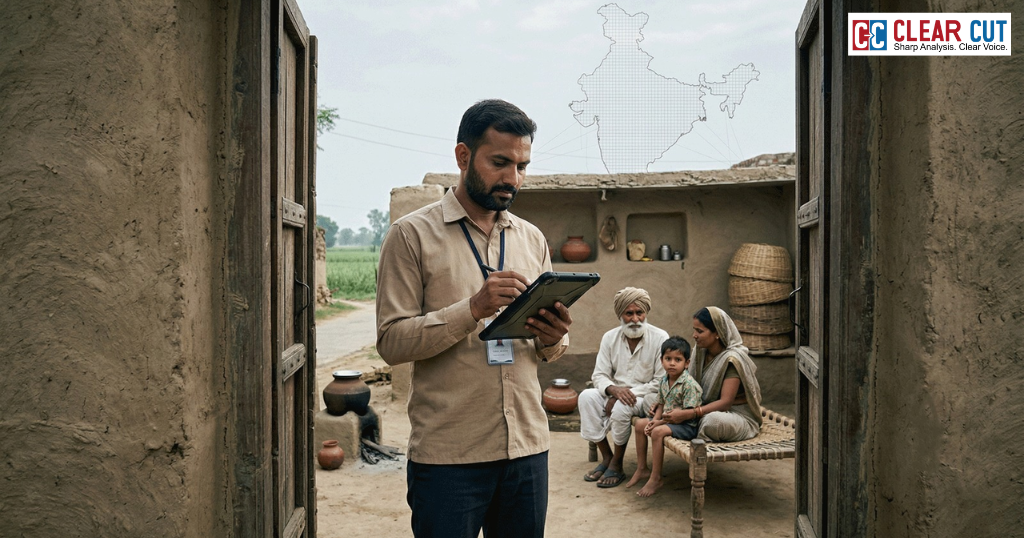
The scale of Census 2027 is almost hard to imagine. It involves over 3 million officials—an army of 31 lakh enumerators and supervisors. These people will travel everywhere, from crowded city streets and remote forests to the highest mountain villages. Each one is trained to carry a small, vital piece of India’s story. This massive effort will happen in two clear phases.
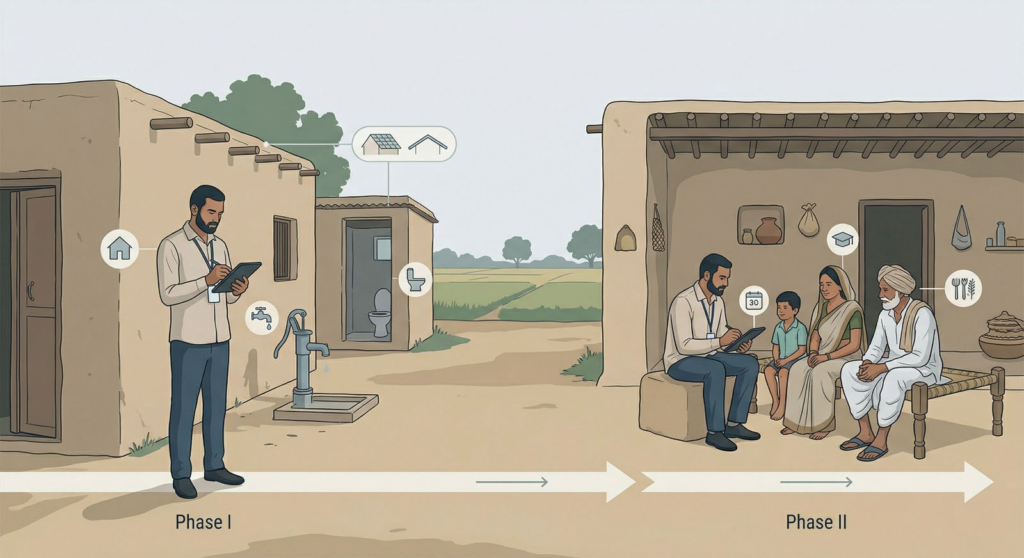
Phase I: House-listing and Housing Census (April–September 2026)
This phase maps the physical reality of India. Every structure is identified. Every household is profiled. Questions move beyond counting, in which they probe living conditions. Access to water. Type of housing. Sanitation. Assets.
Each state and Union Territory will conduct this phase within a 30-day window, preceded by a 15-day self-enumeration period.
Phase II: Population Enumeration (February 2027)
This is where India counts its people. Age, education, occupation, migration, fertility. The social and economic profile of the nation comes into focus.
Together, these two phases form the most comprehensive dataset the country produces.
A census that speaks the language of today
For the first time, India’s census is digital by design. Enumerators will use mobile applications instead of paper schedules. Data will move faster. Errors will reduce. Processing will accelerate.
Citizens, too, are part of this shift. A self-enumeration portal, available in 16 languages, allows households to enter their own data ahead of the enumerator’s visit. It is a small but significant shift, from being counted to participating in the act of counting.
What we will know, and why it matters
The census has always been more than numbers. It is the foundational architecture of governance.
This round will capture demographic, socio-economic, and migration patterns with renewed precision. Importantly, the government has confirmed that caste enumeration will be undertaken in the population phase. This is a move that carries deep implications for social policy.
At the same time, the structure of questions is evolving.
The questions we ask are also changing. In the past, we measured wealth by asking if someone owned a radio. Today, that doesn’t tell us much. This time, the focus shifts to things that actually matter now—like who has internet access, how people move for work, and how they earn a living today.
India is changing fast. People are moving to cities, climate change is forcing families to find new homes, and digital tools are opening new doors. The census needs to keep up with these shifts. This one finally does.
The quiet power behind politics
The census does not make headlines like elections. But it shapes them.
It provides the empirical base for delimitation, the redrawing of constituency boundaries. While seat allocation across states has remained frozen for decades, future political recalibrations will depend on updated population data.
This count is also the key to the Women’s Reservation Act. For that law to actually start working, we first need this new census to redraw political boundaries. It’s the bridge between raw data and making our democracy fairer.
Ending the long wait for data
For years, India has had to rely on guesswork. We used small surveys and big data, but nothing beats the real thing. A census is special because it doesn’t just look at a small group—it counts every single person.
This is how we know exactly where to build a new school or who needs the most help. It helps us plan our cities and see who is being left behind. Without these real numbers, the government is essentially working in the dark. This census finally turns the lights on. It is much more than just a giant list of names.
It is easy to see the census as a bureaucratic exercise. Forms, fields, numbers. But at its core, it is something more fundamental.
It is the State asking a simple question: Who are we, right now?
And for the citizen, it is the moment to answer, to be counted, recorded, and recognised. After sixteen years, India is rebuilding its statistical mirror.
And this time, the reflection will be clearer, faster, and closer to the truth than ever before.
Clear Cut Research, Review Desk
New Delhi, UPDATED: April 01, 2026 08:30 IST
Written By: Paresh Kumar