
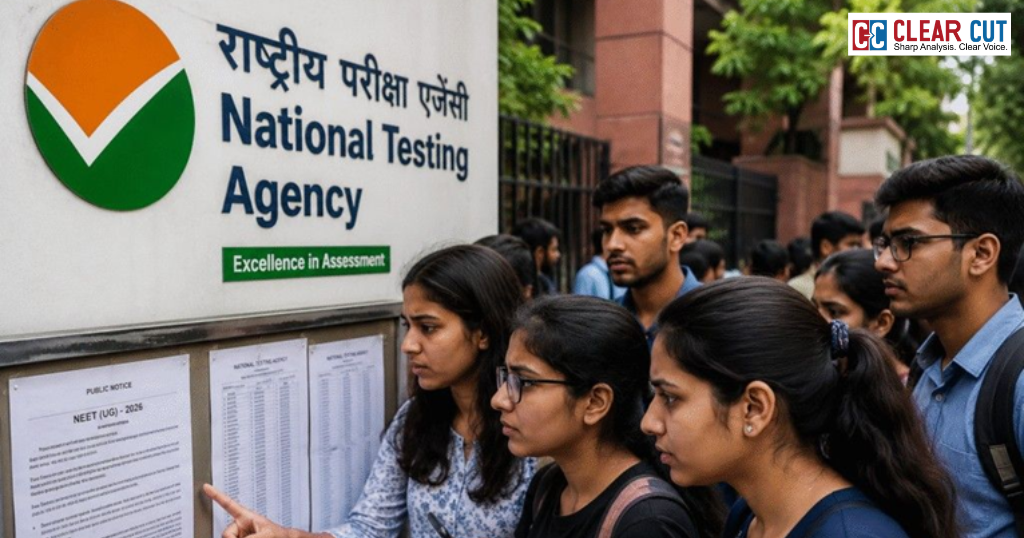
- NEET UG 2026 was cancelled after investigators confirmed a massive question bank breach affecting over 22 lakh students across India.
- The incident exposed deep flaws in India’s centralized examination system and renewed concerns over NTA’s accountability and exam security.
- Experts are now demanding reforms such as computer-based testing, multiple exam sessions, and stronger audit mechanisms.
Priya Sharma Had Prepared for Three Years
Priya Sharma was 16 when she first resolved to become a doctor. She spent 3 years in a coaching institute in Kota, away from her family. She lived in a shared room, studying 14 hours a day. She sat for NEET UG 2026 on May 3. She thought she had done well. Ten days later, the National Testing Agency announced what lakhs of aspirants had feared and what many had suspected: the exam had been compromised. The question bank was breached. The entire examination, sat by over 22 lakh students, was cancelled. Priya would have to wait again. And prepare again. And trust a system that had already failed her once before.
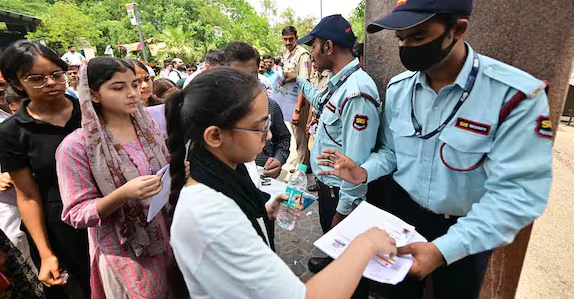
This is not the first time. In 2024, NEET-UG was shaken by a paper leak scandal that led to arrests in Bihar and Gujarat. The cancellation of results for 1,563 candidates, a CBI investigation, Supreme Court hearings, and nationwide protests. The exam that is the sole gateway into India’s undergraduate medical colleges, according to the National Medical Commission’s seat matrix for the 2026 academic cycle, India has approximately 1,29,026 MBBS seats across government and private medical colleges, with over 700 government medical colleges and 348 private institutions contributing to the total undergraduate medical capacity. Two years of institutional promises and process reforms later, it has been compromised again. This time, worse. In 2024, the breaches were localised. In 2026, as investigators have reported, the leak occurred at the question bank level — penetrating the entire translation pipeline across 13 regional languages and the printing phase.
The anatomy of the 2026 failure
NEET UG 2026: Conducted May 3 for 22+ lakh students. Cancelled May 12 after Rajasthan SOG investigation confirmed question bank breach. CBI investigation ordered by Central Government. No additional fees for re-exam. – NTA Official Statement, May 12, 2026
The Rajasthan Special Operations Group, investigating reports that surfaced after the May 3 examination, found that guesses circulating in criminal networks matched the actual NEET 2026 paper with a specificity that could not be coincidental. The SOG shared its findings with the NTA. On May 8, the NTA referred the matter to the CBI. On May 12, via its official Twitter handle, the NTA confirmed what students already feared: the exam stood cancelled. A fresh examination would be held. No additional registration fee would be charged. New admit cards would be issued. An exact date had not been announced.
The CBI investigation will pursue the criminal network. But criminal prosecution, however necessary, does not address the systemic failure that enabled the breach in the first place. India’s examination infrastructure has a structural vulnerability: it centralises question banks in digital systems that are both high-value targets and inadequately protected against insider compromise. The 2024 Committee of Experts appointed by the government to review NTA made specific recommendations on question bank security, randomisation, and decentralised question generation. Implementation timelines have not been publicly disclosed. The 2026 leak suggests that implementation was incomplete.
The Single-exam Model
A change to CBT with several exam sessions could reduce misconduct and provide more transparency, according to the group headed by former ISRO chief K Radhakrishnan. The committee suggested administering NEET in several sessions using a JEE Main-style score normalization procedure. A two-stage exam approach, in which the first step acts as a screening test and the second stage determines final admission eligibility, has also been proposed. Three elements make up Business Standard, an alternative to the single exam model:
1. CBT, or computer-based testing
Digitally delivered questions do away with the physical printing and transportation chain, which is where leaks occur. This format is already effectively used by NEET-PG.
2. Several Testing Windows
The same concept used by JEE Main, candidates take the test on multiple dates with various randomly selected question sets rather than on a single date. All other windows are not affected by a breach on one date.
3. Normalization of Scores
Scores are statistically normalized between sessions to maintain fairness because various windows use different papers. This is the same process used in JEE Main and internationally in the MCAT (USA) and UCAT (UK).
What Must Change Before the Re-Examination
Three immediate demands are non-negotiable. First, the NTA must publish, before the re-exam date is announced, a detailed account of which specific security recommendations from the 2024 Expert Committee have been implemented and which have not. Aspirants and their families deserve to know what is different. ‘We are conducting a fresh exam’ is not a security guarantee.
India must seriously revisit the single-exam model. Placing the entire medical admission system on one national examination, conducted once a year, in pen-and-paper mode, creates an asymmetric vulnerability: a single successful breach affects every aspirant simultaneously. NEET-PG moved to computer-based adaptive testing. NEET-UG must too, with multiple testing windows, randomised question sets, and forensic audit trails that make paper-to-candidate matching impossible.
Third, the 2026 breach must trigger a parliamentary committee review of NTA’s governance structure, funding, independence, and accountability framework. NTA was established in 2017 under the Ministry of Education with the mandate to conduct high-quality, large-scale examinations. It has now presided over two major integrity failures in two years. Either the mandate needs to be restructured or the institution does.
Conclusion
Priya Sharma is going back to her Kota room. She will study again. She will sit the re-exam when it is announced. She will do this because she has no other choice — because NEET is the only door, and she intends to walk through it. The least the system owes her is a door that cannot be picked.
India’s aspiration to produce world-class doctors begins with an examination system worthy of the aspiration. A centralised, pen-and-paper examination that can be breached at the question bank level is not that system. Fix the architecture. Not after the next breach. Now. The 22 lakh students who sat on May 3 are not a cohort. They are a generation. They deserve better than to be the recurring victims of a system that has not yet decided to protect them.
Clear Cut Education Desk
New Delhi, UPDATED: May 15, 2026 05:51 IST
Written By: Janmojaya Barik