
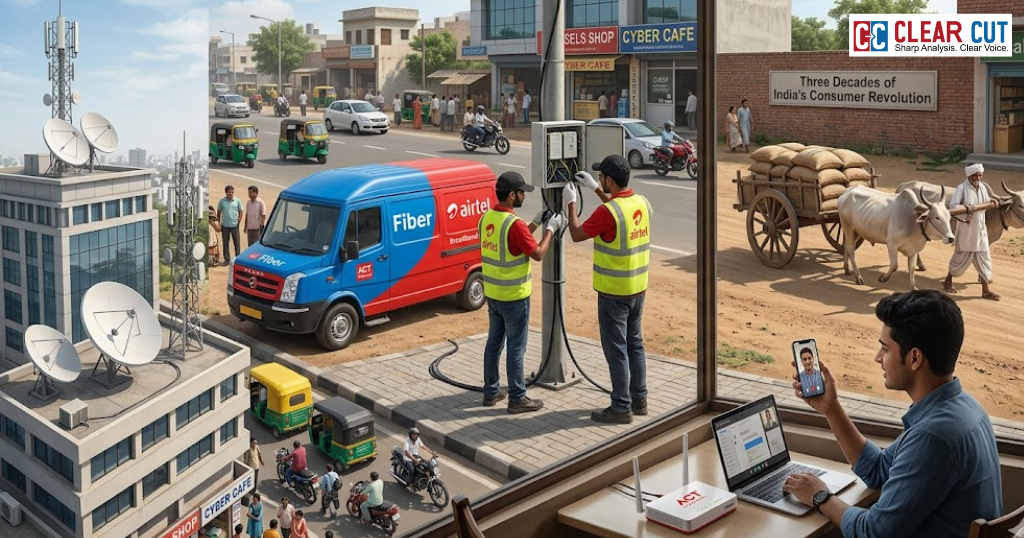
- Three decades of NFHS data show that Indian households have witnessed major improvements in consumer durables, housing quality, electrification, and digital connectivity, reflecting rising living standards and economic progress.
- Mobile phones, televisions, motorcycles, and internet access have expanded rapidly across both rural and urban India, highlighting a shift from basic survival needs to comfort, convenience, and aspiration.
- Government initiatives, economic growth, and technological innovation have driven this transformation, though significant gaps in access to modern amenities still remain for many households.
01. The Quiet Revolution in Indian Homes
Walk into an Indian household today, and you will encounter a world radically different from what existed just a generation ago. The sewing machine that once symbolised household enterprise sits alongside a washing machine; the radio that once connected families to the outside world has been displaced by smartphones streaming video on broadband connections. The transformation is so pervasive that it is easy to forget how recent it truly is.
India’s economic liberalisation, initiated in 1991, set in motion forces that would gradually but profoundly alter the consumption landscape. Rising incomes, aspiration, expanding credit markets, declining real prices of manufactured goods, urbanisation, and a demographic dividend of young, aspirational consumers have collectively driven what can only be described as a consumer revolution. Yet, for all the anecdotal evidence and macroeconomic narratives, the granular household-level picture of this transformation has received less systematic attention.
Recent evidence indicates that India’s household consumption basket is gradually shifting away from basic necessity spending towards modern durables and other asset-building purchases, reflecting broader changes in welfare, aspirations, and economic participation (Ravi & Penumarty, 2025; Banerjee et al., 2017).
Changes in ownership of consumer durables, mobility assets, and digital connectivity, therefore, offer a useful lens through which to understand the country’s transition from subsistence-oriented consumption toward more diversified and modern forms of household consumption (Ravi & Penumarty, 2025).
The National Family Health Surveys (NFHS), conducted in five rounds between 1992-93 and 201921, offer a unique temporal window into this shift. Originally designed as nationally representative health and demographic surveys, the five rounds of NFHS together surveyed over 1.5 million households and collected detailed data on household asset ownership and access to amenities, data that, when examined across three decades, reveal the arc of India’s material transformation with remarkable clarity.
This article draws on these surveys to document the changing patterns of household consumer durables, mobility assets, digital connectivity, housing conditions, and basic amenities, arguing that these trends serve as a powerful reflection of India’s broader economic transition.
02. The Rise of Consumer Durables: Comfort and Aspiration
The story of consumer durables in India over the past three decades is one of accelerating democratisation of comfort. Items that were once markers of middle-class privilege have progressively become standard features of Indian households across the income spectrum.
2.1 The Kitchen and Living Room Transformation
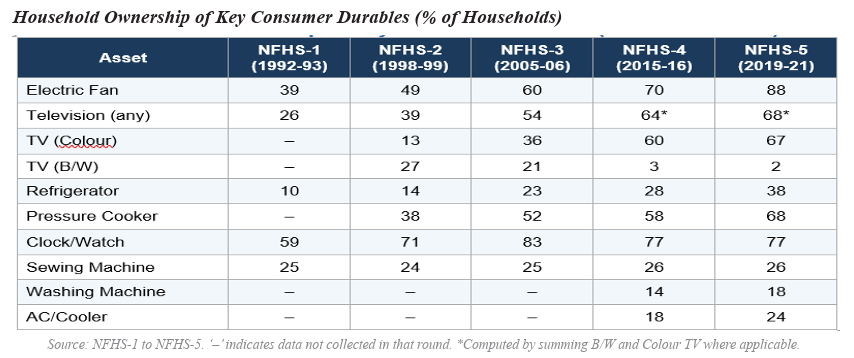
Consider the electric fan perhaps the most basic electrified comfort good. In 1992-93, when NFHS-1 was conducted, only 39% of Indian households owned a fan. By the late 1990s, this had risen to 49%, approaching the halfway mark for the first time.
The upward march continued through 60-70% (2005-06 & 2015-16) and reached almost 88% by 2019-21—a remarkable spread into the homes of even the poorest quintiles, and a more-than-doubling from 1992. The pressure cooker, that indispensable tool of Indian cooking, followed a similar trajectory once it entered the NFHS measurement frame, rising from 38% in NFHS-2 to 68% by NFHS-5.
Refrigerators tell an even more striking story across the full three-decade arc. In 1992-93, only one in ten Indian households owned a refrigerator—a luxury item firmly associated with urban affluence. Over the next two decades, it climbed steadily to 23%, 28%, and finally 38% (Rural 25%, Urban 63%). While still below the halfway mark, this represents a tripling of ownership from NFHS-1, and the pace of increase has been accelerating. The living room has been even more dramatically transformed. In NFHS-1, 26% of households reported owning a television of any kind, and this was overwhelmingly a black-and-white. By NFHS-2, overall television ownership had climbed to 39%, and the survey began distinguishing between black-and-white and colour televisions, revealing that 27% still owned B/W sets while only 13% had transitioned to colour.
The subsequent two decades saw a complete inversion: colour television ownership surged to 36, then 60, and finally 67%, while B/W sets collapsed to 2%. This is not merely a story of more households owning televisions; it is a story of accelerated technological transition and aspiration, where households skipped incremental upgrades and moved directly to colour sets, and increasingly to flat screens and smart televisions. The clock or watch—perhaps an unexpected item in a consumer revolution narrative-tells its own story.
In NFHS-1, 59% of households owned one; by NFHS-3, this peaked at 83% before declining slightly to 77% by NFHS-5, likely reflecting the displacement of standalone timepieces by mobile phones.
Beyond Necessity: The Aspiration Economy
The emergence of washing machines (18% by NFHS-5) and air conditioners/coolers (24%) signals households moving beyond basic comfort to actively pursuing convenience and quality of life. That these items appear for the first time in NFHS-4 (2015-16) and show significant growth by NFHS-5 suggests a new wave of consumer aspiration, mirroring the rapid diffusion of televisions and refrigerators in earlier decades.
That these items appear for the first time in NFHS-4 (2015-16) and show significant growth by NFHS-5 suggests a new wave of consumer aspiration, mirroring the rapid diffusion of televisions and refrigerators in earlier decades.
Furniture and bedding data reinforce this narrative. Chair ownership rose from 53% (NFHS-2) to 83% (NFHS-5); cot or bed ownership climbed from 84% to 90%; and mattress ownership increased from 58% to 74%—suggesting that the material quality of everyday life has improved even among households without headline-grabbing appliances. The sewing machine, by contrast, has remained stable at 24-26% across all five rounds, its functional role neither expanded nor diminished. (data not shown).
3. Mobility and Transportation: From Animal Power to Engine Power
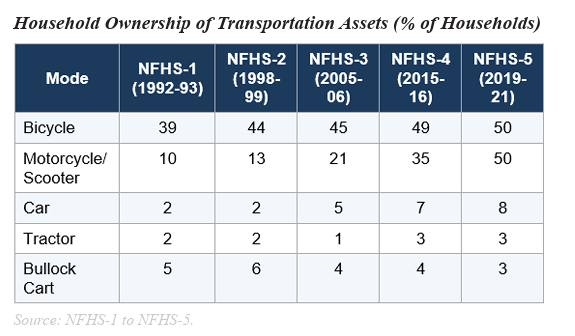
Perhaps nowhere is India’s economic transition more vividly captured than in the changing landscape of household mobility. In 1992-93, when NFHS-1 recorded household transportation assets for the first time, only 10% of Indian homes owned a motorcycle or scooter, a mere 2% owned a car, and 5% still relied on the bullock or animal-drawn cart. The bicycle, at 39%, was the dominant personal transport vehicle. Three decades later, the landscape is unrecognisable.
Motorcycle and scooter ownership has surged from that 10% to 50% —a nearly five-fold increase that makes the two-wheeler perhaps the single most transformative consumer durable of the post-liberalisation era. Car ownership, while still modest at 8%, has grown nearly fivefold from its 2% starting point and continues to accelerate. The bullock cart, once a defining symbol of rural India, peaked at 6% in NFHS-2 before beginning a steady decline to 3% by NFHS5. The thresher has stagnated at around 1-2%.
These declines reflect not merely changing preferences but the mechanisation and modernisation of Indian agriculture. The bicycle, interestingly, has held remarkably steady at around 3950% across all five survey rounds, suggesting that it continues to serve as a basic, affordable mode of transport even as motorised alternatives become available. This persistence speaks to the layered nature of India’s consumer transition: new technologies are adopted alongside, rather than in complete replacement of, older ones—at least until a tipping point is reached.
04.The Digital Leap: Connectivity and the Information Revolution
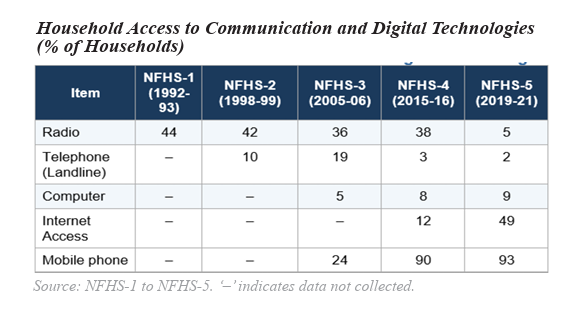
The most dramatic transformation captured in the NFHS data relates to communication and digital technologies—and here the NFHS-1 baseline from 199293 provides invaluable context. In that first survey round, 44% of Indian households owned a radio, the primary medium through which rural India received news, entertainment, and government communication.
There were no landline telephone questions (it was added in 199899), no internet questions, and no computer questions. The information landscape of early-1990s India was, by today’s standards, extraordinarily constrained.
The trajectory of the landline telephone—rising from 10% in NFHS-2 to 19% in NFHS-3, then collapsing to just 2% by NFHS-5-encapsulates in a single data series the story of India’s great.
05 Agricultural Assets and Rural Transformation
The data on agricultural assets, available from NFHS-1 onward, reveal the changing face of rural India over the full three decades. Water pump ownership has steadily increased from 6% in NFHS-1 (1992-93) to 18% in NFHS-5 (2019-21), nearly tripling over the period and reflecting the spread of mechanised irrigation and groundwater extraction. Tractor ownership, starting at 2% in NFHS-1, has increased to 3%, modest in absolute terms but significant in indicating the gradual mechanisation of farming operations.
At the same time, there is a decline in technological transformation. India did not gradually transition from landlines to mobile phones; it essentially skipped the landline era altogether. The pace of mobile phone adoption was nothing short of extraordinary.
First measured in NFHS-3 (200506), mobile phone ownership already stood at 24% of households—outstripping the landline’s peak within a single survey round. By NFHS-4 (2015-16), the figure had surged to 90%, and by NFHS5 (2019-21) it had climbed further to 93%, making the mobile phone arguably the most widely diffused consumer durable in Indian history, even in rural areas (92%). No other asset tracked by the NFHS—not even the electric fan—has matched this speed or universality of adoption.
Internet access tells an even more remarkable story. Not even measured until NFHS-4, when it stood at 12%, internet penetration had quadrupled to 49% by NFHS-5—a period of just four to bullock carts (from 5% in NFHS-1 to 3% in NFHS-5) and the stagnation of threshers at around 1-2% point to a rural economy in transition-one where traditional implements are being replaced by hired machinery, contract farming arrangements, and a gradual shift of labour out of agriculture altogether.
five years. This explosive growth was driven by the entry of Reliance Jio in 2016, which triggered a price war that made mobile data among the cheapest in the world (Baijal et al., 2018).
The consequences of this connectivity explosion—for education, commerce, governance, entertainment, and social organisation— are still unfolding and arguably represent the most consequential shift in India’s consumer landscape.
Computer ownership, by contrast, has remained stubbornly low at 8% across both NFHS-4 and NFHS-5, suggesting that India’s digital revolution is fundamentally a mobile-driven phenomenon.
The decline of radio is steady. From 44% in NFHS-1 (1992-93), ownership fell gradually to 38% (NFHS-4), and finally collapsed to just 5% in NFHS-5, reflecting the complete displacement of broadcast radio by streaming and digital media.
These trends, viewed alongside the rising ownership of motorcycles and mobile phones in rural areas, suggest that rural India is not merely modernising its agriculture but transforming the entire pattern of rural livelihoods and connectivity. (data not shown).
06. The Changing Indian Home: Housing, Electricity, and Fuel
Beyond the consumer durables that fill Indian homes, the homes themselves—and the services that flow into them—have undergone a profound transformation over the past three decades. While ownership of fans, televisions, and refrigerators speaks to what households have acquired, the quality of the dwelling and access to electricity speak to something more fundamental: the basic material conditions of everyday life, arguably even more powerful for household well-being than any individual asset.
6.1 From Kutcha to Pucca: The Transformation of the Indian Home
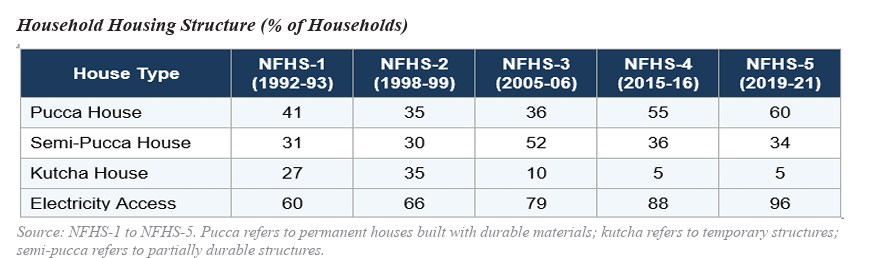
Perhaps no indicator captures the structural improvement in Indian household life more directly than the shift in house type. In 199293, only 41% of Indian households lived in pucca (permanent, durable) houses, while 27% lived in kutcha (mud-and-thatch) dwellings and 31% in semi-pucca structures.
The shift in house type. In 199293, only 41% of Indian households lived in pucca (permanent, durable) houses, while 27% lived in kutcha (mud-and-thatch) dwellings and 31% in semi-pucca structures.
Pucca house ownership climbed steadily to 60% by NFHS-5 (2019-21), while kutcha dwellings collapsed dramatically to just 5%, a more than six-fold reduction. This transformation coincides with the scaling up of rural housing schemes, most notably the Indira Awaas Yojana (IAY) and its successor, the Pradhan Mantri Awas Yojana-Gramin (PMAY-G), launched in 2016.
The semi-pucca category has remained relatively stable at around 35% in the most recent rounds, indicating that the transition is primarily from kutcha to pucca houses.
The implications of this shift extend far beyond physical change.A pucca house offers protection from seasonal weather, better health outcomes, improved sanitation possibilities, and, importantly for the broader consumer story, the structural preconditions for owning appliances like refrigerators, washing machines, and ceiling fans, which require durable walls, reliable roofing, and stable foundations.
6.2. The Electrification of India
Electricity is the lifeblood of modern consumption. Without it, fans, refrigerators, televisions, washing machines, and mobile phone chargers become meaningless. In 199293, only 60% of Indian households had access to electricity—meaning four out of every ten homes relied entirely on kerosene, oil lamps, or no lighting at all after sunset. The real acceleration came in the following decades: 79% by NFHS-3, 88% by NFHS-4, and finally 96% by NFHS-5—effectively universal coverage. This closing of the electricity gap, particularly between NFHS-3 and NFHS-5, reflects the combined impact of sustained rural electrification drives—the Rajiv Gandhi Grameen Vidyutikaran Yojana (RGGVY), the Deen Dayal Upadhyaya Gram Jyoti Yojana (DDUGJY), and the Saubhagya scheme launched in 2017 for last-mile household connectivity. Near-universal electrification is the single most important enabling condition for every consumer durable discussed in this article. Fan, colour television, and mobile ownership are directly linked to the fact that 96% of households now have power to run them. Each percentage point of electrification gain effectively unlocks a latent market for every electrical appliance simultaneously.
07. What the Data Tells Us: Five Key Themes
7.1 The Democratisation of Comfort
The most consistent theme across three decades visible now is the steady spread of basic comfort goods and services to an ever-wider segment of the population. Consumer durables like fans, refrigerators, and pressure cookers are not luxury goods or services; they are the material foundations of a dignified daily life, and their spread signals that the floor of Indian household well-being has risen substantially. While inequality in asset ownership (along with income) persists—and the NFHS data shows significant differences between urban and rural households, and across wealth quintiles, the direction of change is unambiguous towards greater material well-being for the majority.
7.2 Technological Leapfrogging
India’s consumer transition has not followed the linear path of earlier industrialising nations (Soete, 1985). Households have skipped intermediate technologies—from no television to colour television, from no telephone to mobile phone, from no internet to mobile broadband. The NFHS-1 makes this leapfrogging especially vivid: in 1992-93, when only 26% of homes had any television, and 44 per cent relied on radio, no one could have predicted that within three decades, two-thirds of homes would have colour televisions while radio ownership would collapse to 5%. This leapfrogging pattern has significant implications for the pace and character of economic development.
7.3 The Mobile Revolution
The stagnation of computer ownership at 8% alongside the explosion of internet access to 48% confirms that India’s digital transformation is overwhelmingly mobile-driven. With mobile phone ownership reaching 92% by NFHS-5, the handset has become a universal consumer good—the single device through which most Indians access information, entertainment, financial services, and government programmes.
This reshapes everything from government service design (now necessarily mobile-optimised) to digital commerce (increasingly app-based) to media consumption (favouring short-form video and social media).
7.4 Between Aspiration and Rational Choice
While the data show broad-based progress, certain durables remain confined to a minority of Indian households. Refrigerator ownership stands at 38%, washing machine ownership at 18%, and car ownership at 8%—well below the near-universal penetration these goods have achieved in other middle-income countries. Measured against the 1992-93 baseline, the progress is undeniably impressive, but the reasons for low ownership are varied, and not all non-ownership reflects “unmet aspiration”.
While the data show broad-based progress, certain durables remain confined to a minority of Indian households. Refrigerator ownership stands at 38%, washing machine ownership at 18%, and car ownership at 8%—well below the near-universal penetration these goods have achieved in other middle-income countries. Measured against the 1992-93 baseline, the progress is undeniably impressive, but the reasons for low ownership are varied, and not all non-ownership reflects “unmet aspiration”.
For the poorest segments, affordability remains a genuine constraint. For the expanding middle class, however, non-ownership often reflects rational assessments of utility shaped by India’s distinctive conditions. The washing machine competes car with two-wheelers that navigate congested streets far more car with two-wheelers that navigate congested streets far more a deeply entrenched ecosystem of daily fresh markets and neighbourhood provision stores. Low penetration thus reflects a composite of affordability, rational choice, and infrastructure realities-not simply “aspiration gaps”.
7.5 Creative Substitution in the Consumer Basket
The data vividly illustrates how old technologies fade as new ones take their place. Black-and-white televisions, landline telephones, radios, VCR/VCPs, kerosene lamps, and bullock carts have all been displaced by superior alternatives. The VCR/VCP—found in 3.6% cent of households in NFHS-1-had almost disappeared entirely by the next survey round. The kerosene lamp, once universal in rural India, has been rendered obsolete by electrification. Each obsolescent item represents not just a technological transition but a social and economic one—changing how people communicate, travel, access information, and imagine their futures.
Conclusion: The Unfinished Revolution
The three decades of India’s consumerism pathways—from the early 1990s to the early 2020s— tell a story of extraordinary material transformation. India today is, by virtue of every measure of household consumer assets, housing quality, and basic amenities, a fundamentally different country from the India of the early 1990s. A nation where barely four in ten homes had an electric fan, one in ten had a refrigerator or a motorised two-wheeler, and only six in ten had access to electricity has become one where these items and services are approaching or have crossed the majority threshold.
The transformation is real, broad-based, and accelerating—particularly in digital connectivity, motorised transportation, electrification, and housing quality.
Much of this shift has been catalysed by sustained public policy. The electrification drive through RGGVY, DDUGJY, and Saubhagya pushed grid coverage from 60% in 1992-93 to 96% by 2019-21— effectively closing the electricity gap within a single generation.
In parallel, the Indira Awaas Yojana (IAY) and its successor, the Pradhan Mantri Awas Yojana-Gramin, drove the collapse of kutcha housing from quarover a ter of homes in 1992-93 to just 5% by 2019-21.
Complementary initiatives —the Pradhan Mantri Ujjwala Yojana (PMUY) for clean cooking fuel, Swachh Bharat Mission for sanitation, and Jal Jeevan Mission for piped water—have together created the enabling infrastructure that makes the broader consumer revolution possible. lifting hundreds of millions above the subsistence threshold.
The expansion of consumer credit and EMI-based financing for appliances and vehicles has made modern durables accessible to households that would have been priced out a generation ago. The Indian consumer today is still far below global averages in per capita income—yet Indians are better financed, better informed, and, thanks to digital commerce, better connected to markets than at any point in history. However, the revolution remains unfinished. Persistent gaps endure—between urban and rural India, between the richest and poorest quintiles, between leading and lagging states. Refrigerators, washing machines, cars, and reliable internet access remain out of reach for most households
But not all non-ownership reflects unmet aspiration; much of it reflects the rational calculus of households operating within affordability, perceived needs, and infrastructure constraints. As these conditions shift, the next wave of adoption in appliances and automobiles may accelerate rapidly, much as it did for televisions and two-wheelers in earlier decades.
The direction of change is clear. India is moving—unevenly, imperfectly, but unmistakably— from scarcity to sufficiency, from sufficiency to comfort, and from comfort to aspiration. The direction of change is clear. India is moving—unevenly, imperfectly, but unmistakably— from scarcity to sufficiency, from sufficiency to comfort, and from comfort to aspiration.
About the Authors:
Dr. Sushanta Kumar Banerjee is a public health expert with over three decades of experience spanning research, policy, and programme implementation. He holds a PhD in Demography and a master’s degree in Economics, bringing a strong analytical lens to complex development challenges. He recently retired as Chief Technical Officer at Ipas Development Foundation. Dr. Banerjee has authored multiple research papers in peer-reviewed international journals and UN publications, and has contributed economic analyses to the Economic and Political Weekly (EPW). He is also a contributing author to Clear Cut.
Abdul Rahique: Abdul Rahique is a demographer and quantitative researcher at the intersection of public health and development policy, with a focus on reproductive health, ageing, and migration.
Srijan Banerjee: Srijan Banerjee is a Fellow at Hive School of Business, pursuing the PGP in Revenue, Tech and Entrepreneurship.
Clear Cut Research Desk
New Delhi, UPDATED: May 31, 2026 09:00 IST
Written By: Dr. Sushanta Kumar Banerjee, Srijan Banerjee, Abdul Rahique