
- Census 2027 will be India’s first digital-first census, introducing self-enumeration, mobile-based data collection, GIS mapping, and faster processing systems.
- The exercise is expected to provide updated population data and may include the first nationwide caste enumeration since 1931, influencing welfare policies and political representation.
- While technology can improve efficiency, concerns remain about digital access, privacy, and ensuring that vulnerable communities are not left out of the count.
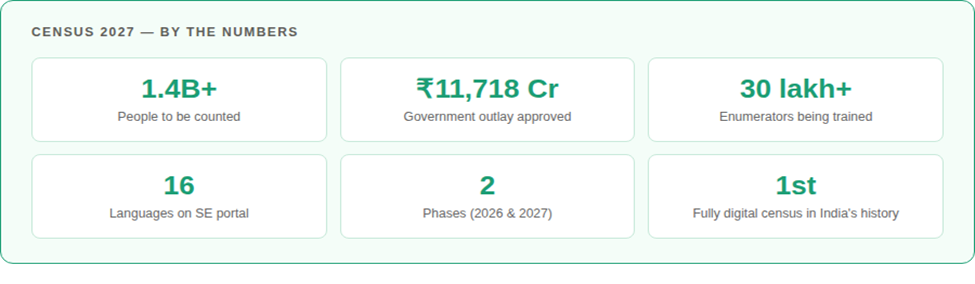
India is preparing to count more than 1.4 billion people once again — but this time, the process itself is changing in major ways that could affect welfare delivery, policymaking, and democratic representation across the country.
Why the census matters
Every ten years, India undertakes one of the largest administrative exercises in the world. Census data influences everything from welfare schemes and parliamentary delimitation to urban planning and public health spending.
After a six-year delay caused first by the COVID-19 pandemic and later by political and administrative factors, Census 2027 is finally moving forward. Along with the delay, the methodology itself is changing significantly.
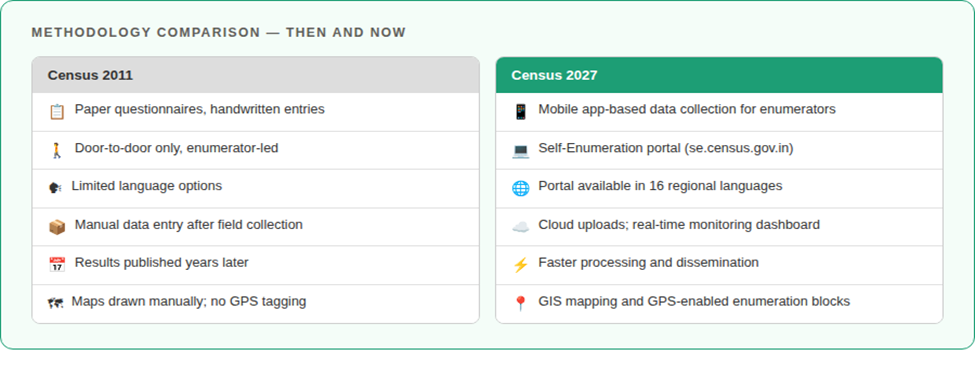
For more than 150 years, the census depended largely on paper forms and door-to-door visits by government enumerators. Census 2027 introduces a digital system. Citizens can now submit household information online through a Self-Enumeration portal. Enumerators are being equipped with mobile applications instead of paper schedules, while GIS-enabled mapping and cloud-based systems are expected to speed up data processing.
The last completed census was conducted in 2011. Since then, India has witnessed rapid urbanisation, large-scale migration, and major expansion in welfare delivery systems. Updated population data has become increasingly important for planning and governance.
“The census is not about counting heads. It is about ensuring that every person is counted — and that those numbers eventually shape schools, hospitals, welfare schemes, and public services.”
2011 vs 2027 — What has changed
How self-enumeration works
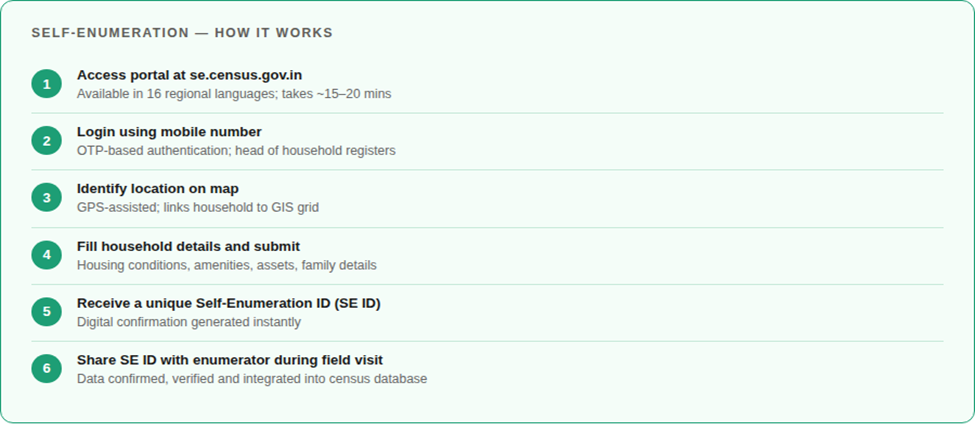
The most visible change is the introduction of the Self-Enumeration (SE) portal. For the first time in India’s census history, households can independently submit their information online through the official portal, register using a mobile number, digitally identify their location, and generate a unique SE ID.
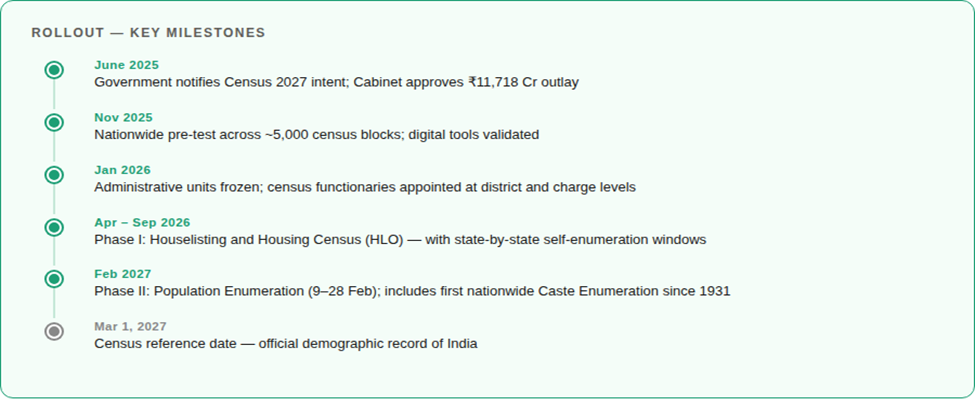
During the house-listing phase, government enumerators will visit households to verify the submitted information. The Union government has approved a budget of ₹11,718.24 crore for the exercise. A nationwide pre-test covering nearly 5,000 census blocks was conducted in November 2025 to test the digital systems before the national rollout.
By early April 2026, more than 5.72 lakh households had already completed self-enumeration in the first batch of states and Union Territories, including Goa, Karnataka, Odisha, Mizoram, and Sikkim.
The Census 2027 timeline
Why this matters beyond technology
Census 2027 is also expected to include the first nationwide caste enumeration since 1931. The exercise is likely to generate fresh data on social groups beyond Scheduled Castes and Scheduled Tribes, which could influence future debates around reservations, welfare targeting, and political representation.
The government has said that data security systems and instruction manuals in 19 languages are being prepared to support the process. Officials have also indicated that customised visualisation tools may be introduced to improve public access to census findings.
The challenges that technology alone cannot solve
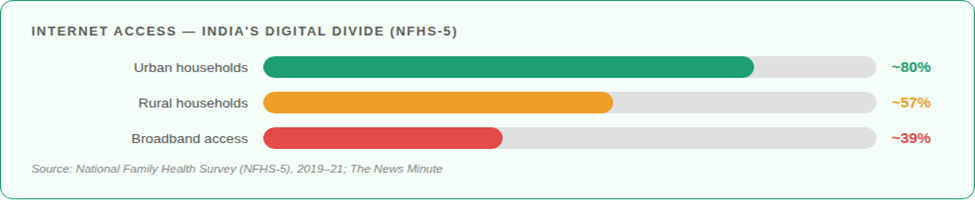
Source: National Family Health Survey (NFHS-5), 2019–21
While the move towards a digital-first census is significant, concerns remain about unequal access to technology across the country. According to NFHS-5 (2019–21), internet access was available to around 57% of rural households compared to nearly 80% of urban households. NSO estimates from 2024 suggest that only about 40% of Indian households have access to a smartphone or computing device.
Several civil society organisations have raised concerns that digital self-enumeration may leave out vulnerable communities, including rural households, tribal populations, migrant workers, elderly residents, women, and domestic workers.
Privacy concerns have also been raised because the census collects detailed information related to housing, caste, migration, disability, and household assets. Since the data will be stored digitally, researchers and policy experts have questioned whether existing safeguards are sufficient.
The concerns draw attention to the Supreme Court’s 2017 Puttaswamy judgment, which recognised privacy as a fundamental right under Article 21 of the Constitution.
Technology is not enough — inclusion remains the real challenge
The government has attempted to address some of these concerns. Instruction manuals are being prepared in 19 languages, and more than 30 lakh enumerators are being trained to use digital tools while continuing physical field visits.
Officials have described the approach as a hybrid model intended to ensure that households without internet access are not excluded.
However, experts argue that digital systems alone cannot guarantee inclusion. Levels of digital literacy remain uneven across the country, particularly in rural and low-income communities. Even relatively common online processes such as income tax filing often require assistance from intermediaries.
Unlike other government databases, the census is expected to reach every household in the country, including populations that remain outside the digital economy.
“Marginalised groups must not become data shadows in a digital-first approach. The government must retain in-person enumeration where needed.” — Population Foundation of India
India has conducted a census every ten years since 1881. Each census has shaped policymaking and the state’s understanding of social and economic conditions.
Census 2027 could become the country’s fastest and most technologically advanced population count so far. But its effectiveness will ultimately depend not only on digital systems, but also on whether the exercise successfully reaches people who remain hardest to count.
Clear Cut Livelihood, Research Desk
New Delhi, UPDATED: May 30, 2026 05:30 IST
Written By: Shivangi