

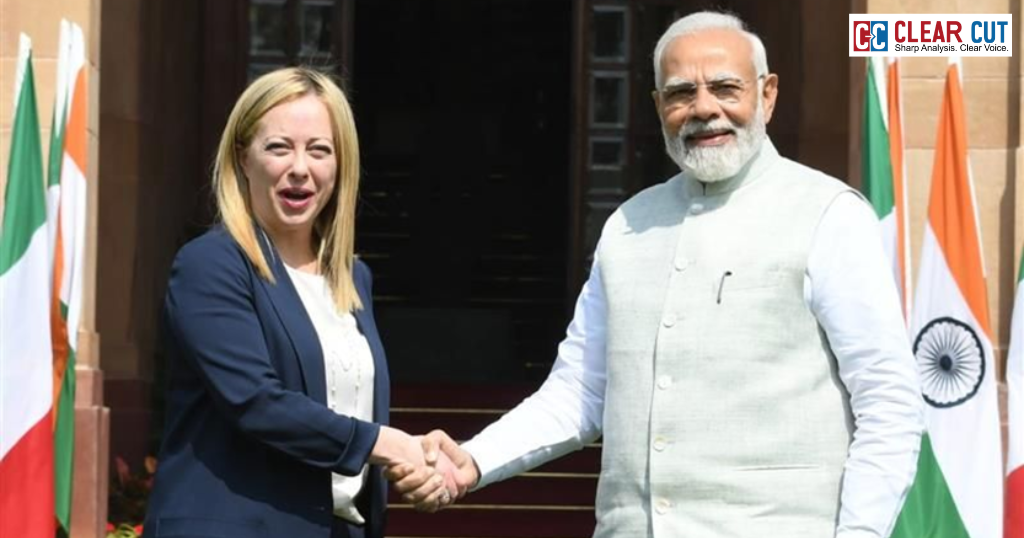
- Prime Minister Narendra Modi’s May 2026 visit to Italy elevated India-Italy relations through a Joint Declaration covering defence, digital economy, renewable energy, critical minerals, and cultural cooperation.
- Italy’s support for the ratification of the India-EU Free Trade Agreement (FTA) highlights its growing importance as a strategic partner for India within the European Union.
- The visit reflects India’s evolving Europe strategy, focusing on stronger bilateral partnerships alongside broader engagements such as the India-Nordic Summit.
The Country That Did Not Make the Headlines
When Prime Minister Modi’s European diplomatic week in May 2026 was discussed in Indian media, the headlines went to the 3rd India-Nordic Summit in Oslo. The meetings were held with the leaders of Sweden, Finland, Denmark, and Iceland, the joint op-ed with Swedish Prime Minister Ulf Kristersson, the bilateral with Iceland’s government. Italy, where the Prime Minister visited immediately before Oslo on May 20, received less column space. The India-Italy Joint Declaration and the bilateral meeting with Prime Minister Giorgia Meloni were treated as footnotes.
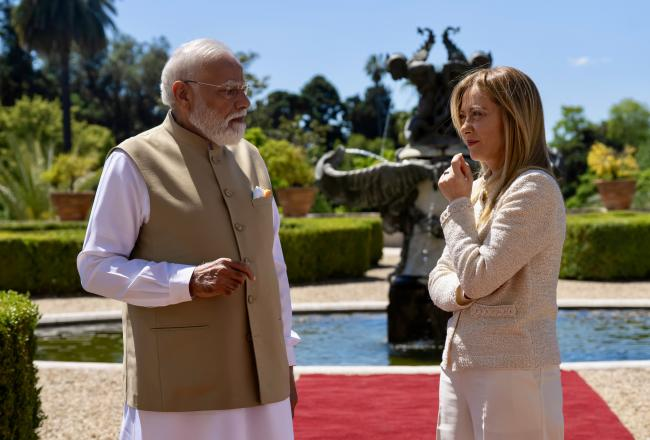
That editorial hierarchy gets the strategic priority wrong. Italy is the 3rd-largest economy in the Eurozone, a G7 member and a NATO ally with significant military procurement relationships. The country’s government has positioned itself as one of Europe’s most engaged proponents of the India-EU relationship. The India-Italy Joint Declaration of May 20, 2026, and the call on Italy’s President, represent the elevation of a bilateral relationship that has historically operated below its strategic potential.
What the Partnership Covers
India-Italy Joint Declaration, May 20, 2026: Cooperation in defence and security, digital economy, renewable energy, critical minerals, cultural exchange, and support for conclusion of the India-EU FTA. Italy: third-largest Eurozone economy, G7 member, major EU interlocutor for India.
[PIB / PM Modi visit Italy, May 20, 2026]
The Joint Declaration’s substance spans five domains of strategic significance. Defence and security cooperation is the most diplomatically sensitive: India and Italy share an interest in maritime security in the Indian Ocean, where Italian naval vessels work under EU anti-piracy missions that intersect with India’s own maritime security architecture. The relationship was strained for years by the Enrica Lexie case involving Italian marines; the case was settled through an international arbitration process in 2020, and the post-settlement normalisation of the relationship is reflected in the current partnership elevation.
The digital economy dimension has practical commercial substance. Italy’s manufacturing sector including its design-intensive industrial clusters in Lombardy and Emilia-Romagna, is actively seeking digital transformation partnerships. India’s IT sector, which is already significantly embedded in European digital transformation supply chains, has an opportunity to deepen those relationships through the Italy corridor. The India-Italy Business Forum, set up in parallel with the diplomatic visit, is designed to activate this commercial potential.
Italy’s Positioning Within the EU and India’s FTA Ambition
The most strategically significant element of the Italy relationship is not bilateral. It is multilateral. Italy, as a large EU member, is an important voice in the Council of the European Union, which must ratify the India-EU Free Trade Agreement that was concluded on January 27, 2026 (PIB, Ministry of Commerce). The conclusion of the FTA was a diplomatic landmark. Ratification by all 27 EU member states is the necessary next step, and it is a process where bilateral relationships between India and individual EU capitals matter.
Italy’s Meloni government has been consistently supportive of a stronger EU-India trade relationship. The Joint Declaration’s explicit reference to the India-EU FTA is a signal that Italy intends to use its Council voice in support of ratification. That is a concrete diplomatic dividend from what might otherwise be dismissed as a courtesy visit.
The Nordic Dimension: Five Partnerships, One Coordinated Message
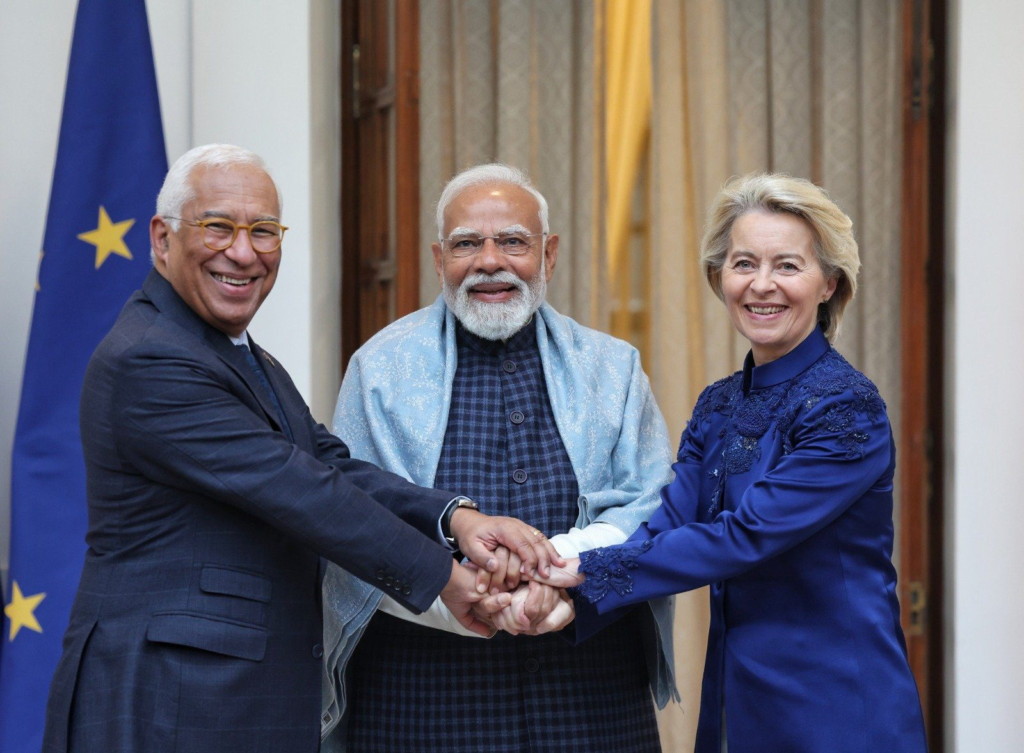
The 3rd India-Nordic Summit brought together India and the five Nordic nations including Sweden, Finland, Denmark, Norway, and Iceland. This linkup was for a structured multilateral engagement on clean energy, green hydrogen, maritime cooperation, digital governance, and global health. The joint op-ed with the Swedish PM, published simultaneously in both countries, is a diplomatic form that signals genuine alignment, not ceremonial goodwill. Sweden’s Saab-BAE collaboration with India on the Gripen fighter programme gives the defence dimension of the Nordic relationship practical substance.
Europe Is Not a Monolith. India Must Engage It as Such.
India’s European diplomacy is maturing. The EU-India FTA is done. The Nordic Summit is in its third edition. The Italy Joint Declaration has given the bilateral relationship a structured framework for the first time. What must follow is the harder work: converting diplomatic frameworks into commercial outcomes, ensuring that the FTA’s ratification process is actively managed through bilateral capital-by-capital engagement, and building the people-to-people ties. This can be achieved through student exchanges, cultural programming, and business mentoring that give diplomatic agreements roots deep enough to survive government changes. The photograph was taken. Now do the work behind it.
Clear Cut Awards & Events, Research Desk
New Delhi, UPDATED: June 02, 2026 09:00 IST
Written By: Tanmay J Urs