
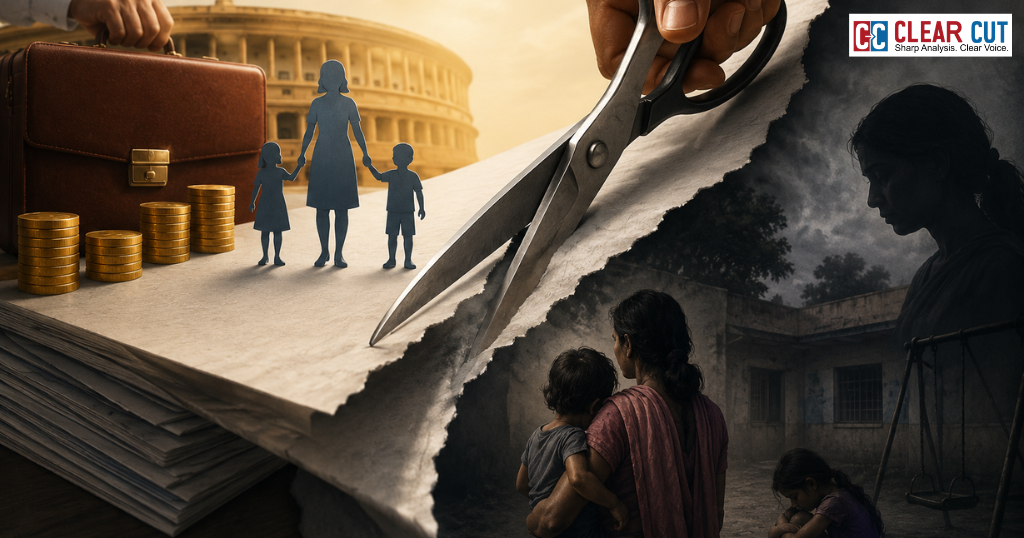
- Mission Shakti and Mission Vatsalya, two key welfare schemes for women and children, faced significant funding cuts in the 2025-26 revised estimates, raising concerns about support services for vulnerable groups.
- The reductions are part of a broader trend of underspending on social welfare programmes, even as demand for child protection, women’s safety, and rehabilitation services continues to grow.
- Although the 2026-27 Budget has increased allocations for both schemes, experts argue that these increases largely restore previous cuts rather than expand welfare support.
India’s Budget speech is a carefully choreographed event. Numbers go up, schemes get named, and ministers applaud. But a quieter story plays out months later, in documents called Revised Estimates. This is where the real spending decisions happen.
In 2025-26, two of India’s most critical welfare schemes for women and children were slashed significantly at the revised estimates stage. Mission Shakti and Mission Vatsalya, key schemes aimed at women and child protection, witnessed reductions at the RE stage in 2025-26 of 37% and 27% respectively. These are not small administrative adjustments. These are cuts to programmes that protect survivors of violence, support orphaned children, and fund district-level child welfare structures across the country.
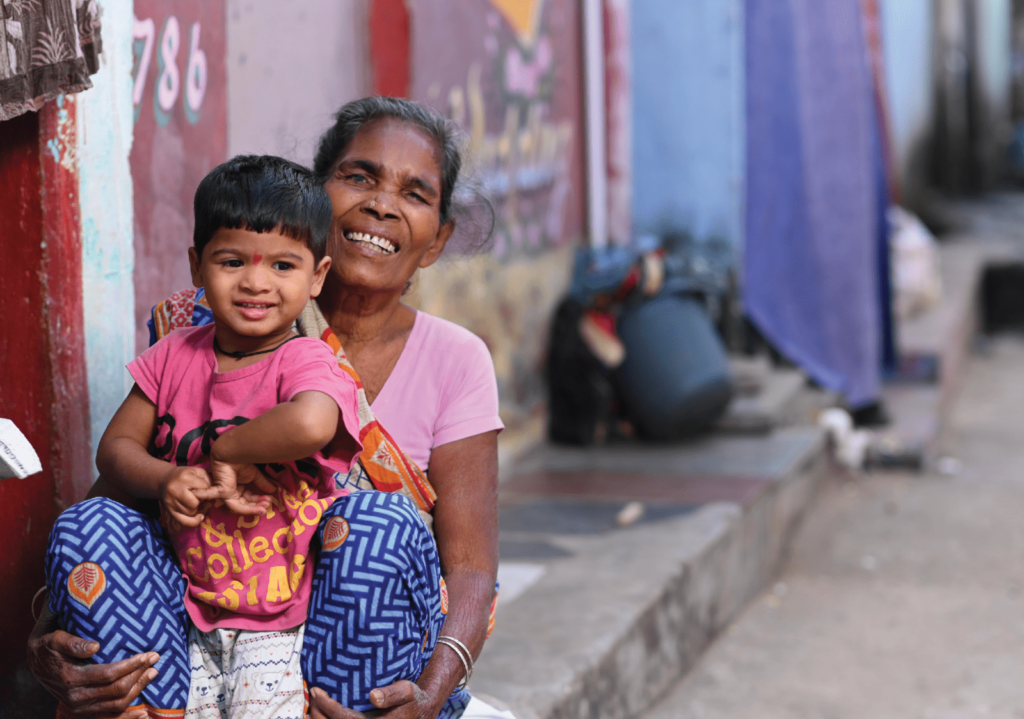
What These Schemes Actually Do
Understanding the scale of the damage requires understanding what these schemes cover on the ground.
Mission Shakti provides support for women through care, safety, protection, rehabilitation, and empowerment. It has two sub-schemes: Sambal, focused on safety and security, and Samarthya, focused on empowerment. It subsumed schemes like Beti Bachao Beti Padhao and PM Matru Vandana Yojana,according to PRS Legislative Research’s analysis of the Ministry of Women and Child Development’s demands for grants.
Its most visible delivery mechanism is the One Stop Centre network. As of July 31, 2025, there are 854 One Stop Centres operational across the country, having aided over 12.20 lakh women. The Women Helpline number 181 is operational in 32 states and union territories and has provided assistance to over 92 lakh women, with 2.51 crore calls received, according to India Brand Equity Foundation (IBEF), citing official Ministry of Women and Child Development data.

Mission Vatsalya seeks to create a supportive ecosystem for the overall development of children in need of care and protection, and those in conflict with the law. It subsumed the Child Protection Services scheme,as noted by PRS Legislative Research. It funds Child Care Institutions, Child Welfare Committees, and Juvenile Justice Boards at the district level across all states and union territories.
In plain terms, these are not aspirational programmes. They are emergency infrastructure for India’s most vulnerable citizens.
The Numbers Behind the Cuts
Mission Shakti was reduced from Rs 3,150 crore to Rs 2,000 crore at the revised estimates stage in 2025-26. Mission Vatsalya fell from Rs 1,500 crore to Rs 1,100 crore,reported The South First, citing Union Budget revised estimates documents.
The Samarthya component of Mission Shakti, which funds women’s empowerment services, faced a similar pattern. The budgetary allocation for Samarthya went up from Rs 2,521 crore in 2025-26 to only Rs 2,573 crore in 2026-27. Even those small allocations are not being fully spent, as the Revised Estimates show only Rs 1,678 crore actually utilised,reported BehanBox, a gender-focused policy analysis publication. It noted that services funded by this budget are critical not only for health and nutrition but also for reducing the unpaid care work burden on women.
A Pattern Across the Entire Social Sector
The cuts to Mission Shakti and Mission Vatsalya are not isolated. They are part of a wider pattern of mid-year contractions in social spending.
The Union government underspent on over 100 of the 191 Centrally Sponsored Schemes originally budgeted for 2025-26. In aggregate, allocations for all 191 schemes were pared down from Rs 5.42 lakh crore in the budget estimates to Rs 4.20 lakh crore in the revised estimates. Other welfare schemes for marginalised communities also faced sharp cuts: PM AJAY, targeting Scheduled Castes, was brought down from Rs 2,140 crore to Rs 1,250 crore, and PM YASASVI, covering OBCs and de-notified tribes, was cut from Rs 2,190 crore to Rs 1,500 crore,reported The South First.
IndiaSpend, citing its own budget analysis, quoted an analyst who observed: “Within social sector ministries, it is those focused on the marginalised such as minority affairs, social justice, development of north-east and so on that see the most cuts.”
In 2024-25, the latest year for which actual spending data are available, social sector spending fell to an all-time low in a decade at 17% of total expenditure, with only Rs 7.7 lakh crore spent, according to IndiaSpend.
Parliament Raises the Alarm
These trends have not gone unnoticed in Parliament. A Parliamentary Standing Committee on Social Justice and Empowerment, chaired by BJP MP P.C. Mohan, examined demands for grants for 2026-27 and raised pointed concerns.
The committee noted that the Ministry of Minority Affairs had proposed a budget of Rs 4,758.37 crore for 2026-27, but the Ministry of Finance approved only Rs 3,400 crore, about 28.5% less than the requested amount. The panel also noted that scholarship schemes for minority students have not been distributed since 2022-23 after irregularities were found in some states.The committee’s findings were reported by 8PM News in March 2026.
The committee noted repeated patterns of low utilisation across financial years and urged better execution and monitoring, according to Impressive Times, reporting on the parliamentary panel findings.
A Recovery on Paper
The Union government has responded with higher headline allocations in 2026-27. Mission Vatsalya’s budget has been revised from Rs 1,100 crore in 2025-26 to Rs 1,550 crore in 2026-27, an increase of approximately 40.9%. Mission Shakti has seen its budget increase from Rs 2,000 crore at the revised estimates stage to Rs 3,200 crore in 2026-27, an increase of approximately 60%, reported Down to Earth.
But critics argue that the 2025-26 mid-year cuts make the new allocations a restoration, not a genuine increase. Starting from a cut baseline and returning to near-original levels does not represent real progress for a programme whose ground-level needs have only grown.
Analysts at BehanBox noted that the significantly larger overall budget size does not bring any special benefits to social sectors such as health, education, nutrition, and rural development, or for people from marginalised sections including women and children. The education ministry’s budget increased by only 8%, the total health budget by just 6.8%, and the rural development budget by only 3.5%.
What It Means on the Ground
A total of 4,45,256 cases of crime against women were registered across India in 2022, almost 51 FIRs every hour, up from 4,28,278 in 2021 and 3,71,503 in 2020, according to NCRB data.  The Tribune reported this data citing the National Crime Records Bureau’s annual Crime in India report.
One Stop Centres, Women Helplines, and Shakti Sadans are the primary response infrastructure the government has built for survivors. Cutting funding to Mission Shakti mid-year does not close these centres overnight. But it slows hiring, delays maintenance, reduces outreach, and leaves district-level staff without resources.
For Mission Vatsalya, the consequences are equally direct. Child Care Institutions run on thin margins. Juvenile Justice Boards need trained staff to function. Child Care Institutions established under Mission Vatsalya provide age-appropriate education, access to vocational training, recreation, health care, and counselling. Under non-institutional care services, support is provided through sponsorship, foster care, adoption, and after care, according to a Press Information Bureau release citing the Ministry of Women and Child Development.
The government’s Budget speeches speak of Viksit Bharat. But the revised estimates tell a quieter, harder story about who gets left behind when fiscal arithmetic tightens.
Clear Cut Gender Desk
New Delhi, UPDATED: June 04, 2026 05:00 IST
Written By: Ayushman Meena