As India races to become a global AI hub, its data centres are quietly consuming water from some of the country’s most stressed aquifers. The environmental cost of India’s digital economy is a policy conversation we are overdue to have.
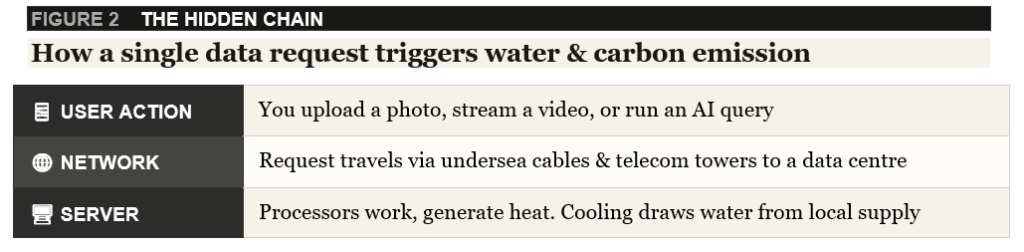
Every time you stream a film on a Mumbai morning commute, every email you send your colleague in Bengaluru, every AI query you type at midnight that action ends somewhere physical. A server. A room. A facility that runs all day, every day, drawing electricity and water in quantities that most Indians would find startling if anyone thought to measure them clearly.
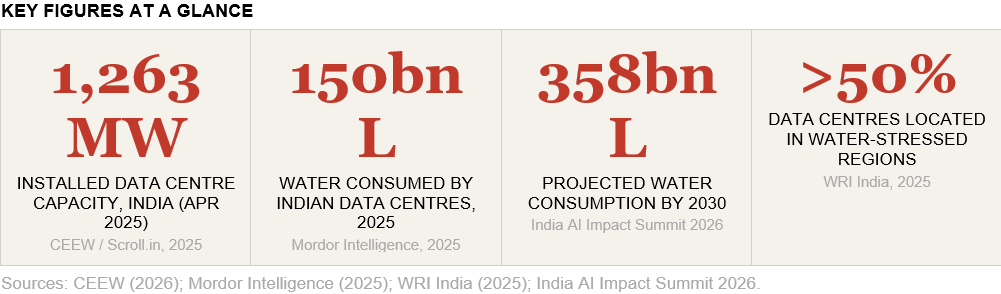
India’s data centre industry has grown more than fourfold since 2020. Installed capacity crossed 1,263 MW in April 2025, and the government, backed by some of the world’s largest technology companies, is pushing it far higher. Google announced a $15 billion AI-focused facility in Andhra Pradesh in 2025. Adani has committed $100 billion in hyperscale infrastructure by 2035. The Union Budget 2026-27 extended a tax holiday to foreign cloud providers through 2047[1].
This is not a bad story. The digital economy is projected to contribute 20 per cent of India’s national income by 2030. Jobs, services, governance all are becoming inseparable from cloud infrastructure. But the country’s push to host the world’s data is running directly into a resource constraint that India knows better than most nations: water scarcity.
The Physical Reality Behind Every Click
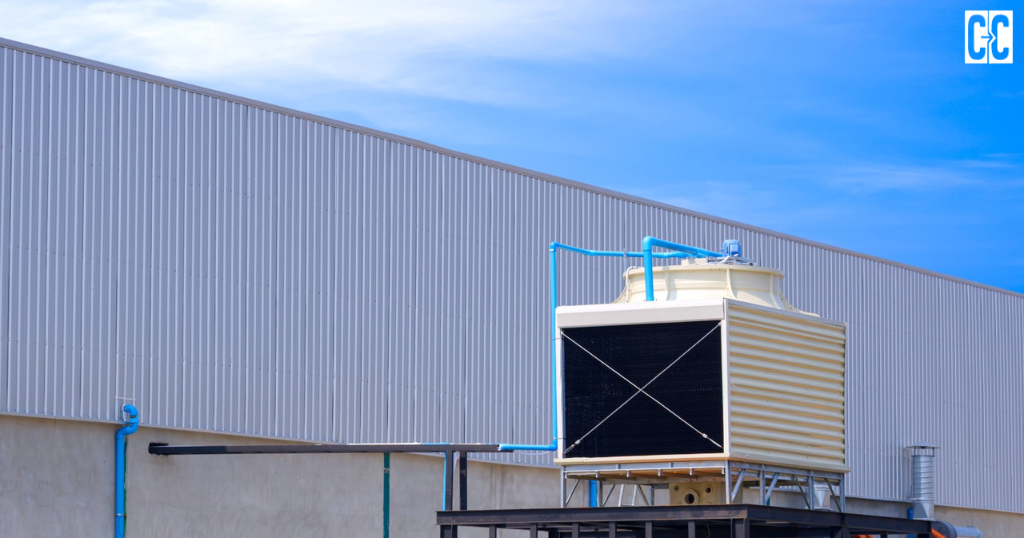
The word “cloud” was always a fiction of convenience. Data does not float. It sits in warehouses of servers the size of large shopping malls, most of them clustered in Mumbai, Hyderabad, Chennai, and Bengaluru cities that already face severe competition over water between homes, industry, and farms. The process that consumes water is cooling. Servers generate enormous heat. In a country where ambient temperatures routinely exceed 40°C in summer, most Indian data centres rely on evaporative cooling systems: water is circulated over hot components, evaporates, and carries away the heat. It is cheap, effective, and increasingly difficult to justify in a water-stressed country.
According to a WRI India map published in 2025, more than half of India’s data centre capacity is concentrated in regions already flagged as facing high water stress.
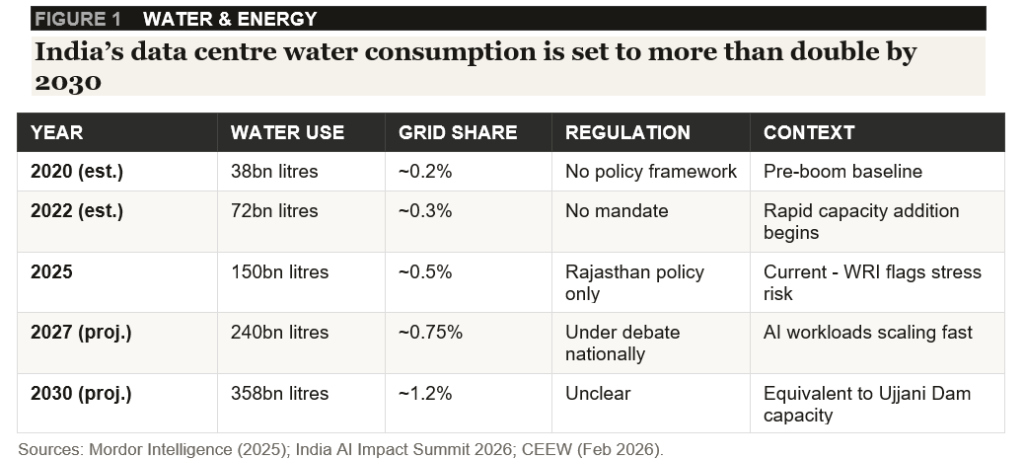
To put those numbers in perspective: 358 billion litres is roughly the full storage capacity of the Ujjani Dam in Maharashtra. It is water that will mostly evaporate into the air above server halls in cities that their own residents struggle to keep supplied through a dry season.
An Energy Calculus Running on Coal
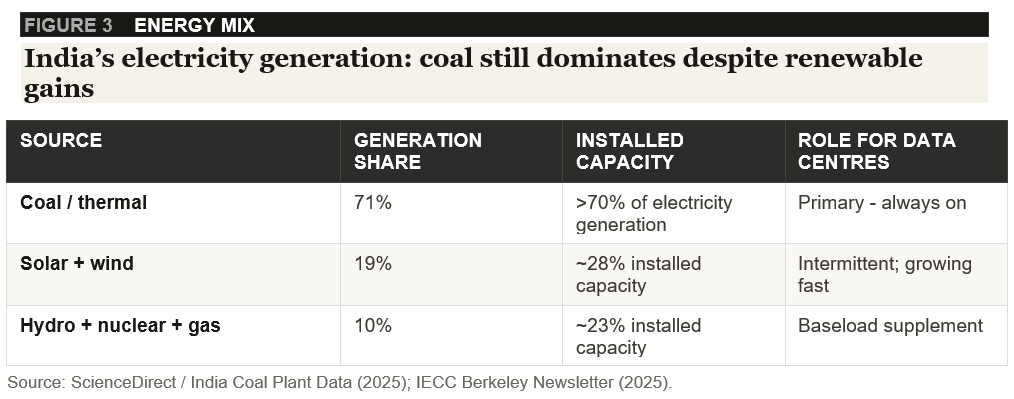
Water is only half the problem. Data centres require electricity at a scale and reliability that make them, in effect, demand-side proxies for whatever sits at the other end of the grid. In India, that means coal,a lot of it.
As of 2025, coal-fired power generation accounts for roughly 47 per cent of India’s installed capacity but generates more than 70 per cent of its electricity, because coal plants run continuously while solar and wind are intermittent. Data centres need 24-hours-a-day, near-zero-downtime power. That demand, structurally, is most easily met by coal.
Labanya Jena of the Climate and Sustainability Initiative made this point plainly at the India AI Impact Summit in February 2026: “Fossil fuels are contributing close to 71-72 per cent of total energy generation in the country… data centres will indirectly contribute to additional coal capacity as they need 24/7 energy.”

The renewable energy promise is real but partial. India crossed the milestone of 50 per cent non-fossil installed capacity in late 2025 a genuine achievement. But renewable generation is intermittent, and no Indian operator has yet demonstrated how to run hyperscale AI workloads entirely on solar and wind without backup coal. The CEEW estimates that up to 80 per cent renewable supply is achievable leaving a gap of at least 20 per cent that, at present, is fossil fuel.
Where the Data Centres Are, the Water Isn’t
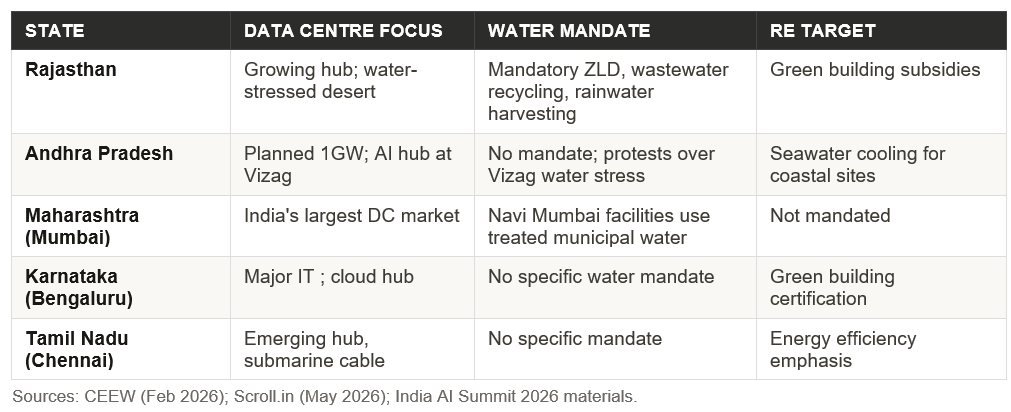
The geography of the problem is stark. India’s largest data centre hubs Mumbai, Hyderabad, Chennai, Bengaluru also sit in regions that WRI’s Aqueduct tool classifies as facing medium-to-high water stress[1]. The proposed Visakhapatnam AI hub in Andhra Pradesh, set to become one of the world’s largest, has already drawn protests from the Human Rights Forum, which warned that the city faces acute water stress and cannot sustain the demands of a gigawatt-scale facility.
S&P Global has projected that 60 to 80 per cent of India’s data centres could face high water stress within this decade. Water shortages already shut down power plants across India every summer. The same constraint will hit data centres, and unlike power plants, data centres integrated into real-time financial and medical systems cannot afford downtime.

The AI Multiplier
If conventional cloud computing strained resource budgets, artificial intelligence is multiplying the demand by an order of magnitude. Training and running large language models requires far more compute per unit of useful output than standard web services. AI workloads push power consumption per server rack above 100 kilowatts compared to 10-15 kW for typical enterprise servers.
A 2025-26 study by researcher Alex de Vries-Gao estimated that AI systems globally could produce between 32.6 and 79.7 million tonnes of CO₂ in 2025, with a water footprint of 312.5 to 764.6 billion litres. Morgan Stanley’s September 2025 projections put global data centre water use rising 11 times to 1,068 billion litres a year by 2028, with AI the primary driver.
The Policy Gap India Cannot Afford
What makes this situation urgent is not the numbers in isolation it is the mismatch between the speed of investment and the pace of regulation. The government has offered tax holidays and investment incentives; it has not, at the national level, mandated water-use efficiency metrics, third-party reporting, or location restrictions for new facilities in water-stressed zones.
The contrast with international practice is instructive. The EU is introducing a harmonised data centre rating scheme from 2026. Singapore’s Green Data Centre Roadmap sets rigorous standards. China has imposed caps on water-to-energy ratios for cooling systems. Ireland has introduced grid-connection rules requiring on-site generation and storage.
Within India, Rajasthan stands as an exception its 2025 policy framework mandates zero liquid discharge, wastewater recycling, and rainwater harvesting for new data centres. That it remains an exception, rather than the national standard, is the policy gap that climate advocates are pushing to close.Despite the rapid expansion of India’s data centre sector, there is currently no mandatory national requirement for public disclosure of water consumption by data centre operators. Government responses in Parliament have primarily focused on promoting water-efficient cooling technologies and groundwater regulation, rather than requiring company-level water-use reporting.
What Solutions Look Like
The picture is not entirely grim. Several credible interventions exist. Facilities in Navi Mumbai have switched to treated municipal wastewater for cooling. Andhra Pradesh’s coastal geography creates an opening for seawater cooling at Vizag. On the energy side, CEEW believes 80 per cent renewable supply is achievable through geographically diversified solar-wind portfolios combined with battery storage.The critical levers are regulatory. Experts recommend mandatory water and energy efficiency disclosures, stricter assessments in water-stressed regions, and a nationwide sustainability framework for data centres based on Rajasthan’s model.
A Reckoning Hiding in Plain Sight
India’s digital economy ambitions are not wrong. The country needs cloud infrastructure, AI capability, and the economic activity both generate. But the assumption that the environmental costs of digital infrastructure are negligible or someone else’s problem is one India cannot sustain.
The country supports 18 per cent of the world’s population with access to just 4 per cent of global freshwater resources. Its groundwater tables are falling. Into this landscape, a sector is being invited in that will consume hundreds of billions of litres a year and require coal-backed electricity around the clock.
That is a policy choice, not a natural consequence of technological progress. The data centres being approved this year will operate for the next two decades. The water they drink, and the carbon emitted to power them, will shape the country’s environmental ledger long after the investment announcements have faded from the news cycle.
India’s cloud is not floating. It is sitting on the same aquifer as a farmer in Telangana, a resident of Bengaluru, a municipal water system in Vizag. The conversation about what it costs to keep it running should not wait until the crisis arrives. It should be happening now.
Clear Cut Climate Desk
New Delhi, UPDATED: June 09, 2026 09:00 IST
Written By: Shivangi Mishra