
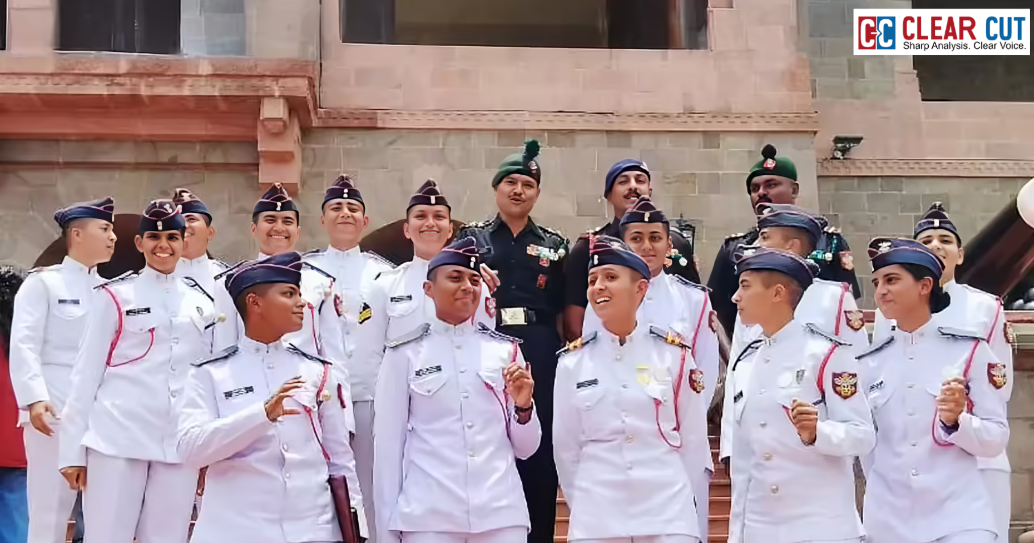
- The first batch of 17 women cadets graduated from the National Defence Academy (NDA) in June 2026, becoming the first women trained at the academy to be commissioned as officers in the Indian Armed Forces.
- Their commissioning follows the 2021 Supreme Court order that opened NDA admissions to women, marking a significant step towards gender integration in India’s military institutions.
- The milestone reflects a broader transformation in the armed forces, highlighting the growing role of women in military leadership and the need for greater institutional accountability on diversity and inclusion.
CROSSING THE ANTIM PAG
There is a moment at the National Defence Academy that every cadet remembers for life. It is called the Antim Pag (the last step). You walk across the Khetarpal Parade Ground, past the Quarterdeck, and out of the academy as a commissioned officer. In June 2026, for the first time in NDA’s seventy-plus-year history, women took that step. Not as spectators. Not as support staff. As officers of the Indian Armed Forces.
The commissioning of the first batch of women cadets trained at the National Defence Academy marked a closure of one chapter and the opening of another. A Supreme Court order in 2021 opened the doors. The UPSC admitted women from 2022. The 148th course culminated in a Passing Out Parade that brought together history and discipline on the same parade ground.
| 17 Women Cadets in First NDA Batch | 2022 Year UPSC Admitted Women to NDA | 2021 Supreme Court Order | 1,341 Total Cadets in POP (148th Course) |
HOW THIS MOMENT WAS MADE
The road to the Antim Pag was not a straight march. For decades, the NDA’s tri-services training institution at Khadakwasla, Pune admitted only male candidates. The argument was tradition. However, the counter-argument, ultimately upheld by the Supreme Court in 2021, was the Constitution. The court directed the UPSC to allow women to apply to the NDA, ending a structural exclusion that had no basis in law.
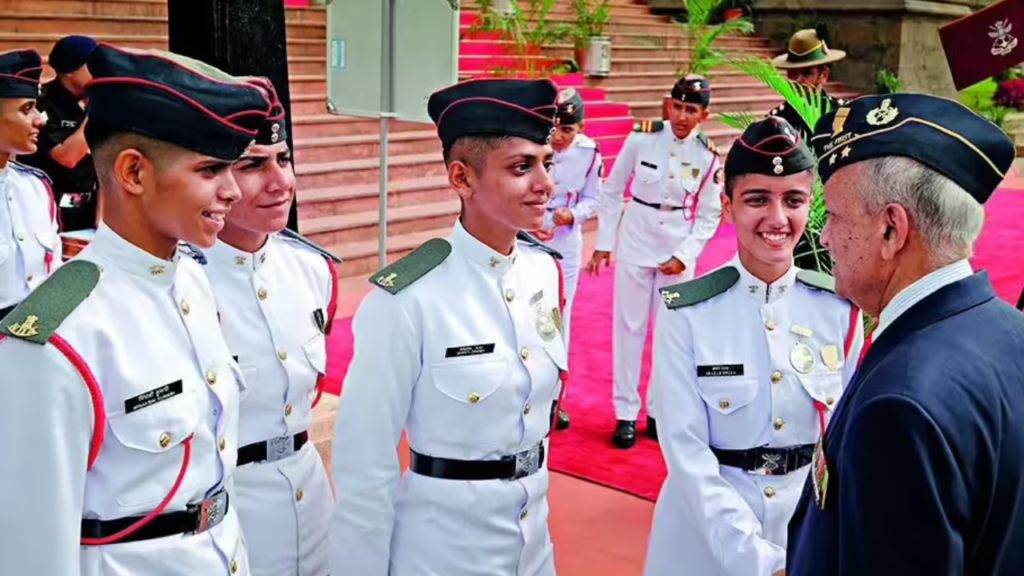
The 17 women who completed the 148th course trained alongside over 300 male counterparts. They undertook the same physical regimen, the same academic programme, the same military drills. Their graduation celebrated as the first co-ed passing-out parade in NDA’s history was not a special event. It was simply an overdue normalisation.
BEYOND SYMBOLISM: WHAT THE DATA SAYS
The Indian Armed Forces have been integrating women into more roles over the past decade. The Officers Training Academy in Gaya, Bihar commissioned 23 women officers in September 2025 up from 18 the previous year. Women have been permitted Permanent Commission in the Army (by Supreme Court order, 2020) and inducted into the military police. The NDA commissioning is not an isolated symbolic act. It is the latest data point in a measurable structural shift.
India’s military currently has one of the lowest proportions of women officers among major democracies. The United States, United Kingdom, and Australia have all crossed 15-20% female officer representation. India remains significantly below that threshold. The NDA commissioning will add to that number slowly, but with institutional permanence.
THE VISION THE SERVICE NEEDS
Gender integration in the armed forces is not a welfare programme. It is a capability question. Diverse leadership teams make better decisions under uncertainty. Diverse intelligence units bring wider analytical lenses. Diverse peacekeeping forces are more effective in civilian engagement. Every major NATO study on gender and military effectiveness has reached the same conclusion: inclusion is not a concession to social pressure. It is a strategic asset.
India’s Ministry of Defence must now act on the principle the Supreme Court established. The NDA must release annual data on women cadet enrolment, attrition, and commissioning. The services must report on the diversity of their officer corps by rank and branch. Tradition is a living thing. The NDA’s finest tradition has now, finally, included half of India.
Clear Cut Gender Desk
New Delhi, UPDATED: June 19, 2026 09:00 IST
Written By: Tanmay Urs