


- India’s youth are facing growing career anxiety as job opportunities remain limited despite higher education, while the employability gap continues to widen.
- The rapid rise of AI, automation, and skills-based hiring has transformed the job market, placing constant pressure on students and young professionals to continuously upskill.
- Career uncertainty is no longer just an employment issue; it has become a broader social challenge linked to mental health, societal expectations, and concerns about future security.
For many years, education has been regarded as the most dependable route to success in India. Families have put their savings into schooling and higher education, believing that having a degree would assure them of stable employment, financial stability, and social advancement. However, this assurance is increasingly being challenged today.
Throughout the country, countless young Indians are facing a rising sense of uncertainty concerning their futures. Students are anxious about whether their degrees will result in job opportunities. Graduates find it difficult to obtain jobs that align with their qualifications. Young professionals feel an ongoing pressure to acquire new skills in order to stay pertinent in a changing job market. What was once seen as individual career anxiety is now becoming a far-reaching social and economic concern.
The issue isn’t insufficient education. Instead, it lies in the widening disparity between education, job readiness, and available opportunities.
A Generation More Educated, Yet More Anxious
India possesses one of the largest youth demographics globally, with nearly 65% of its population under the age of 35. In the last twenty years, access to higher education has significantly increased, leading to millions of graduates entering the job market each year. However, job opportunities have not grown at a similar rate.
The India Employment Report 2024, published by the International Labour Organization (ILO) and the Institute for Human Development (IHD), indicates that educated young people make up a disproportionately high percentage of the unemployed. The report points out that unemployment rates tend to be higher among graduates compared to those with lower educational qualifications.
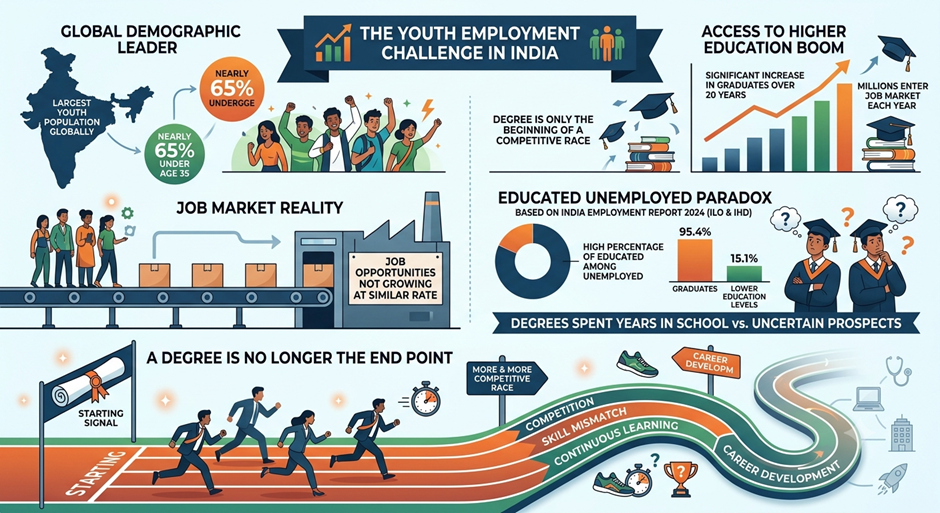
A paradox has been produced by this trend. Despite spending more years in school than ever before, many young people are still unsure of their employment prospects.
A degree is no longer seen as the end point for many students. Rather, it is only the beginning of a race that is becoming more and more competitive.
The Growing Importance of Skills
The increasing focus on talents rather than credentials is one of the biggest shifts in today’s workforce.
Candidates that can solve issues, speak clearly, use digital tools, and adjust to shifting work environments are becoming more and more sought after by employers. While technical proficiency is still crucial, employability is frequently determined by job skills and real-world experience.
This change has revealed a discrepancy between industrial aspirations and academic education.
Only about 55% of graduates are deemed employable by industry standards, according to the India Skills Report 2025. Even while students may have academic knowledge, many companies complain that students lack critical thinking, communication, computer literacy, and practical problem-solving skills.
Young people are therefore always under pressure to improve their skills. In an effort to stay competitive, many people pursue online certifications, internships, coding classes, language training, and professional development programs in addition to a college education.
The AI Revolution and the Fear of Being Left Behind
Industries are changing at a rate never seen before thanks to artificial intelligence. Innovation in technology has opened up new possibilities, but it has also raised new concerns.
An increasing number of tasks that were formerly completed by entry-level workers are becoming automated. According to recent studies, AI is already changing positions in software development, customer support, data processing, content creation, and business operations.
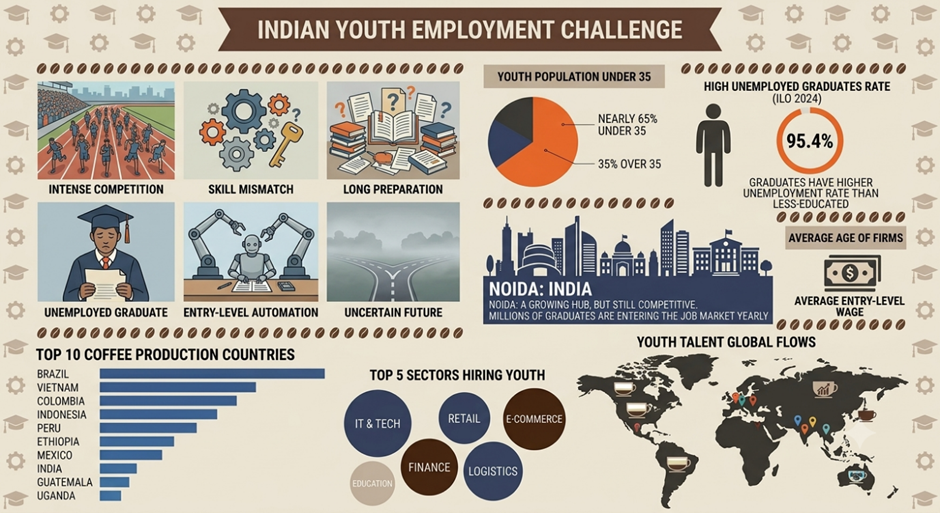
This presents challenging issues for young workers and students. In five years, would their present talents still be useful? Will employment be replaced by technology more quickly than new opportunities arise? Which professions will be safe going forward?
Young Indians are not just getting ready for a career, in contrast to earlier generations. They are getting ready for a labor market that keeps changing in unexpected ways.
Social Media and the Pressure to Succeed
Economic realities are not the only factor contributing to career anxiety. Another significant factor is social media. Social media sites like YouTube, Instagram, and LinkedIn frequently include success stories. Young people come across posts touting high-paying job offers, international university admissions, startup successes, and quick professional advancement on a daily basis.
Social media frequently emphasizes accomplishments while concealing mistakes, setbacks, and years of work that went into them. However, frequent exposure to these success stories promotes comparisons.
A recent graduate getting ready for competitive exams can liken themselves to a software developer employed overseas. When peers announce promotions and career milestones, a young professional with a steady salary may feel inadequate.
The Competitive Examination Trap
Due to job security, benefits, and social prestige, government employment continues to be one of the most sought-after career opportunities for millions of Indians. Millions of applicants vie annually for a small number of jobs in public sector companies, banking, railroads, and government agencies. Many times, candidates prepare for exams for years without knowing if they will pass.
Both the financial and emotional expenses may be high. Aspirants frequently put off starting their careers, put off achieving their personal objectives, and experience recurring cycles of optimism and disappointment. Many young people experience increased stress and worry when a career is linked to a single exam score.
When Career Anxiety Becomes a Public Health Concern
Career insecurity has repercussions that go beyond job outcomes. They are having an increasing impact on mental health.
Long-term unemployment, job insecurity, and financial uncertainty have been linked to increased levels of stress, anxiety, despair, and low self-esteem, according to studies. Young adults who have trouble finding steady work may feel frustrated and alone.
In India, familial expectations frequently exacerbate these pressures. Parents naturally want to see positive results from the substantial resources they invest in their children’s education. Even though these expectations are typically well-meaning, they might increase the emotional strain that young people face when navigating an unpredictable employment market.
Therefore, career anxiety cannot be considered exclusively a problem related to job. Additionally, it is a developing mental health issue that calls for increased focus from companies, educational institutions, and legislators.
Preparing Young Indians for an Uncertain Future
Addressing career anxiety requires more than just creating jobs. It calls for a reevaluation of how the educational and employment sectors prepare young people for the future.
Educational institutions must prioritize fostering industrial ties, encouraging experiential learning, and integrating the development of practical skills into academic courses. Career advice should be a regular part of education rather than an afterthought.
Additionally, employers need to invest in training and opportunities for continuing education. As technology continues to change industries, lifelong learning will become essential for workers at every stage of their careers.
The most important thing is that society must broaden its definition of success. There are nonlinear career pathways. Trying new things, retraining, changing careers, and navigating unpredictable times are all common components of today’s professional development.
The Road Ahead
India’s demographic dividend is one of its greatest opportunities. Because of its largest youth population, the country has the potential to lead the world in innovation, entrepreneurship, and economic growth. However, the challenges that today’s kids encounter must be acknowledged if this promise is to be completely realized.
Career anxiety is not solely a result of personal insecurity. It demonstrates deeper changes in the relationships between opportunity, work, and education. Degrees are still important, but they are no longer sufficient on their own. Although skills are essential, they must constantly evolve. The workplace of the future presents both fresh chances and uncertainties.
India faces more challenges than just preparing young people for their first employment. It is to give them the flexibility, resiliency, and support systems they require to effectively navigate an increasingly complex workplace. In a period of fast change, our ability to learn, adapt, and grow in the future may be more important than our current knowledge.
Clear Cut Edication Desk
New Delhi, UPDATED: June 24, 2026 05:45 IST
Written By: Harsh Gautam
Designation: Senior Research Associate – MLE at Devinsights