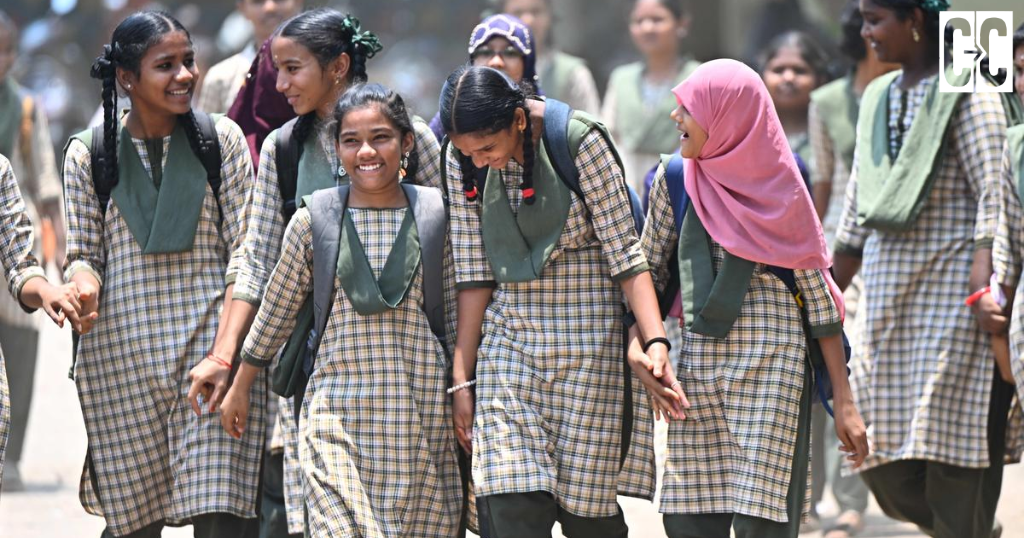
India’s newest health survey data, and why a national gain in girls’ secondary-school completion still depends heavily on where a girl happens to be born.
Nationally, the proportion of Indian women aged 15 – 49 with at least 10 years of schooling, according to the NFHS definition, is a proxy for secondary level – increased from some 41 percent in the 2019-21 NFHS-5 Survey to 46.4 percent in the NFHS-6 Survey (2023–24) that was released on May 29, 2026, by the Health and Family Welfare Ministry. A five percentage-point climb, on an all-India basis, must surely read as good news. More relevantly, it also smooths a geographical disparity that had proved exceptionally difficult until now.
It really isn’t only a matter of academic interest that, statistically speaking, completing “10 years or more” has been one of the better indicators of a woman ever getting married before she hits the age of 18, not marrying a younger boy, and eventually being part of the paid workforce, not to mention participating in household decision-making. This implies the disparity between states, rather than the national gain alone, is indeed the better story.
The existing NFHS-5 survey has already highlighted the farthest extent to which female education has failed to penetrate. Tripura had the lowest proportion of women with over 10 years of education country-wide – just 23.2 percent, with just a slightly wider differential across Bihar, Assam, and Gujarat. At the other end of the scale is Kerala, with 77 percent of women having 10 or more years of schooling.
To understand this gap – 54 percentage points – across states, it can only be comparable with the range that is reflected in a world context – i.e., between average girl lower secondary enrolment, which according to UNESCO for 2024 is projected at 79 percent, and the countries at the bottom, like Mali and Guinea.
As seen in NFHS-6, the gap shows signs of closing in some states but increasing in others. Bihar’s secondary completion for females increased from 28.8 to 33.1 percent, a substantial 4.3-point jump, on the back of Bihar’s Mukhyamantri Balika Cycle Yojana, which provides a cash grant for a bicycle to Class 9 girls since 2006, and its Kanya Utthan Yojana, which provides Rs 10,000 upon passing Class 10 examinations. An independent econometric assessment of the cycle scheme revealed a 27.5 percent increase in the probability that a girl would complete Class 10. At 33.1 percent, Bihar’s figure remains about 13 percentage points short of the national average, illustrating how a state could pick up the pace but fail to close the gap.
Meanwhile, Telangana demonstrates an equally concerning, though of a different variety, gap: one of implementation rather than intention. Between NFHS-4 and NFHS-5, the state’s ten-plus-year schooling figures saw gains among women of only 1.9 percentage points, compared with 6.7 among men, registering as one of the sharpest gender disparities reported in that round. Telangana’s key retention strategy – the network of residential Kasturba Gandhi Balika Vidyalayas (KGBVs) – had more enrolments for girls than any other state, but in December 2025, a government answer in Parliament revealed secondary level retention for the country’s entire KGBV cohort hovering below 50 percent; another, by a state’s financing body, discovered scholarship monies too small to matter and mostly disbursed long after the school year concluded, with countless authorised KGBV places going unoccupied. The infrastructure to accommodate is theoretically in place; the funds and placements don’t reliably reach the young women for whom it was devised.
The one exception worth mentioning is Andhra Pradesh. Its female secondary-completion rate went from 39.6 to 57.9 percent from one survey round to another – some four times more than what Bihar gained – elevating it from below to well above the national average in a single cycle.
Researchers reviewing the NFHS-6 release describe India’s gender gap in schooling as “narrowing” but “substantial,” noting that closing it further would compound into gains beyond education itself — later marriage, better maternal health, greater workforce participation. That compounding logic is exactly why the state-level spread matters more than the national headline. A five-point national gain, distributed this unevenly, still means a girl’s chances of finishing school depend less on her ability than on which state she is born in — on whether a cash transfer arrives on time, a hostel seat is actually filled, or a scheme built to close the gap is funded and staffed at the scale the gap demands. Both Andhra Pradesh’s leap and Telangana’s stall occurred in the same three years and in broadly the same environment. “It is quite clear that they do not fail because there is no policy on paper”, says the senior academic. “They fail when the money, the seats, and follow-through do not arrive with the woman or the child on whose behalf the policy was named and launched”.
Clear Cut Education Desk
New Delhi, UPDATED: July 28, 2026 12:30 IST
Written By: Yatharth Pathak