- India’s higher education enrolment reached a record 4.5 crore in 2023–24, with the Gross Enrolment Ratio (GER) rising to 30% and gender parity continuing to improve.
- Despite this growth, significant inequalities remain in access, disability inclusion, and regional participation, highlighting the need for more equitable higher education opportunities.
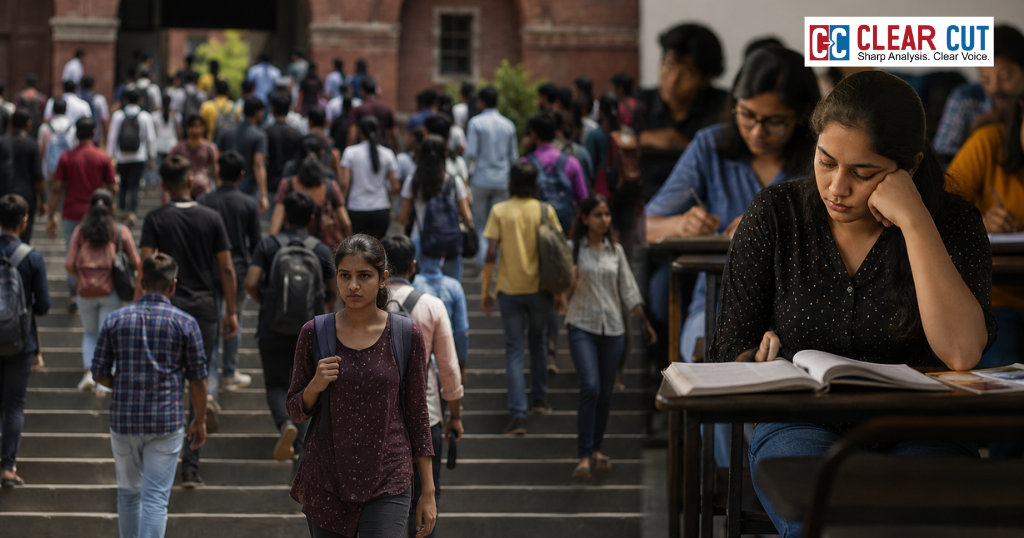
In 2023-24, as many as 4.50 crore students enrolled in India’s higher education sector, as compared to 3.42 crore in 2014-15, as shown by the All India Survey on Higher Education (AISHE) reports for 2022-23 and 2023-24 published on Sunday July 8, 2026 by the Union Ministry of Education. A total of 1,289 universities, 48,246 colleges, and over 15,000 stand-alone institutions make up the sector. The Gross Enrolment Ratio (GER) in the 18-23 age bracket now stands at 30.0 (up from 23.7 in 2014-15), and the Gender Parity Index (GPI) has risen to 1.08, marking the seventh consecutive year it has been on the positive side. While the upward trend lines look valid when compared against global numbers, the questions of who is moving upward and by how much, and whether the country is lagging behind the global average, are complex.
Historical Roots: From Ancient Gurukuls to Modern Expansion
India’s present boom in higher education also draws on the country’s long civilisational heritage. As far back as the 6th and 5th centuries BCE, Taxila (modern-day Pakistan) was one of the world’s earliest established higher educational institutions, drawing students from across Asia to study Medicine, Mathematics, logic and philosophy, Sanskrit, and Vedic sciences. Later, Nalanda University, 5th CE in Bihar, rose as a massive residential global centre with thousands of students and professors from China, Korea, Japan, Tibet, and Central Asia; it possessed one of the largest libraries in the world at the time, and advocated argumentative reasoning, debate, and free interdisciplinary study. These institutions showed that education was perceived as a non-border-conscious undertaking long before the establishment of universities such as Bologna or Oxford in Europe.
India, which was left with only 20-odd universities and fewer than a quarter of a million students in 1947, rapidly established higher education institutions in the post-independence period. This expansion was facilitated by public and private funding and also through major policy interventions, such as the National Education Policy (NEP) 2020. With the introduction of AISHE in 2010-11, India gained the crucial statistical infrastructure to measure and track the rapid growth of its modern higher education system.
Ahead on Growth, Behind on Reach
At 31.5% over the past decade, India’s enrolment growth is significant in Indian terms but remains small on a global stage. For 2024, 269 million globally enrolled in higher education, and the Global Higher Education Global Trends Report by UNESCO, which came out in May 2026, recorded a global GER of 43 percent – 13 points higher than India’s present GER. Regionally, India’s 30.0 is similar to the regional average for South and West Asia, at 30 percent, but far behind Western Europe and North America, where 80 percent of youth attend college. Comparing the country with China, another independent research platform, Data for India, found in the early 2000s that enrolment rates in India and China were similar; in 20 years, 73 percent of youth in China and less than four in ten Indians attend college.
The Gender Crossover
The clearest way India has achieved a degree of global recognition is by closing the gap with men. The Global Gender Parity Index (GPI) has remained above the benchmark of 1.0 for the last seven years. Between 2014-15 and 2023-24, women’s participation in higher education has increased by 42.2 percent, compared with an overall increase of 31.5 percent among all students, signaling a higher participation rate among girls relative to their share of the population. In fact, UNESCO reported that, globally, 114 women per 100 men were enrolled in higher education in 2024, and gender parity was achieved across all regions except sub-Saharan Africa.
The fastest progress was seen in Central and South Asia, including India. The 23-year period for this region, with female enrolment rising from 68 women per 100 men in 2000 to complete parity in 2023, is remarkable. Even in STEM (Science, Technology, Engineering and Mathematics) Education, which used to be male-dominated, women and girls accounted for 44 percent of student enrolment in 2023-24, compared with 38.4 percent in 2014-15.
A Mixed Statement on Equity
The reservation system for the historically disadvantaged communities of society also registered an increase in enrolment: while enrolment for Scheduled Castes grew by 51.4% from 2014-15 and for Scheduled Tribes by 75.7%, the enrolment rate of students of Other Backward Classes rose by 60.2%, and the total enrolment of students from Scheduled Castes and Scheduled Tribes (as measured by the Gross Enrolment Ratio or GER) increased by roughly nine points in each case. Brazil has a more recent and similar experiment with affirmative action. Under a law passed in 2012 that reserved 50% of places in public universities for public-school graduates, low-income candidates, and Black and Brown students, by 2019, Black and Brown students constituted roughly half the population of public higher-education institutions, and more than one million students were enrolled under the quota law between 2012 and 2021.
Some segments of the Indian population represented in the data did not perform the same way.
The number of students with a benchmark disability enrolled dropped from 88,816 in 2022-23 to 54,080 in 2023-24 – a decrease of almost 40%. But while most categories showed an increase in student enrolment over the years, the UNESCO report points out that institutional participation is voluntary. Thus, caution must be exercised when interpreting yearly data. It is this sort of disparity in opportunities, as UNESCO Director-General Khaled El-Enany remarked upon the publication of the global report, that while “there has been a global expansion in demand for higher education … That demand does not always translate into equitable opportunities.”
Who Is Building the Expansion
India’s college-level enrolment now stands largely in private colleges – nearly 71 percent compared to a worldwide average share of a third – and at a level similar to countries like Chile, Japan, South Korea, and Brazil, where four out of every five college-going students’ study privately. India had 58,134 international students from 173 countries in 2023-24, with Nepal as the largest contributor to this figure – an indicator that the country’s educational expansion is being watched and utilized outside India as well. How much of this growth is absorbed by private entities, especially as the enrolment reaches the international average level, and at what price, could be a defining factor in AISHE trends over the next decade, not unlike policy.
Clear Cut Education Desk
New Delhi, UPDATED: July 13, 2026 15:28 IST
Written By: Yatharth Pathak