

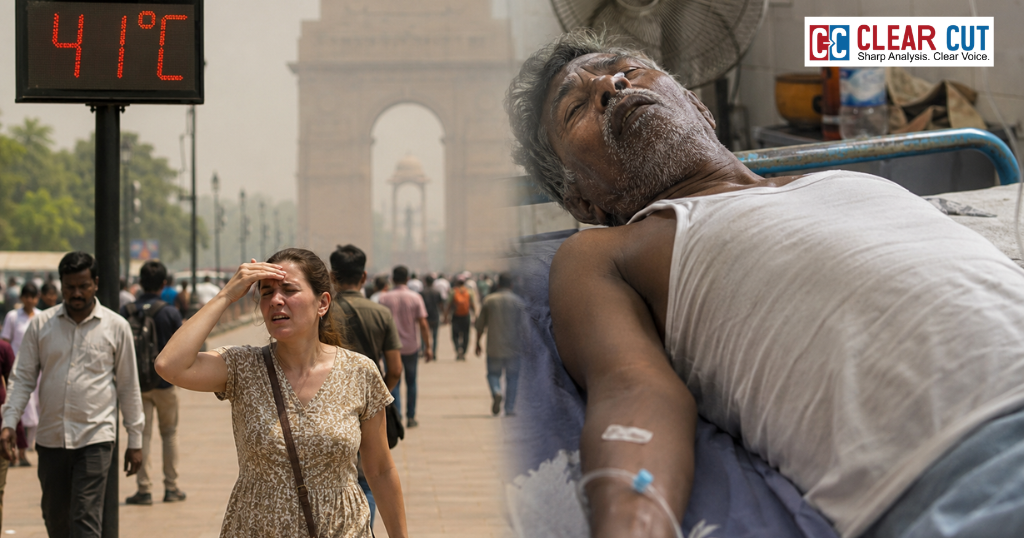
- Western Europe experienced its hottest June on record, while India faced an intense 2026 heatwave, highlighting how climate change is driving more frequent and deadly extreme heat events.
- The WHO has introduced updated Heat-Health Action Plan guidelines to help governments strengthen early warning systems, protect vulnerable populations, and improve healthcare preparedness against heat-related risks.
- India’s Ahmedabad Heat Action Plan offers a proven model, but experts stress that stronger implementation, funding, and protection for outdoor workers are essential to reduce preventable heat-related deaths.
Western Europe registered its hottest June on record as heat-breaking weather smashed national temperature records across several European nations within days this summer. Temperatures in Denmark topped 37C – beating a previous high that has stood since 1975 – as 39.4C in the Netherlands on June 26 set a new national high, and Bilbao in Spain saw a record high of 42.7C. The heatwave was triggered by record-breaking sea-surface temperatures in June, which intensified atmospheric heat, according to the WMO.
“Heatwaves like this are what we expect to see in a changing climate,” John Kennedy, WMO’s chief of climate information, told reporters.
“Europe has heated by approximately 2°C compared to the equivalent heatwave event in 1976, and Europe is heating up more rapidly than anywhere else on earth.”
Over 200,000 people have been killed by heat-related illness over the last four years, says the World Health Organization (WHO), an “overwhelmingly” preventable loss of life. Around the globe, “extreme heat caused on average 489,000 deaths annually between 2000 and 2019, mainly the elderly, outdoor workers, and those lacking reliable access to cooling”, according to the WMO. Public health experts are already calling it a “silent killer” because heat-related fatalities often pass under the radar and are instead attributed to heart or respiratory conditions.
To fight back, the WHO’s European regional office published a new set of updated guidance this month-the first major revision of the global “Heat-Health Action Plan” since 2008-that offers an eight-pillar framework, spanning the implementation of early warning systems to the identification of populations at risk to the strengthening of health-care system readiness.

It aims to “get governments from mere awareness to an action,” says WHO program manager Oliver Schmoll, but most nations don’t yet have such a plan in place. The new guidance, designed to be portable beyond Europe, makes an important point: “what works in a Mediterranean city is not automatically what works” in a South Asian monsoon environment or sub-Saharan climate, as the WHO-WMO Climate and Health Joint Program’s Joy Shumake-Guillemot states, which means it is directly relevant to India.
South Asia’s Harsher Arithmetic
India’s 2026 heat season broke early and stayed hot. Sri Ganganagar in Rajasthan recorded 48.2 °C on 27 May, the highest in the world that day. By the time it reached its peak, 50 of the world’s hottest cities were in India, 26 in Uttar Pradesh. That one day of extreme heat resulted in an estimated 3,400 excess deaths nationwide, rising to nearly 30,000 during a five-day heat wave, with the bulk of them (8,100) in Uttar Pradesh, according to this year’s study in Frontiers in Environmental Health. Just the previous month, a heat-related death toll in Pakistan’s Karachi rose to ten amid the same pre-monsoon wave that took at least 37 lives in India. It serves as a potent reminder that this crisis affects a region of 1.7 billion, not just one country.
Yet these are numbers and predictions, not direct measurements. Even Telangana’s 2026 Heatwave Action Plan has only 10 heat deaths predicted for 2024 – a figure much lower than the National Crime Records Bureau’s count of 116 heatstroke deaths in Telangana in the same year. Abhiyant Tiwari, an expert on heat health and climate resilience based in Delhi, says, “The data collated from multiple sources accounts only for deaths occurring due to heatstroke and not those occurring due to heat.” Those undercounted are people working outside, daily-wage agricultural laborers, laborers on construction sites, and vendors at roadside markets, all of whom can ill afford to lose a day’s wage.
An Ahmedabad Blueprint
India’s highest-cited answer predates WHO’s new guidelines by over a decade. After more than 1,300 deaths from a May 2010 heatwave in Ahmedabad during a single month, city officials partnered with the Indian Institute of Public Health and the Natural Resources Defense Council to inaugurate South Asia’s first Heat Action Plan in 2013, which coordinated heat alerts, provided publicly cooled areas, and banned outdoor labor during peak hours. “We were believing in adaptation and accustomed to the heat before us. The mortality data proved them wrong,” says Dr. Dileep Mavalankar, one of the designers of the plan, about a belief widespread before the initiative’s implementation. The strategy has been extended to more than 130 cities and districts in 23 states as part of a National Disaster Management Authority plan. Yet, many of these efforts “mostly stay in writing, don’t come with funding, and have weak enforcement mechanisms,” several media reports have pointed out. And at the core of the stories that link a heatwave victims’ ward in Bilbao and another in Rajasthan is one truth: death from heat comes without a shout or an obvious siren, touches many varied populations, and can, to a great extent, be prevented. Since less than 8 percent of Indian homes currently have an air conditioning unit, both the WHO’s recently published guidelines and Ahmedabad’s 10-year-old plan leave behind the question of whether these approaches are useful, and rather more pointedly, who is first to benefit from their effectiveness.
Clear Cut Climate Desk
New Delhi, UPDATED: July 13, 2026 09:00 IST
Written By: Yatharth Pathak
Thanks for climate related story, “The Silent Killer”. Please also read my cover article as published in “TerraGreen” titled, “Geopolitics of Heatwave”. You can find the complete article by logging: https://www.facebook.com/dr.anil.p.singh/posts/pfbid0fQ3pJ2JjG6BBRi4cbjNfiMfSLwvL7zPrdzEqxGDaDyzDFvdbW8UwaxAoE8VCkMEHl
Best,
Dr. Anil Pratap Singh
globalaps@rediffmail.com
Hi Dr. Anil Pratap Singh,
Thank you for reading the article and for your kind words! I appreciate you sharing your perspective on the topic.
I’ll take a look at your piece on the “Geopolitics of Heatwave” in TerraGreen. Thanks for the link.