


- Recent food poisoning outbreaks and food adulteration cases reveal persistent gaps in India’s food safety system, highlighting weaknesses in surveillance, enforcement, and institutional food hygiene.
- Strengthening laboratory capacity, real-time monitoring, stricter enforcement, and better coordination between health agencies is essential to prevent recurring outbreaks and protect public health.
- Improved food labelling, consumer awareness, and proactive regulation can build a safer, more transparent, and resilient food safety ecosystem across India.
India’s food safety situation is at a crossroads. This regulatory architecture has been constructed over almost two decades and is supported by the Food Safety and Standards Authority of India (FSSAI), but is that it is being enforced on par with the scale and complexity of India’s food system, or are there a slew of outbreaks, food adulteration scandals and institutional feeding failures that indicate otherwise? A review of recent events shows that the same structural gaps exist and that there are reforms to be put in place that will help bridge the gap between regulatory intent and public health impact.
A Pattern of Recurring Outbreaks
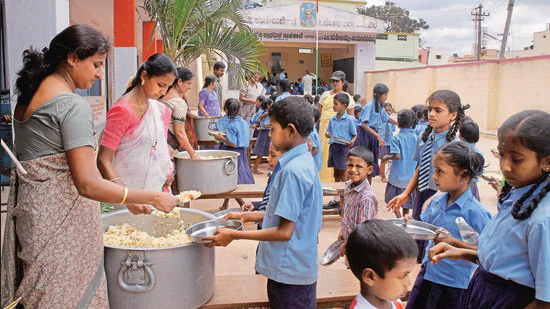
The government data before Parliament, linking the district, state, and class, indicates that 674 school children across six states have been affected by contaminated mid-day meals under the PM Poshan Scheme in the last five years, including Bihar, Delhi, Odisha, Rajasthan, Uttar Pradesh and West Bengal. The issue of reoccurrence of such incidents under a scheme covering about 11 crore children in over 10 lakh schools highlights the challenge of ensuring basic food hygiene even within a well-funded and centrally monitored programme. The incident in Kalol, Gujarat, where 40 students and teachers became ill after consuming a school feeding programme is a microcosm of the failures of the government to provide safe and nutritious foods in its institutional food services.
The institutional outbreaks are reminiscent of the worst incident the country has seen in school feeding, when 23 children died in 2013 after eating food tainted with an organophosphate pesticide residue from cooking oil stored in a container that had previously contained pesticide. Over a decade later, it’s clear that the lessons from that tragedy have not been fully understood by everyone and similar, but smaller, outbreaks continue to emerge from schools, weddings and street vendors as well as community feasts.
Adulteration is also endemic in staple commodities, outside of institutional settings. The Tirupati ghee scandal of 2025 uncovered loopholes even in prestigious value chains that deliver ghee to the Tirumala Tirupati Devasthanams over the years, when the license holder’s ghee license was suspended after allegations of its adulteration with foreign fats over five years. The situation is not as good with milk, which is consumed daily by hundreds of millions, national surveys have found high volumes of samples that fail quality tests, often because they are diluted, contain detergents or urea or other contaminants, and more recently reports of a milk adulteration racket in Mumbai’s Andheri West where branded milk is mixed with urea and refined oil to increase volume. Academic surveillance data from 2008-2018 also showed outbreaks are concentrated in the states of West Bengal, Karnataka and Gujarat and over 50% of affected people experience their illness between March and July, suggesting a significant seasonal / heat related component to foodborne disease burdens in the country.
This seasonal phenomenon was very pronounced in April 2026, when a wedding feast in Abhlod village of Dahod district, Gujarat infected over 400 people with abdominal pain, vomiting, and diarrhoea, of which more than 40 had to be hospitalized at Zydus hospital. In the initial investigation, the authorities suspected that it was a milk-based dessert or contaminated water as dairy products like mawa, paneer and cream go bad quickly during the peak summer season if they are not refrigerated properly. FSSAI took active involvement on its own and requested a detailed report from the state government and sent its officials to help with the investigation and Gujarat’s Food and Drug Control Administration launched an investigation drive in the state. Remarkably, the Dahod wedding had not been a one-off incident but was one of several such incidents in the state that same week – 60 people became ill after eating ‘farali’ food at a temple in Mehsana, 25 students who had stayed in a hostel in Surat reported food poisoning symptoms and families fell ill after eating sweets from a popular local brand in Ahmedabad. There was also a suggestion of a trend in near 60 students at a residential school in Dahod having suffered from a similar outbreak last year, laced with near-inevitable causes which included bulk food preparation, poor cold chain and lack of hygiene monitoring during the wedding and festival season, which local reporting highlighted.
Where the System Falls Short
A number of structural flaws reappear in these episodes. Firstly, there is a lack of surveillance. There is a decentralised reporting system in India, Integrated Disease Surveillance Programme (IDSP), but much of the data reported by the suspects, paramedical personnel and medical officers are not readily available for policy action, and many mild or rural cases are not reported, according to researchers, leading to underestimation of the true burden.
Second, enforcement has tended to be reactive, instead of being proactive. The leadership of FSSAI itself have admitted the disconnect between the priorities and outcomes and have talked about resilient, transparent, and future-ready food systems, and have urged states to ensure more robust grievance redressal and daily reports of enforcement. However, critics note that the same infractions are being detected year after year like milk adulteration, which makes it unclear if testing is effective over the years; it is also not clear whether penalties are effective at curbing repeat offenders.
Third, transparency and front of pack labelling reform have been sluggish. FSSAI has been criticized for failing to make any progress on its directive of introducing clear warning labels on packaged foods with high levels of fat, sugar and salt, and procedural and trade-related objections have been raised multiple times. This contrasts with European Food Safety Authority’s precautionary principle, which limits the use of additives when there is scientific uncertainty and requires farm-to-fork traceability.
Steps Toward a Stronger Ecosystem
There have been some recent institutional responses which indicate the right direction, but not sufficient. FSSAI has stepped up inspection drives, like sending 100 percent inspection missions to packaged drinking water units in Maharashtra and has introduced consumer-friendly digital tools such as a mobile app for reporting misleading claims on labels, and the Food Safety Connect App, which is now mandatory for food businesses to display through QR code at customer-facing points. In September 2025, the agency also hosted a Global Food Regulators Summit in New Delhi to share experiences and learn from each other’s practices for enhancing the food safety system across the food supply chain.

Further enhancement of this ecosystem might well require action on multiple fronts. There is a need for greater interoperability between IDSP and hospital reporting systems and state health departments, where possible, with mobile reporting of informal and rural incidents. Laboratory capacity, particularly at the district level, must be increased to ensure detection and tracing of contamination before large-scale distribution, before clusters of illnesses appear. Enforcement should be backed by stepped up – but serious – penalties for repeat offenders in areas with informal supply chains, including dairy, edible oil and street food, where it is more difficult to trace. For institutional feeding programmes like PM Poshan, there is a need for real-time monitoring of temperature and hygiene at the cooking point and not after the samples are sent to the lab for periodic testing. Last but not least, front-of-pack labelling changes consistent with the Supreme Court’s guidance would empower consumers to make informed decisions without leaving enforcement laggards.
Conclusion
The most important issue of food safety in India is not a shortage of regulation but rather a failure of regulation to cope with the large, diverse, and rapidly changing food economy. Recurrence of institutional feeding failures, seasonality of outbreak clusters and staple food adulteration alludes to the lack of surveillance, deterrence and transparency, not to lack of intent. Addressing these gaps will rely not so much on new laws, but on ongoing investments in laboratory capacity, live surveillance at the place of food preparation, and effective enforcement with bite, and in making a point of each outbreak not repeat the comas of the so-far endless sequence.
Clear Cut WASH Desk
New Delhi, UPDATED: July 14, 2026 09:00 IST
Written By: Subhanshu