

- Akshaya Patra has served 5 billion meals to school children, growing from 1,500 children in Bengaluru to 2.35 million children across 16 states and 3 UTs.
- Its mid-day meal, Anganwadi feeding and scholarship programmes aim to tackle child hunger, improve school attendance and support better learning outcomes.
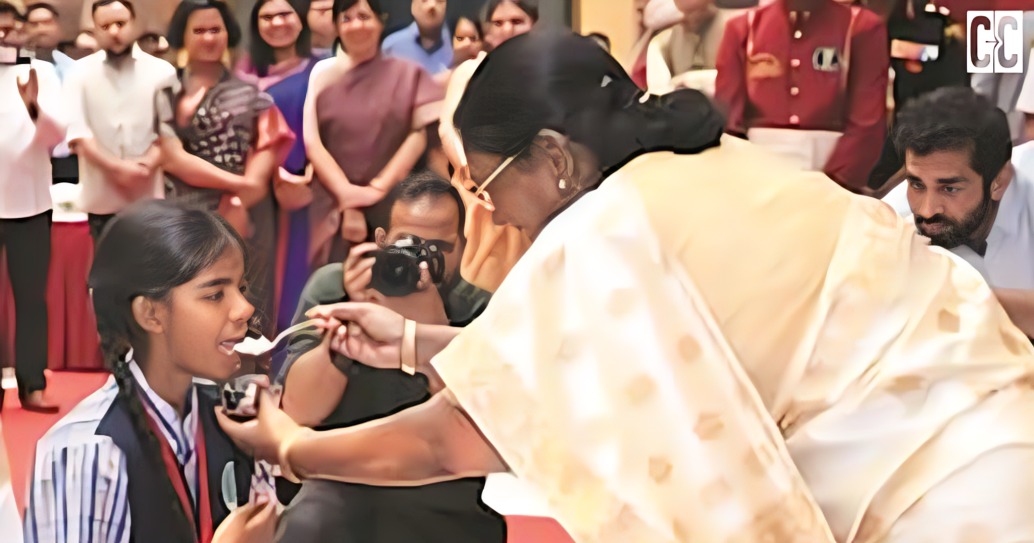
On 17th March 2026, President Droupadi Murmu arrived at Rashtrapati Bhavan for an unusual ceremony. She was there to mark a number: 5 billion. The Akshaya Patra Foundation has served many mid-day meals to schoolchildren since its founding in Bengaluru in 2000, 1,500 children, 5 schools, and 1 kitchen. The journey has travelled from 1,500 to 2.35 million; from 1 city to 16 states and 3 UTs, from 5 schools to over 25,000. It is a very methodical story of scale-up in Indian civil society. It is also a story about what it takes to keep a hungry child in school.

From 1,500 to 2.35 Million: The Architecture of Scale
Akshaya Patra’s growth has been anchored by a model it calls centralised, industrialised cooking. It uses mechanised processes to prepare tens of thousands of meals with high hygiene standards, then deliver them to schools in insulated containers before mid-morning. In 2003, it became the first NGO in India to enter a formal Public-Private Partnership under the government’s school feeding programme. That partnership, now formalised under the PM POSHAN initiative, allows the Foundation to co-implement at scale while maintaining independent operational management. The result is a production line for nutrition that currently sends hot, freshly cooked meals to over 2.35 million children every single school day.
Why the Meal Matters Beyond the Plate
Peer-reviewed and 3rd-party studies consistently show that mid-day meals reduce absenteeism, improve concentration and keep children enrolled for years. In rural and tribal communities, the mid-day meal is often the most nutritious meal a child receives all day. In some cases, it is the only guaranteed meal. Akshaya Patra also runs a morning nutrition snack programme in select locations. It gives children a healthy start before the mid-day meal itself, reinforcing the principle that a hungry child cannot learn, regardless of how good the teacher or classroom is.
25 Years and a Milestone Rooted in Accountability
November 2025 marked the Foundation’s 25th anniversary. Its own tracking shows a cumulative timeline of milestones that reads like a lesson in institutional patience: 500 million meals by 2009, 1 billion by 2012, 2 billion by 2016, 3 billion, then 4 billion in subsequent years, and 5 billion by March 2026. Each milestone required not just funding but operational excellence, because cooking 2.35 million meals a day and delivering them hot, across geographies that include urban slums, semi-urban towns and deeply rural blocks, is a logistics challenge comparable to running a mid-sized food manufacturing company, except that the product must arrive perfectly every single school morning.
Anganwadis, Scholarships and the Next Frontier
Beyond its flagship mid-day meal work, the Foundation runs an Anganwadi Feeding Programme that reaches over 150,000 young children with daily nutritious meals, and a Scholarship Support Programme for older students. Its stated ambition is to expand its reach further, targeting coverage in states and districts where public school feeding infrastructure is weakest. In an era when India’s NFHS data still shows persistent stunting among young children in its poorest states, the Foundation’s kitchen network represents not just a welfare service but one of the country’s most scalable pre-emptive nutrition interventions.
The Way Forward
Five billion meals are a number that deserves to be held against a specific policy failure it is quietly compensating for: India still has 58 million children who go to school hungry, according to Akshaya Patra’s own estimates. The Foundation’s partnership with the government has kept millions of children in school who would otherwise have drifted out. But a 25-year-old NGO should not be the primary institution standing between a child and daily hunger. The Union and state governments should treat the PM POSHAN programme’s current coverage gap as a public health emergency. It should fund and track it as rigorously as they track immunisation coverage, with district-level data, public accountability and zero tolerance for schools where the meal does not arrive.
Clear Cut Education Desk
New Delhi, UPDATED: September 15, 2026 13:00 IST
Written By: Tanmay J. Urs