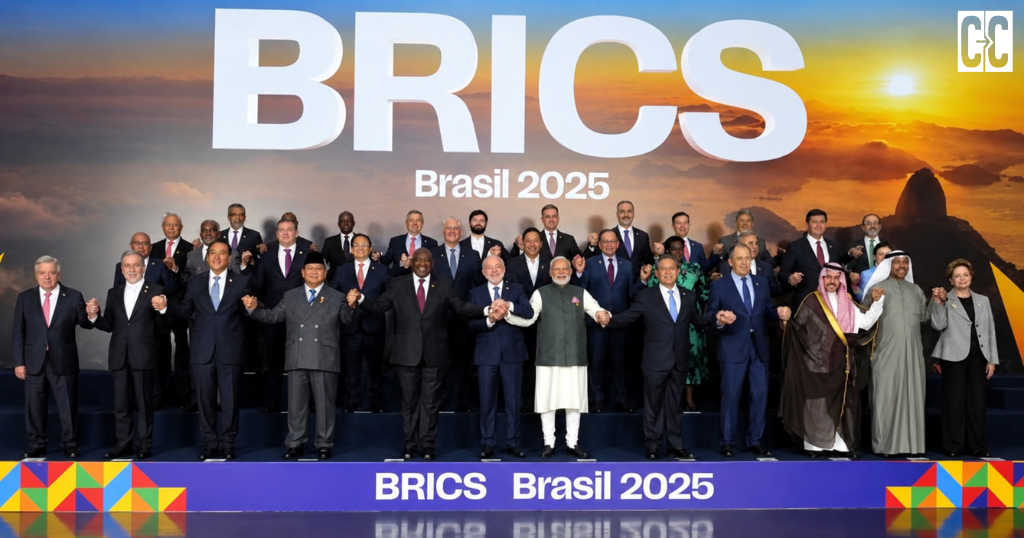
On September 12, 2026, at the Bharat Mandapam in New Delhi, the leaders of the eleven-member BRICS grouping adopted, by consensus, a 140-paragraph document titled “Building for Resilience, Innovation, Cooperation and Sustainability,” known as the New Delhi Declaration. Published at the end of the 18th BRICS Summit, hosted by India, it is the grouping’s most comprehensive declaration, and its main economic call is straightforward: reconfigure international financial institutions to reflect the importance now inherent in developing economies.

The bloc has grown well beyond its founding five — Brazil, Russia, India, China and South Africa now sit alongside Egypt, Ethiopia, Indonesia, Iran, Saudi Arabia and the UAE. Together they account for nearly half the world’s population and, measured at purchasing power parity, more than 40 percent of global GDP, compared with roughly 28 percent for the G7. Voting power inside the IMF and World Bank has not moved at the same pace, and closing that gap is what the declaration’s finance sections are built around.
On the IMF, the declaration urges that quota increases agreed under the Fund’s 16th General Review take effect “with no further delay,” and calls for a 17th review that shifts voting shares toward emerging economies while protecting the poorest members’ shares. It also presses for a “merit-based, inclusive and transparent” process for choosing the leadership of the IMF and the World Bank — an implicit challenge to the decades-old convention of an American at the Bank and a European at the Fund. At the World Bank, BRICS supports the 2025 Shareholding Review to correct decades of underrepresentation of developing countries.
Those numbers matter beyond diplomatic optics. Quota share determines a country’s voting weight, its access to IMF lending on favourable terms, and its allocation of Special Drawing Rights, the Fund’s own reserve asset. For economies that borrow on tougher terms than wealthier ones, a genuine quota realignment would mean more usable capital for infrastructure, healthcare and climate adaptation — not just a larger seat at the table.
The declaration applies the same logic to trade. It voices concern over the spread of unilateral tariffs and non-tariff barriers that it says conflict with WTO rules, and separately condemns coercive economic sanctions imposed without UN Security Council authorisation, warning of their “far-reaching negative implications” for health, food security and development in the countries they target. It also calls for restoring the WTO’s two-tier dispute settlement mechanism, which has been unable to hear final appeals since the United States began blocking new judge appointments in 2019.
Innovation is the declaration’s other through line. It frames artificial intelligence as both an opportunity and a governance challenge for developing countries, calling for inclusive access to AI resources and greater representation of the Global South in setting AI rules — an acknowledgement that computing power and training data are as unevenly distributed as IMF votes. The New Development Bank, the bloc’s own lender, was described as entering a “second golden decade” with a mandate to expand local-currency financing for infrastructure, an alternative funding route that bypasses the conditions attached to traditional Bretton Woods lending.
Whether the declaration’s language converts into real institutional change is a separate question. Praveen Donthi, senior analyst at the International Crisis Group, said expectations going into the summit were modest given the bloc’s internal divergences, and that members invested in BRICS’s survival as a non-Western platform would be “reasonably satisfied with the modest outcome.” That outcome was not guaranteed: a May 2026 meeting of BRICS foreign ministers broke up without a joint statement after Iran and the UAE could not agree on language addressing the West Asia conflict, and the New Delhi text required marathon negotiations, with India, as host and chair, working to bridge the two positions.
Alongside its economic agenda, the declaration also condemns the 2025 Pahalgam terror attack in the strongest terms and reaffirms zero tolerance for cross-border terrorism regardless of who commits it — one of the few places where the text names a specific incident rather than speaking in general terms. On its central economic ask, though, the language is less novel: similar calls for Bretton Woods reform have appeared in BRICS statements for more than a decade, including the Rio de Janeiro Vision and the New Delhi text that explicitly reaffirms. Whether this round produces a different outcome depends on negotiations still to come inside the IMF and World Bank — institutions that the declaration itself does not control.
Clear Cut Research Desk
New Delhi, UPDATED: September 15, 2026 19:30 IST
Written By: Yatharth Pathak