
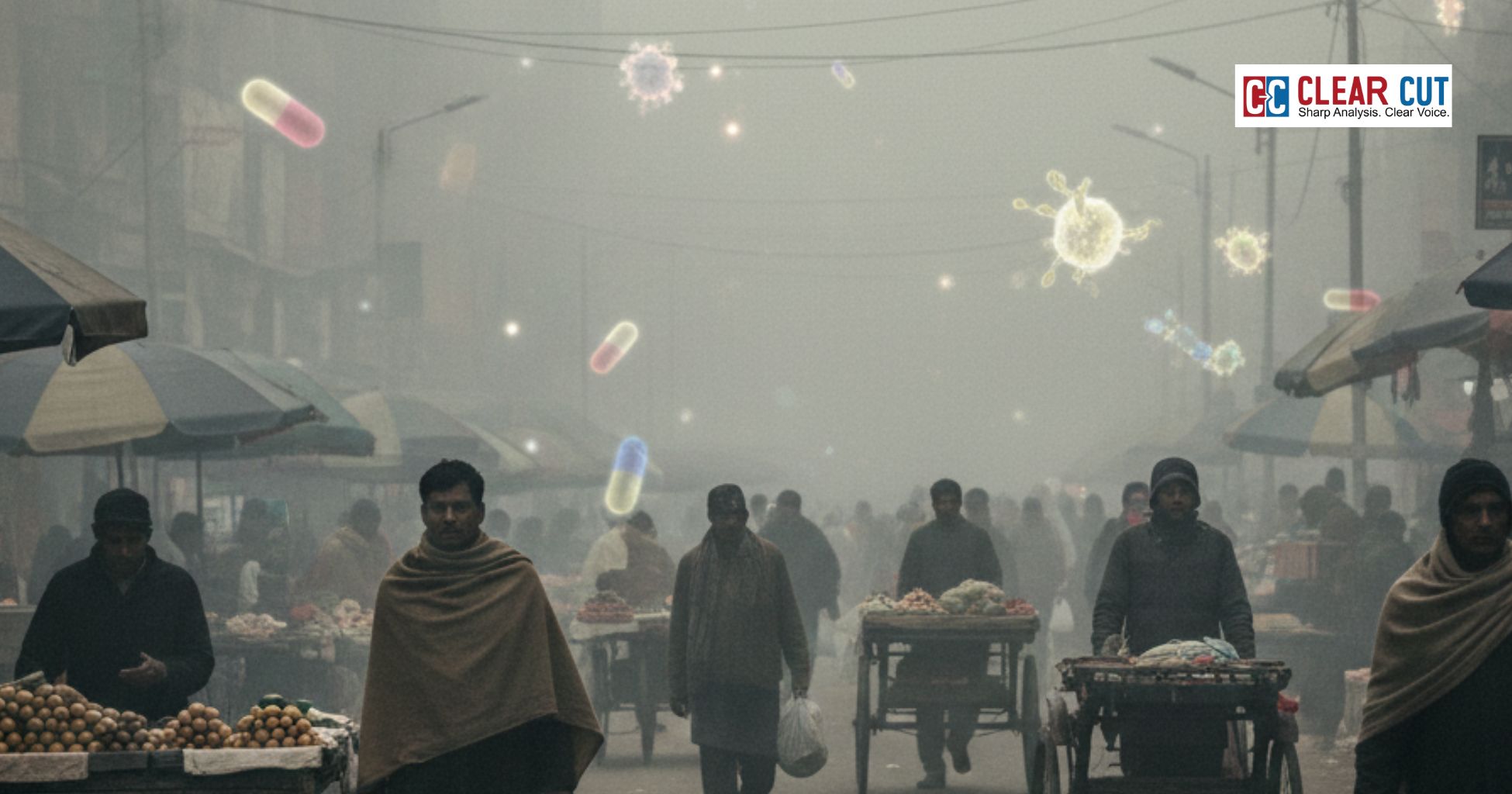
Delhi’s winter air already comes with a familiar sting. Burning eyes. Tight chests. A cough that lingers longer than it should.
Now add one more invisible passenger. Antibiotic-resistant bacteria.
A new study by researchers from Jawaharlal Nehru University, published in Scientific Reports (Nature Portfolio) on December 3, has found high loads of airborne staphylococci across multiple Delhi locations, indoors and outdoors, along with worrying patterns of methicillin resistance and multidrug resistance.
Many outlets have reported it as a “superbug in toxic air” story. That is true. But it is also incomplete.
Because the most unsettling question is not just medical. It is economic. And social.
Not everyone inhales the same Delhi
The study sampled air from four urban settings in south Delhi: an urban slum (Vasant Vihar area), a market complex, an apartment setting, and a sewage treatment plant area.
The highest staphylococcal loads appeared in crowded spaces, especially during winter.
This detail is crucial as the crowded markets are not just places of commerce. This is a place that provides livelihood to many including vendors, delivery workers, sanitation staff, security guards, gig workers, and daily-wage earners who spend long hours there. They are often without masks. Often with existing exposure to dust and smoke. Often with limited access to early care.
If antibiotic resistance is increasingly becoming part of the air ecosystem, then it will not hit “Delhi” equally. It will hit the Delhi that works outdoors first.
What the researchers actually found
The study reports staphylococcal loads that exceed a WHO-referenced limit of 1000 CFU/m³, with peaks far above that, especially in winter.
More importantly, it found a meaningful slice of isolates that were methicillin-resistant, and among confirmed methicillin-resistant staphylococci, a large share showed multidrug resistance.
The study also notes that winter conditions in Delhi—poor dispersion, higher particulate matter—may help bacteria persist and travel.
In plain terms: dirty air is not only bad for lungs. It may also act like a vehicle.
The real “superbug” story is about everyday infections
When people hear “antibiotic resistance,” they imagine rare hospital outbreaks.
But the Prime Minister, Narendra Modi recently framed it differently in Mann Ki Baat , warning against casual antibiotic use and citing concerns that antibiotics are becoming less effective for infections like pneumonia and UTIs.
Now place that reality inside Delhi’s winter. Hospitals have repeatedly warned about spikes in respiratory patients when air quality worsens.
This is where the JNU study shifts from “science headline” to “city crisis.” If polluted winter air increases respiratory illness burden, and if resistant bacteria circulate more widely, Delhi may be walking into a loop: more infections, more antibiotic use, more resistance, more treatment failure.
The economic angle most coverage missed
Antibiotic resistance is expensive. Not only for governments, but for families too.
When first-line medicines fail, treatment becomes longer and costlier. People miss work. Caregivers miss work. Children miss school. The poor feel it faster because their safety nets are thinner. And Delhi is a city where “missing work” is not a minor inconvenience. For many, it is a direct income shock.
A market vendor does not get paid sick leave. A delivery worker does not get paid for staying home. A domestic worker risks losing employment if she takes too many days off. A construction worker cannot “work from home.”
So, when resistant infections rise, the harm spreads beyond health. It hits productivity. Household savings. Nutrition. Debt.
Even the setting matters. The study’s sampling includes crowded market areas and a slum environment. These are the places where baseline vulnerability is higher and where exposure can be chronic.
That is the socio-economic punchline: AMR becomes another inequality amplifier.
Air, antibiotics, and the aftertaste of Covid
One of the study’s sharp observations is resistance to macrolides like azithromycin, which it links to increased usage during the Covid-19 period.
This is uncomfortable, but necessary, to acknowledge. Covid normalised “just in case” antibiotics in many places. It also normalised self-medication, WhatsApp prescriptions, and pharmacy-first care.
That behaviour did not disappear with the pandemic. It simply blended into routine.
So, Delhi may now be facing a double exposure: the biological residue of antibiotic overuse, and the environmental conditions that allow microbes to travel.
What should a citizen do with this information?
This is where most stories become preachy. They should not.
The residents are not irresponsible by default. People self-medicate because healthcare is costly, time-consuming, and hard to access quickly. People buy antibiotics because diagnostics are not always available or affordable. People stop a course midway because they feel better, or because they need to use money for other priorities. So, the answer cannot be just “be responsible.” It must be systemic.
Still, a few practical points are worth stating plainly:
- Stop treating antibiotics like fever tablets. The PM’s warning is important and directionally right: antibiotics are not a shortcut.
- Demand diagnosis when infection is recurrent or severe. A test can feel expensive. But repeated failure is often more expensive.
- Treat clean air as infection prevention. Air quality policy is not only climate policy. It is also healthcare policy.
The policy shift Delhi needs
The study itself calls for environmental AMR surveillance and not just hospital surveillance. That is a serious idea. Because today, we track AQI obsessively, but we do not track the microbial and resistance load of that air. Not in a way that shapes public health planning.
If Delhi can publish daily AQI alerts, it can also build a system that monitors environmental AMR hotspots. Especially for crowded markets, transport hubs, waste zones, high footfall public spaces. The same can be linked with health advisories, sanitation design, ventilation upgrades, and antibiotic stewardship campaigns.
It is better to be prepared than to panic. Because if antibiotic resistance becomes part of what Delhi breathes each winter, then the cost will not be counted only in ICU beds. It will be counted in catastrophic health expenditures, missed wages and depleted savings.
Clear Cut Health Desk
New Delhi, UPDATED: Jan 03, 2026 03 :17 IST
Written By: Paresh Kumar