
On World Environment Day 2026, India designated its 100th Ramsar wetland site. The Prime Minister praised it as a milestone. One of the sites added the same year had already been flagged for encroachment. This is the story of what a Ramsar tag actually does and what it conspicuously does not.
India Has 100 Ramsar Sites. Are Our Wetlands Really Safer?
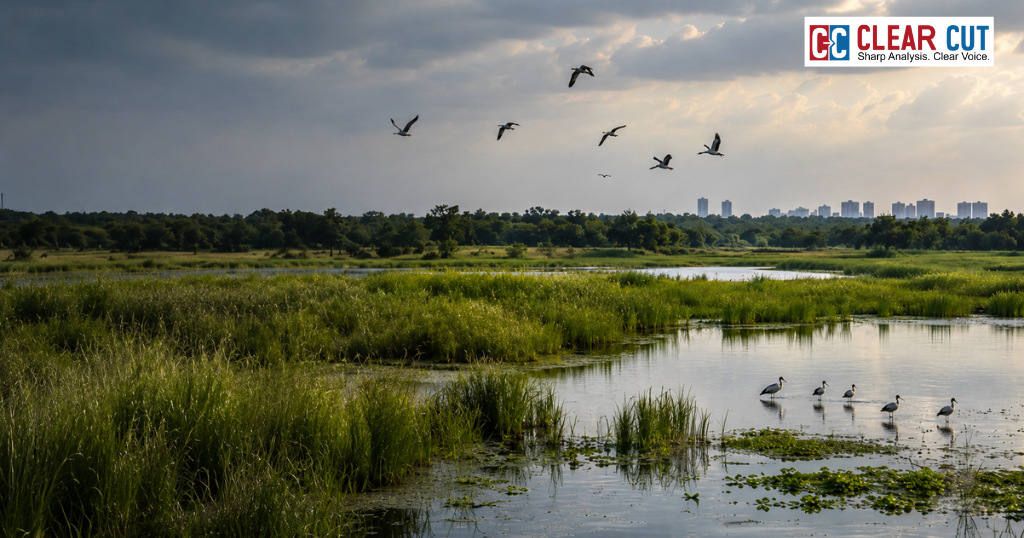
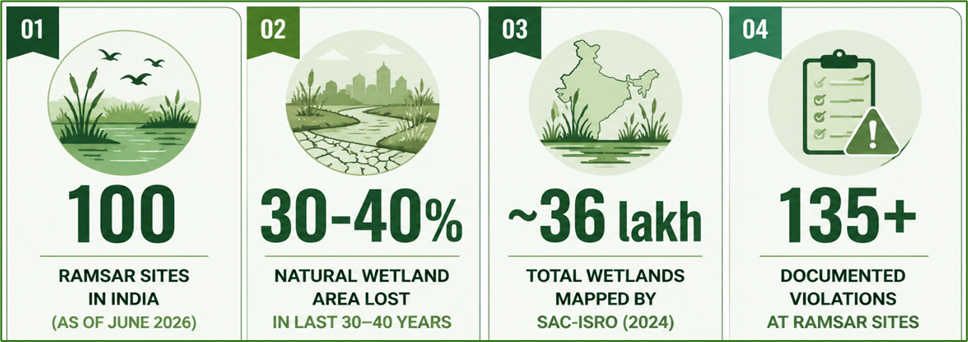
On 5 June 2026, World Environment Day, the Prime Minister of India announced that the Jai Prakash Narayan Bird Sanctuary Surha Tal, a 34-square-kilometre oxbow lake in Ballia district, Uttar Pradesh had been designated India’s 100th Ramsar site. India now has more internationally recognised wetlands than any country in Asia and ranks third globally, behind only the United Kingdom and Mexico.
The announcement was framed as a conservation milestone. Within days, the South Asia Network on Dams, Rivers and People published a report headlined: “Ramsar Milestone Masks Deepening Wetland Crisis in India.”
Both things are true. India’s tally of internationally recognised wetlands has grown faster in the past five years than in the previous three decades. And Surha Tal itself the landmark 100th site had been documented by SANDRP in a 2022 blog for facing active government-led encroachment: the conversion of part of its eco-sensitive zone into a university campus, flooding that damaged infrastructure in 2019 and 2021. The Ramsar tag arrived after the encroachment, not before.
THE SCALE OF THE HEADLINE
What Is a Ramsar Site, and What Does the Tag Actually Do?
The Ramsar Convention on Wetlands, signed in 1971 in the Iranian city of Ramsar, is one of the oldest international environmental treaties in existence. India acceded to it in 1982. Under the convention, countries nominate wetlands that meet one or more of nine ecological criteria supporting rare species, serving as habitat for migratory birds, sustaining fish populations, or providing measurable hydrological functions to a global list of ‘Wetlands of International Importance.’
What the Ramsar designation actually confers is softer than the name suggests. There is no international enforcement mechanism. The convention has no inspectorate, no penalty regime, and no power to override national law. Once a site is listed, the obligation on the host country is to manage it under a principle of “wise use” a term the convention itself acknowledges is open to national interpretation.
In India’s domestic legal context, a Ramsar listing does not automatically give a wetland the legal protection of a wildlife sanctuary, national park, or forest reserve. The primary domestic instrument governing wetland protection is the Wetlands (Conservation and Management) Rules, 2017, which transferred management authority to State Wetland Authorities. These state bodies vary considerably in capacity, staffing, and political will and the 2017 Rules have been widely criticised by researchers for weakening, rather than strengthening, the enforcement that existed under earlier notifications.
FIG. 1 THE RAMSAR JOURNEY
India’s milestone additions from 2 sites in 1981 to 100 in 2026 and what happened along the way
| Year | Total sites | What was added | Context |
| 1981 | 2 | Chilika Lake (Odisha), Keoladeo Ghana (Rajasthan) | India’s first two sites; Keoladeo briefly removed 1981–83 after govt disputes, then reinstated |
| 1990 | 3 | Sambhar Lake, Rajasthan added | Now lost ~89% of wetland area to encroachment and salt pans despite Ramsar tag |
| 2002-2012 | 25+ | Loktak, Harike, East Kolkata Wetlands, Bhoj Wetlands etc. | Period of steady but slow growth; enforcement gaps already being documented |
| 2019-2022 | 49→75 | Rapid expansion under MoEFCC wetland push; multiple Tamil Nadu, UP sites | India overtook UK in Asian count; Tamil Nadu became leader with 14+ sites |
| 2024 | 85 | Tawa Reservoir (MP), Kazhuveli & Nanjarayan (Tamil Nadu) | PIB: PM called it a ‘joyous occasion reflecting harmony with nature’ |
| Feb 2025 | 89 | Sakkarakottai, Therthangal (TN); Khecheopalri (Sikkim); Udhwa Lake (Jharkhand) | Sikkim and Jharkhand received first Ramsar designations |
| Jun 2025 | 91 | Khichan and Menar, Rajasthan | Both added on World Environment Day 2025 |
| Sep 2025 | 93 | Gokul Jalashay and Udaipur Jheel, Bihar | Bihar reaches 5 Ramsar sites |
| Apr 2026 | 99 | Shekha Jheel Bird Sanctuary, Aligarh, UP | UP’s 12th Ramsar site |
| Jun 2026 | 100 | Jai Prakash Narayan Bird Sanctuary (Surha Tal), Ballia, UP | Designated on World Environment Day 2026; 34.32 sq km oxbow lake on Ganga; faces documented encroachment |
The Gap Between the Map and the Ground
India’s SAC-ISRO Wetland Atlas of 2024 mapped approximately 36 lakh wetlands, covering around 5.12 per cent of the country’s geographical area. Against this, the MoEFCC’s own national wetlands portal lists 1,309 wetlands including 100 Ramsar sites with health cards publicly available for just 684 of them.
Read differently: of 36 lakh wetlands, only 100 have Ramsar recognition. Of those 100, the convention’s own monitoring framework has flagged 19 as facing ecological stress. SANDRP has documented 135 separate violations at Ramsar sites between 2024 and 2026 alone encroachments, pollution, mining, sewage discharge, and government infrastructure projects inside notified buffers.
India has lost between 30 and 40 per cent of its natural wetland area in the past three to four decades, according to multiple assessments including SAC-ISRO data and Down to Earth’s analysis of national inventory records. Of the wetlands that remain, an estimated 50 per cent are considered ecologically degraded meaning they are no longer providing the flood control, water purification, and biodiversity services they were designated to protect.
FIG. 2 SITES UNDER THREAT
Eight Ramsar-listed wetlands facing documented degedegraded meaningndia’s 100th
| Site | Ramsar status | On-ground reality |
| Sambhar Lake, Rajasthan | Ramsar since 1990 | Lost ~89% of wetland area; illegal salt pans, unchecked groundwater extraction, development within protected zone; feared to lose wetland character altogether (SANDRP 2026) |
| Kolleru Lake, Andhra Pradesh | Ramsar since 2002 | 6,908.48 ha encroached per 2024 RTI; 135 NBWL-documented violations; chemicals-based aquaculture expanding; senior IAS officers have written to MoEFCC; state govt accused of inaction under political pressure |
| Deepor Beel, Assam | Ramsar since 2002 | Open water area lost ~59% (1991–2010); railway embankment cuts off water flow; MSW dumping site adjacent; turbidity up 50%+ per Springer (2025) while performing irreplaceable flood regulation for Guwahati |
| East Kolkata Wetlands, West Bengal | Ramsar since 2002 | World’s largest wastewater aquaculture system; sewage diversion from Vidyadhari River drying bheris; 4 lakh livelihoods at risk; urban expansion from SW encroaching; fishermen now working as construction labourers |
| Vembanad Lake, Kerala | Ramsar since 2002 | Native fish species in sharp decline due to invasive species from aquaculture escape; wetland area declined 58 ha between 2019–2024 per Kerala study; tourism and aquaculture pressures unresolved |
| Hokersar Wetland, J&K | Ramsar since 2005 | Government infrastructure projects identified as primary threat; DTCP yet to act on 32 violations reported Dec 2024; critical for migratory waterfowl on the Central Asian Flyway |
| Pallikaranai Marshland, Tamil Nadu | Ramsar since 2022 | State-led development encroaching on one of Chennai’s last urban wetlands; city faces recurring floods partly attributable to loss of buffer wetlands |
| Jai Prakash Narayan BS (Surha Tal) | India’s 100th Ramsar (Jun 2026) | SANDRP documented encroachment even before Ramsar tag: conversion of eco-sensitive zone for university campus; 60 acres waterlogged and damaged in 2019 and 2021 floods due to compromised drainage |
Sources: SANDRP (Jan 2026, Jun 2026); Springer/Discover Water (Nov 2025); Business Standard/IANS (Mar 2023)
The pattern across these sites is consistent. The Ramsar tag is awarded at a point in time and carries no mechanism for automatic response to subsequent deterioration. The Global Wetland Outlook 2025 identified policy fragmentation wetlands falling under multiple ministries with no single coordinating authority and data deficiency as the two structural barriers to improvement.
Wetlands and Urban Flooding: The Infrastructure Nobody Priced
India’s recurring urban flood crisis Chennai 2015, Mumbai 2017, Hyderabad 2020, Bengaluru 2022, Guwahati year after year is routinely described as a problem of inadequate drainage infrastructure, climate change, or poor planning. All of those factors are real. What is less often stated plainly is that a significant share of the flood risk in these cities was manufactured by the deliberate removal of the infrastructure that managed water for centuries: wetlands.
Wetlands are not decorative ecological features. They are hydrological systems that absorb rainfall, slow runoff, store floodwater during peak events, and release it gradually. The Observer Research Foundation’s 2024 Issue Brief on governing urban wetlands stated directly that rising incidents of urban flooding across Indian cities result from encroachment on wetlands by haphazard real-estate development, and that urban planning has “disregarded the historical use of land” in the areas where flooding now occurs[5].
Bengaluru is the canonical example. The city historically had over 900 interconnected lakes and wetlands managing its water systems. Urban expansion has reduced that number dramatically. The city now experiences simultaneous water stress in summer and catastrophic flooding in the monsoon two conditions that a functioning wetland network prevents by storing water in both seasons. Pallikaranai Marsh in Chennai, one of the last surviving urban wetlands in that city, measurably attenuated flooding in 2015 the parts of the drainage basin where the marsh had already been built over, did not.
FIG. 3 WETLANDS AND URBAN FLOODS
The hydrological logic what wetlands do, what happens when they are lost, and the evidence from Indian cities
| Topic | The connection |
| What wetlands do hydrologically | Act as sponges absorb surface runoff during rain events; release water slowly; reduce peak flood discharge; recharge groundwater; hold water that would otherwise inundate streets |
| What happens when they are built over | Peak flood flow increases sharply; water that the wetland would have held hits roads, basements, homes within hours of heavy rain; stormwater drains designed for their original catchment are overwhelmed |
| Chennai flood 2015 | 100+ wetlands in the Adyar-Pallikaranai system had been encroached or built over; Pallikaranai marsh, partially surviving, still provided measurable flood attenuation the parts that had been built over did not |
| Bengaluru flooding (recurring 2017–2025) | Bengaluru historically had 900+ interconnected lakes; urban expansion reduced this number dramatically; city faces simultaneous water stress and flooding the loss of storage and recharge |
| Guwahati flooding | Deepor Beel’s open water area fell 59% between 1991–2010; Guwahati’s flood incidents increased over the same period; Springer (2025) peer review directly links wetland loss to reduced flood regulation |
| Delhi NCR | Numerous smaller wetlands lost to urbanisation; East Delhi and Yamuna floodplain settlements flood annually; floodplain encroachments legally contested but not reversed |
| The cost of replacing nature | ORF Issue Brief (2024): replacing a natural wetland with engineered drainage infrastructure costs 3–5× more in lifecycle maintenance; the wetland also provides water purification, biodiversity, and heat island reduction the drain does not |
Sources: ORF Issue Brief No. 690 (Feb 2024); Springer/Discover Water (Nov 2025); India Water Foundation Status Report 2025; Empower Trust (Jun 2026).
The India Water Foundation’s Status of Wetlands 2025 report made the economic logic explicit: replacing a natural wetland with engineered drainage infrastructure costs three to five times more in lifecycle maintenance, and produces none of the co-benefits water purification, biodiversity, groundwater recharge, urban cooling that the wetland provided for free.
Deepor Beel in Guwahati is the sharpest documented case of the urban wetland-flood nexus. A 2025 peer-reviewed paper in Springer’s Discover Water journal found that the Ramsar site had lost approximately 59 per cent of its open water area between 1991 and 2010, driven by urban expansion, a railway embankment cutting off water flows, and an adjacent municipal solid waste dump. Over the same period, Guwahati’s flood incidents increased.
Who Actually Lives Here: The Livelihoods the Numbers Miss
When the Ramsar Convention was being negotiated, its drafters understood that wetland conservation and human livelihoods were not separable. Recommendation 6.3 of the convention specifically encourages “active and informed participation of local and indigenous people” in Ramsar site management. India’s Wetlands Rules 2017, critics note, did the opposite: they regulate livelihood activities at wetlands without recognising traditional rights, making conservation prohibitive for the communities most invested in the wetland’s survival.
Inland fisheries account for roughly 70 per cent of India’s total fish production and depend directly on healthy wetland ecosystems. The story of East Kolkata Wetlands the world’s largest wastewater aquaculture system, a Ramsar site since 2002, covering 12,000 hectares on the eastern fringe of Kolkata is the story of what happens when that dependence meets urban pressure without governance strong enough to hold the line.
The Kolkata wetlands treat over 550,000 cubic metres of Kolkata’s untreated sewage daily through natural biological processes, growing fish and vegetables in the process. The fish produced caters to Kolkata’s markets and to Bihar, Jharkhand, Odisha, and several other states. An estimated 4 lakh people are directly and indirectly dependent on it. The Ramsar tag has not protected it from sewage diversion that is drying out the fishponds.
FIG. 4 WHO DEPENDS ON WETLANDS
The livelihoods directly tied to India’s wetland health and the threats they face
| Wetland / sector | Who depends on it | Status & threat |
| Inland fisheries (national) | ~70% of India’s fish production depends on healthy inland wetland ecosystems | Wetland degradation directly threatens fish nursery grounds; JIS Exams / national assessment data |
| East Kolkata Wetlands | 4 lakh people directly and indirectly dependent; 30,000+ in fisheries alone; 7 registered + 30 unregistered cooperatives | World’s largest wastewater aquaculture; sewage diversion threatening the system (Business Standard / IANS, 2023) |
| Chilika Lake, Odisha | ~2 lakh fishermen dependent; historically 150,000–200,000 fishing families | Successful restoration post-1990s; but Global Wetland Outlook 2025 still flags ecological stress; invasive weed Miosotis reducing fish habitat |
| Sambhar Lake, Rajasthan | Traditional salt production livelihoods; migratory bird tourism | 89% wetland loss has collapsed the ecosystem that sustained both traditional salt workers and ecotourism potential (SANDRP 2026) |
| Loktak Lake, Manipur | Estimated 100,000 people dependent; floating phumdis support fishing communities | Weed invasion, siltation, and hydro-project-altered water regimes threatening floating island communities |
| Urban wetland services (all cities) | Wetlands like EKW save Kolkata ₹crore annually in sewage treatment; urban water bodies reduce local temperatures 2–4°C | Services are real but unpriced cities only notice them after loss; ORF / RICE IAS data |
Sources: JIS Exams / national data (2026); Business Standard/IANS (2023); Global Wetland Outlook 2025; SANDRP (2026); ORF (2024); RICE IAS (2026).
The East Kolkata fishermen who have given up their ponds are now working as construction labourers and porters in vegetable markets, some migrating to Uttar Pradesh and Maharashtra. The resource they depended on is a Ramsar-listed site of international importance. The Ramsar listing has not reversed the sewage diversion. It has not stopped the urban expansion approaching from the south-west. It has not funded the kind of management that would keep the bheris productive.
The Amrit Dharohar Initiative: A Policy Response That Exists
It would be unfair to say the government has not acknowledged the problem. The Amrit Dharohar scheme, launched in the Union Budget 2023 and operationalised through MoEFCC, explicitly aims to promote conservation values at Ramsar sites while “generating employment opportunities and supporting local livelihoods.” It focuses on species and habitat conservation, nature-based tourism, wetland livelihoods, and the emerging area of wetland carbon credits.
The National Plan for Conservation of Aquatic Ecosystems (NPCA), formulated by MoEFCC in 2023, provides a broader framework for managing wetlands beyond just Ramsar sites. Udaipur and Bhopal have applied to the Ramsar Secretariat to be recognised as “Wetland Cities” a newer designation that integrates urban planning with wetland management.
What these initiatives have not yet produced is the unglamorous work that wetland protection actually requires: a national inventory with health cards for more than 684 of 36 lakh wetlands; a single coordinating authority that can cut across the ministry fragmentation; and a legal framework that gives wetland communities property rights over the ecosystems they manage, rather than just regulatory constraints on how they use them.
100 Sites, and Counting But Counting What?
India’s 100-site milestone is real. The administrative effort required to nominate, document, and gazette 100 wetlands under an international framework is not trivial. Tamil Nadu’s 20 Ramsar sites the most of any state represent a genuine record of state-level biodiversity documentation. Sikkim and Jharkhand gaining their first Ramsar sites in 2025 puts their wetland resources on a global map for the first time.
The question the milestone does not answer is simpler: are these wetlands safer now than they were before the designation? The evidence from the sites documented in this article suggests, for several of them, the honest answer is no. Sambhar Lake lost 89 per cent of its wetland area after Ramsar listing, not before. Deepor Beel lost 59 per cent of its open water after Ramsar listing. Surha Tal the 100th site was already encroached before it was listed.
The Ramsar Convention itself acknowledges this gap. The Global Wetland Outlook, which the convention’s secretariat publishes, consistently notes that designation alone is insufficient without implementation funding, community participation, and enforcement capacity. These are not secrets. They are structural features of a governance model that has chosen recognition over regulation, fanfare over follow-through.
India’s wetlands are not safer because they are Ramsar sites. They would be safer if the government enforced the Wetlands Rules 2017 with the same energy it deploys in announcing new designations; if health cards existed for more than 0.2 per cent of the mapped wetland inventory; if the communities who depend on these ecosystems had legal recognition alongside the ecological designation. The milestone of 100 sites is worth marking. The work that would make it meaningful has barely begun.
Clear Cut Climate Desk
New Delhi, UPDATED: July 26, 2026 18:45 IST
Written By: Shivangi Misra
Designation: Assistant Manager – MLE at Devinsights