
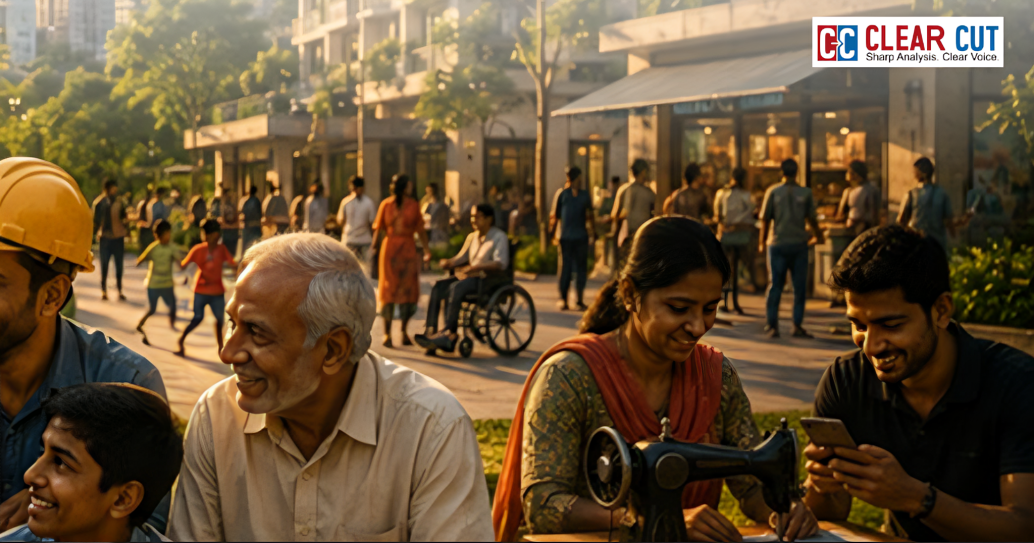
- Migration and urbanisation are driven by people’s aspirations for better jobs, education, safety, and quality of life, making cities important centres of opportunity and economic growth.
- As India urbanises rapidly, the focus must shift from simply expanding cities to creating inclusive urban spaces that provide affordable housing, social protection, healthcare, and equal opportunities for migrants.
- The article highlights that the true success of urbanisation lies not just in economic development but in ensuring every migrant can live with dignity, security, and a sense of belonging.
Migration & Urbanisation: Movement, Opportunity and the Search for Belonging
When we hear the words migration and urbanisation, our imagination often moves towards a familiar picture — a worker leaving a village, moving to a city in search of employment, living in an informal settlement, and becoming part of the urban workforce.
This picture is real. It represents the lived reality of millions. But it is only one dimension of a much larger story. The story of migration and urbanisation is ultimately the story of human ambition.
People move because they imagine a different future. They move because they seek opportunity, education, dignity, safety, stability, and a better quality of life. Cities grow because they absorb these aspirations and transform them into economic activity, cultural diversity, and collective progress. Yet, as the world becomes increasingly urban, a deeper question emerges: are cities only becoming larger, or are they becoming more inclusive spaces where people can truly belong?
Migration Is Not One Story
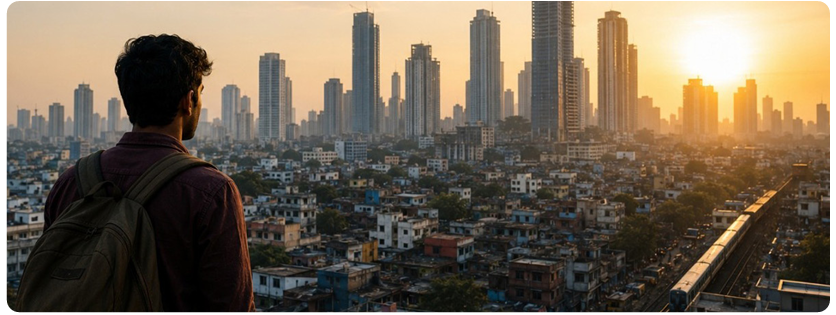
Migration is often spoken about as if it is a single phenomenon. But movement of people has many forms, and each carries a different reality. It changes families before it changes cities. We discuss migrant workers, but rarely the families they leave behind. Migration reshapes parenting, caregiving, gender roles, childhood, ageing, and emotional relationships. The biggest migration impact may happen thousands of kilometres away from the city. A young person moving from a small town to a metropolitan city for a technology job, a construction worker migrating seasonally for livelihood, a student leaving home for education, or a family relocating due to climate pressures are all migrants. Their circumstances are different, but the underlying search has similarities. They are all moving towards a possibility.
Over time, migration has evolved. Today, people move not only because they have to, but also because they aspire to. Students move for education. Professionals move for specialised opportunities. Families move for better services and quality of life. Entrepreneurs move towards ecosystems that enable innovation.
Migration today includes seasonal migration, circular migration, skilled mobility, climate-related movement, and increasingly, digitally enabled forms of work that allow people to participate in urban economies without always physically relocating. This is why migration cannot only be viewed as a sign of crisis. It is also a strategy of resilience. Families migrate to diversify income, reduce vulnerability, invest in education, and create better opportunities for the next generation.
The difference lies not only in why people move, but in the kind of support systems they carry with them. A highly skilled migrant may struggle with identity, loneliness, and adaptation, while a low-income migrant may face these challenges along with insecure housing, uncertain income, and limited access to essential services. The journey of adjustment may be common, but the ability to navigate it is unequal.
Cities: Where Dreams Meet Systems
Urbanisation has historically been associated with economic transformation. Cities together markets, infrastructure, institutions, innovation, and employment opportunities. According to the United Nations, more than 56% of the world’s population currently lives in urban areas, and this share is projected to reach nearly 70% by 2050. India is also undergoing a major urban transition. The World Bank estimates that India’s urban population could reach around 50% of the country’s population by 2050. This transformation presents immense opportunity. But it also creates a paradox.
If cities are centres of opportunity, why do many people who migrate to cities continue to struggle with poverty and insecurity? The answer lies in the difference between urban growth and inclusive urbanisation.
The Invisible City Within the City
A city may grow economically while many of its residents remain excluded from the benefits of that growth. Modern cities often contain multiple realities existing together. One city has global connectivity, formal employment, advanced infrastructure, technology, and investment.
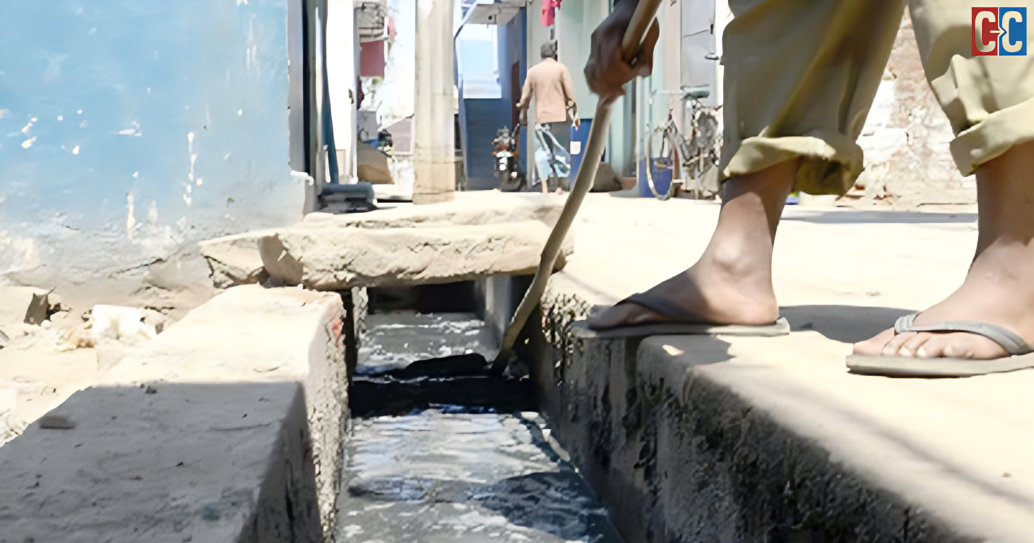
Another city exists alongside it, shaped by informal work, insecure housing, limited access to healthcare, and uncertain livelihoods. The people who build cities are often the people who struggle most to access them.
Urbanisation creates a new form of loneliness. We notice the delivery arriving, the building getting constructed, the streets being maintained, and services being provided. But we often do not see the person behind these everyday urban functions — where they live, how they manage healthcare, what happens during emergencies, or how their families cope. Physical density may not be the concern, but emotional distance.
Urbanisation therefore carries its own paradox: cities depend on migrants as contributors, but do not always recognise them as citizens. People can be surrounded by millions and still experience isolation.
The Periodic Labour Force Survey (PLFS) highlights that a large share of India’s workforce continues to remain in informal employment, meaning millions of workers participate in economic activity without conditions stable employment or comprehensive social security. Urban poverty, therefore, is not always visible poverty. It can exist alongside mobile phones, digital payments, daily wages, and access to markets, while basic security remains uncertain.
Movement Has Visible Gains and Invisible Costs
Migration is often measured through what is visible i.e. increased income, employment opportunities, payments, and economic contribution. However, the transitions beneath it remain harder to measure.
Leaving environments behind behind means social community support, familiar leaving networks, cultural familiarity, and informal systems of care. For many migrants, especially those living away from families, urban life brings not only opportunity but also isolation and uncertainty. For some, migration expands possibilities. For others, it creates a constant negotiation between survival and belonging. The cost of movement is not always captured in economic indicators.
A person may earn more after migration but still struggle to feel rooted. A family may gain financial stability but experience emotional distance. A city may gain a workforce but fail to create a sense of inclusion. The real question is not only whether migration improves economic conditions, but whether it enables people to build a meaningful life in the places they move to.
COVID-19: A Moment That Changed the Migration Conversation
The COVID-19 pandemic changed the migration conversation globally. For India, the pandemic was a reminder that migration cannot be understood only through employment numbers. Behind every migrant worker is a person connected to a family, community, and future aspiration.
Before the pandemic, cities often asked: “How do we manage migration?” During the pandemic, cities were forced to confront another question: “How much do we depend on migration?”
The large-scale movement of migrant workers back to their home regions revealed a reality that was often invisible. Urban economies were deeply dependent on migrant labour, but many migrants lacked security within those cities. The crisis highlighted gaps around housing, social protection, healthcare access, and portability of essential services.
The International Labour Organization estimated that around 1.6 billion globally impacted informal workers were significantly by the economic disruption caused by Covid-19. The pandemic also reinforced that migration is not simply movement from one place to another. It is a relationship between cities and the communities connected to them.
Technology and the New Geography of Mobility
Technology is reshaping the very nature of mobility. Earlier, opportunity often required physical movement: Move to the city to access work and improve livelihood. Today, digital platforms, remote work, online education, digital payments, and technologyenabled services are creating new possibilities where opportunities can travel without people always needing to relocate.
This is changing the geography of movement. However, technology also creates new questions. Does digital access automatically mean equal access? Does flexibility always translate into security? Platform-based work can create new opportunities, but without adequate protections it can also create new forms of vulnerability. The future of mobility may not only be about people moving towards cities. It may also be about ensuring that opportunities reach beyond cities.
What Other Cities Teach Us
Around the world, different approaches show that urbanisation becomes more successful when people remain at the centre of planning. Singapore’s urban planning experience demonstrates the importance of integrated housing, transport, infrastructure, and community services. Its lesson is that a city is not only a collection of buildings; it is a system designed around everyday life. Medellín in Colombia offers another perspective through its social urbanism approach. By investing in public transport, social infrastructure, community spaces, and previously excluded neighbourhoods, it demonstrated that inclusion requires bringing opportunity closer to people. The common lesson from these examples is simple: Urban development is not only about creating spaces; it is about creating belonging.
India’s Urban Future: From Absorption to Inclusion
India has taken important steps towards more inclusive urban systems through affordable housing initiatives, livelihood programmes, public transport expansion, digital service delivery, and portability of social protection. Initiatives around affordable urban housing, urban livelihoods, street vendor support programmes, and portability of welfare benefits reflect a growing recognition that migrants and informal workers need access to urban citizenship. Yet, significant gaps remain.
The scale of India’s urbanisation makes implementation complex. Challenges around rental housing, informal employment, access to services, and migrant inclusion continue. The gap between policy intent and lived reality remains visible. The next stage of India’s urban journey requires moving beyond the idea of cities as economic engines alone. Cities must become ecosystems where people can participate, contribute, and belong.
The Larger Reflection
Migration is not simply a movement of people; it is a movement of aspirations, skills, and human potential. The challenge is not to stop migration. People will continue to move because societies continue to change. The success of a city is not only reflected in its skyline. It is reflected in the lives of the people who create that skyline. So, the deeper food for thought lies with: Can the person who builds the city afford to live in it? Can a migrant family access opportunity with dignity? Can a migrant family find not only employment, but belonging?
Clear Cut Livelihood Desk
New Delhi, UPDATED: July 27, 2026 09:00 IST
Written By: Sonali Maheshwari