
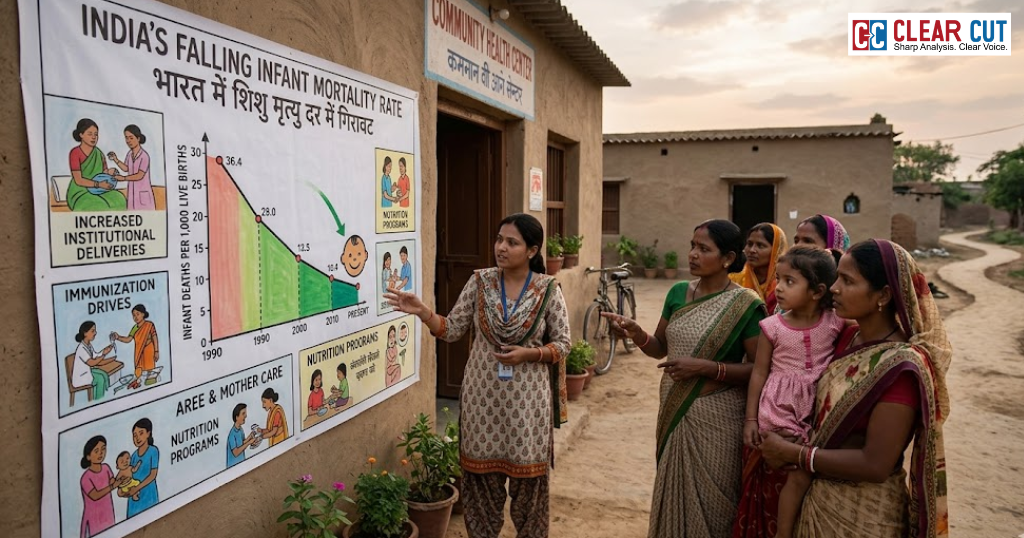
- India’s Infant Mortality Rate has fallen to 24 and the Total Fertility Rate to 1.9, reflecting major improvements in healthcare, maternal services, education, and child survival across the country.
- Kerala continues to lead India’s public health performance with the country’s lowest IMR, showcasing the long-term impact of strong healthcare systems, female literacy, and social development.
- While these achievements mark significant progress, India now faces emerging challenges such as ageing populations, regional healthcare inequalities, and the need for future-ready public health policies.
India’s public health landscape is experiencing a notable demographic shift. The latest Sample Registration System (SRS) Statistical Report from the Registrar General of India shows that the country’s Infant Mortality Rate (IMR) has dropped to 24 deaths per 1,000 live births. The Total Fertility Rate (TFR) has also fallen to 1.9, below the replacement level of 2.1. Kerala has the lowest IMR in the country at 8, confirming its status as one of India’s leading public health performers.
These figures go beyond mere statistics. They reflect years of investment in maternal and child healthcare, immunization, institutional delivery systems, female literacy, and public health outreach. However, they also bring up new concerns about aging populations, regional disparities, workforce changes, and the future of healthcare planning in India.

India currently faces a critical demographic crossroads. The drop in infant mortality and fertility rates shows progress, but it also signals the start of a new social and economic reality that policymakers need to prepare for carefully.
Understanding the Decline in Infant Mortality
Infant Mortality Rate is one of the most important indicators of a country’s healthcare system. It shows how well the system works in terms of medical access, nutrition, sanitation, maternal health, education, and overall social development. India’s IMR has steadily declined over the last two decades. In the early 2000s, the national IMR was above 60 deaths per 1,000 live births. Its reduction to 24 reflects major improvements in healthcare access and child survival. Several factors have contributed to this progress:
- Expansion of Institutional Deliveries Government programs like Janani Suraksha Yojana (JSY) and Janani Shishu Suraksha Karyakram (JSSK) encouraged institutional childbirths by providing financial support and free maternal healthcare services. Institutional deliveries significantly lowered the risks linked to childbirth complications and neonatal mortality.
- Improved Immunization Coverage The expansion of immunization programs under Mission Indradhanush and the Universal Immunization Programme helped lower deaths from vaccine-preventable diseases such as measles, pneumonia, and tetanus.
- Strengthening of Primary Healthcare Systems Accredited Social Health Activists (ASHAs), Auxiliary Nurse Midwives (ANMs), and Anganwadi workers played a crucial role in improving maternal awareness, antenatal care, breastfeeding practices, and early childhood monitoring.
- Better Nutrition and Awareness Improvements in maternal education, nutrition programs, sanitation campaigns, and access to clean drinking water also helped enhance child survival outcomes. Despite this progress, challenges remain. Significant disparities continue between states, rural and urban areas, and socio-economic groups.
Kerala’s Success Story
Kerala’s IMR of 8 matches that of several developed countries. This highlights the value of long-term investment in public health and education. Kerala’s success comes from more than one program. It shows decades of consistent investment in:
- universal healthcare access
- high female literacy
- strong local governance
- community healthcare systems
- maternal education
- decentralized public health delivery
The state’s healthcare system allows for early intervention, improved neonatal care, and better referral systems. High literacy rates also help families seek healthcare more effectively. Kerala shows that healthcare outcomes relate closely to broader social development indicators. Public health gains do not come from hospitals alone; they also arise from education, nutrition, gender empowerment, and local governance. However, Kerala’s demographic shift poses new challenges. The state now deals with an ageing population, increasing non-communicable diseases, and higher healthcare costs for elderly care. This indicates the wider demographic changes India may face in the coming decades.
India’s Fertility Rate Falls Below Replacement Level
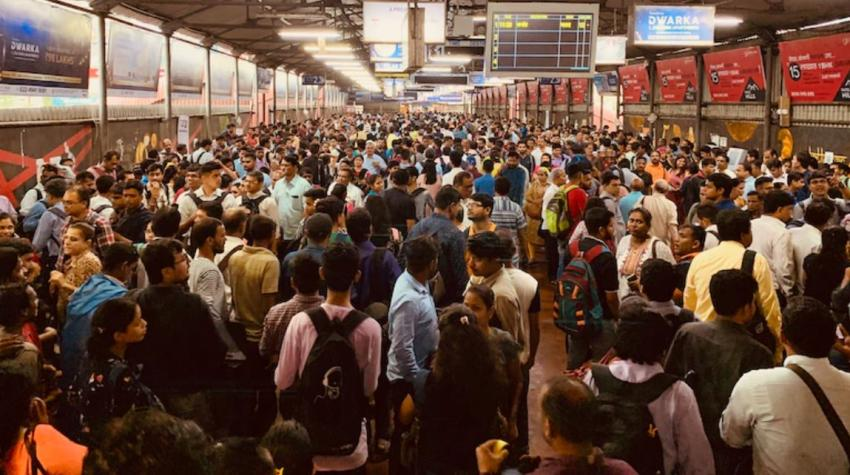
The reduction of India’s Total Fertility Rate to 1.9, is another important demographic trend. The Replacement level Fertility rate or the RLF rate is normally quoted as 2.1 children per woman. Any fertility rate above 2.1 ensures continued growth of the population whereas below 2.1 ensure slowdown of the growth of the population and finally, stabilisation of population size.
The falling fertility rate is a result of a large number of changes taking place across the length and breadth of India. Key factors include increased female education, urbanization, increased age of marriage, increasing employment of women, availability of contraceptive methods, changing fertility expectations of people and pressures associated with child raising.
Falling fertility rate to an extent is also a pointer towards development. Parents are preferring quality over quantity when it comes to children, i.e., providing good education, health and life to few children rather than many.
However, the process of demographic transition across states in India is highly uneven. Southern states like Kerala, Tamil Nadu and Karnataka are already witnessing a very low fertility rate. Some states in the north of India still exhibit a relatively high fertility rate. This will continue to create unequal demographic pressures across states. States that still experience higher fertility will be under pressure in terms of their health systems, education systems, and employment systems, whereas those having low fertility will be the ones facing an ageing population.
Emerging challenge of ageing: India has for long been a very young country with demographic dividend. But with falling fertility rate, this situation would gradually change over time. The implications of an ageing population include increased health expenditure, growing prevalence of non-communicable diseases, growing demand for elderly care facilities and increasing demand on social welfare systems and pension schemes. Many countries like Japan, South Korea and a number of countries in Europe are already facing problems due to ageing population and declining fertility rates. India still has time before we reach such proportions, but it has already begun in many parts of the country. Thus, there would have to be a shift in public policy from just focusing on mother and child welfare to preparing for geriatric health care, long-term care and care systems, mental health care for the elderly and age-friendly policies. For the demographic dividend to be realized, India must prepare itself for the future with necessary investments in human capital, job creation and health care preparation.
Persistent Regional Inequalities
While national averages indicate progress, healthcare inequalities remain a major concern.
States with weaker health infrastructure continue to record higher infant mortality and maternal health challenges. Rural populations, tribal communities, and economically vulnerable groups often face:
- limited healthcare access
- shortages of trained medical personnel
- poor referral systems
- nutritional deficiencies
- inadequate neonatal care
The gap between high-performing and low-performing states highlights the need for more targeted health interventions.
Public health progress in India has often been uneven. Some states achieved remarkable outcomes through strong governance and social investment, while others continue struggling with systemic gaps.
Bridging these disparities will require:
- higher public health expenditure
- stronger primary healthcare systems
- improved rural healthcare infrastructure
- healthcare workforce expansion
- localized health planning
Women’s Education and Healthcare Outcomes
The association between women’s education and health outcomes is one of the most robust findings from India’s demographic transition. Higher levels of female literacy at the state level correlate with
- lower infant mortality
- lower maternal mortality
- lower fertility rates
- better nutrition outcome indicators
- higher institutional delivery rates
- Women with better levels of education have a higher likelihood of accessing:
- antenatal care facilities
- healthcare facilities in general
- immunization for children
- family planning services
and informed decisions regarding health in general. This indicates how strongly health interventions are intertwined with gender empowerment and education policy. It seems possible that investments in girls’ education could generate among the greatest, longest-term public health returns.
The Future of Public Health in India
India has made evident progress on lowering both the IMR and TFR. They highlight that public health institutions, when invested in, can deliver tangible progress at the national level.
Despite this remarkable feat, the next chapter of healthcare in India will need to see a reordering of priorities.
Future public health must not be defined just by survival, but by the:
- quality of healthcare,
- preventive healthcare,
- nutrition security,
- mental health,
- an aging population,
- non-communicable diseases,
- digital health access, and
- equity of access, among others.
Technologies like AI will become even more significant in delivering healthcare and in monitoring health and in early diagnosis. Yet, technology alone cannot fix structural inequalities. Public health will continue to be rooted in institutions, trained health workers, community faith and access.
Conclusion
India’s recent SRS report encapsulates a nation undergoing demographic transition. Falling IMR of 24 and total fertility rate of 1.9 have been significant landmarks in India’s progress toward health and social well-being.
Kerala serves as an example of what prolonged sustained investments in health, education and social services can deliver with respect to human development.
But these achievements are just the opening of new policy arenas. Increased life expectancy, geographical imbalances, work force constraints and unequal health services are all set to define India’s trajectory in the future.
India’s story of healthcare is not simply the decline in deaths and population control anymore but that of constructing adaptable, equitable, and future ready public health systems that are able to cater to a rapidly shifting world. The demographic transition of today will write India’s next narrative of social and economic growth.
Clear Cut Health, Research Desk
New Delhi, UPDATED: May 29, 2026 04:00 IST
Written By: Nairita Das