
- India has launched the Cell Broadcast System (CBS), a new emergency alert technology that can instantly send disaster warnings to every mobile phone in an affected area without internet, apps, or SMS congestion.
- Developed by C-DOT in collaboration with NDMA and the Ministry of Home Affairs, CBS aims to strengthen disaster preparedness by delivering multilingual alerts during floods, cyclones, earthquakes, and other emergencies.
- The article argues that India must now focus on operational readiness through clear activation protocols, pre-approved regional language templates, and nationwide public awareness before the next monsoon season.
The Alert That Nobody Sent, But Everyone Received
On the night of August 16, 2024, flash floods struck three villages in Himachal Pradesh’s Mandi district. Families were woken by the sound of water, not by a warning. Evacuation was reactive, not planned. Two people did not make it out. In the inquiry that followed, the District Disaster Management Authority noted that the meteorological alert had been issued. Unfortunately, that communication did not reach to households in the affected valleys which rely on officials making phone calls, whatsapp groups and a PA system. The information existed. The pathway to put it in everyone’s hand at the same moment did not.
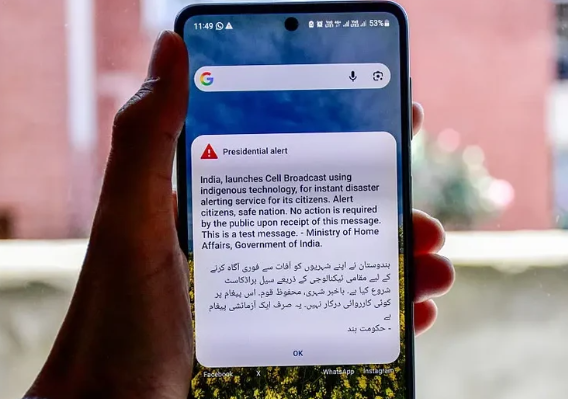
That pathway now exists. The Cell Broadcast System (CBS) is a technology that sends emergency alerts simultaneously to every mobile phone in a defined geographic area. The USP of this sytem is that it does not require the phone number, an app or a network connectivity beyond basic cellular service. The system was formally launched by Union Minister of Communications Jyotiraditya Scindia on May 2, 2026, in New Delhi. It was developed indigenously by the Centre for Development of Telematics (C-DOT) under the Department of Telecommunications, in collaboration with the National Disaster Management Authority (NDMA) and the Ministry of Home Affairs, under the guidance of Union Home Minister Amit Shah.
What Cell Broadcast Technology Does and Why It Is Different
CBS sends emergency alerts to every active mobile phone in a targeted geographic cell simultaneously, regardless of phone number. Unlike SMS, it does not require recipient lists, does not congest networks, and reaches phones even in areas of high-traffic load. Compatible with all phones including basic 2G/3G devices. [PIB / Ministry of Communications, May 2026]
Cell Broadcast is architecturally distinct from every previous emergency communication method India has used. A WhatsApp message requires the recipient’s number, an internet connection, and app installation. An SMS alert requires the operator to send to individual numbers, creating network congestion exactly when networks are most stressed. A television or radio alert requires the recipient to be watching or listening at the right moment. A PA system’s reach is physical and finite.
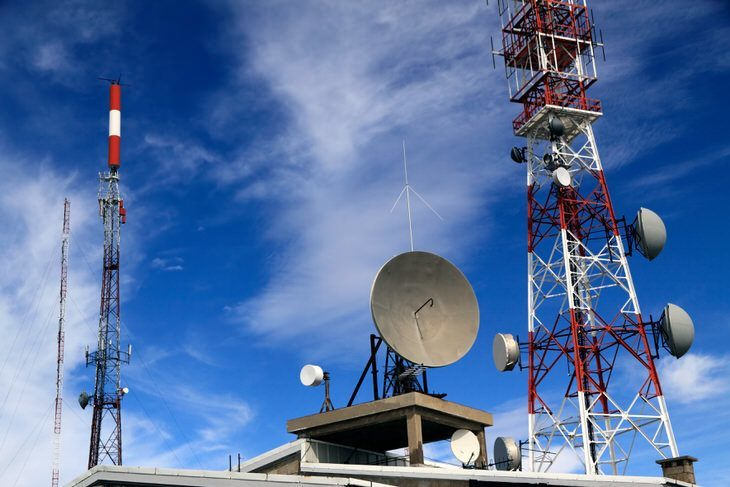
CBS sends a message to every active device registered in a specific geographic cell is a cluster of base stations covering a defined area. It uses a broadcast channel, not the SMS channel, so it does not create network congestion. It reaches 2G, 3G, and 4G devices. It works on basic feature phones. In an emergency, when network congestion is at its worst and when the people who most need warning are those without smartphones and internet access, CBS delivers the alert to every phone in the danger zone simultaneously.
The India-Specific Context
India’s disaster communication challenge is compounded by several structural features: a highly diverse linguistic landscape requiring alerts in multiple languages; a large population of non-smartphone users who cannot receive app-based notifications; geographic fragmentation in flood plains, coastal areas, and hill districts where community-level alert networks are thin; and the organisational complexity of multi-agency disaster response that often slows the decision-to-alert timeline.
CBS addresses several of these simultaneously. The system is programmable to send multilingual alerts, which is consistent with BHASHINI’s multilingual infrastructure. It requires no recipient database. The decision to send an alert can be authorised at district or state level, enabling faster activation than systems that require national clearance. And because it reaches every phone in the geographic cell, it eliminates the problem of communication gaps in communities where not every household has a smartphone.
India has 1.1 billion active mobile subscribers. Even accounting for multiple SIM ownership and inactive numbers, the CBS reaches a communication infrastructure of extraordinary reach. The system’s indigenously developed architecture also means that the technology investment stays in the domestic ecosystem and can be maintained, upgraded, and exported on India’s own terms.
What Must Follow the Launch
Technology launches require operational follow-through. Three things must happen before CBS can be considered an operational disaster communication system rather than a demonstration capability. First, integration with the district and state disaster management authority decision protocols: CBS is only as fast as the human decision to activate it. Every state’s disaster management framework must specify, in writing, at what trigger level and by whose authority a CBS alert is sent, with no ambiguity that slows the decision at the critical moment.
Second, multilingual alert templates in all 22 scheduled languages must be pre-approved and pre-loaded for all major disaster categories: flood, earthquake, cyclone, tsunami, industrial accident, forest fire. Designing the message during a disaster is a preventable failure. Third, public awareness about CBS must be active: a large proportion of India’s population has never received a CBS alert and will not know what the full-screen notification means when it arrives. A national public awareness campaign, run through schools, gram panchayats, and All India Radio, must accompany the deployment.
When the Alert Arrives Before the Water
The people of the three Mandi villages in 2024 had mobile phones. The meteorological alert had been issued. The information and the communication infrastructure were both present. What was absent was the system to put the alert on every phone in that valley at the moment it was most needed. That absence cost two lives.
CBS is the system that fills that absence. It will not eliminate disasters. It will not prevent floods or earthquakes or cyclones. What it will do is ensure that every person in the path of a disaster receives a warning at the same moment, in a language they understand, with enough time to act. Build the protocols. Pre-load the templates. Tell the public what the alert means. The infrastructure is live. Make it operational before the next monsoon.
Clear Cut Climate, Research Desk
New Delhi, UPDATED: May 29, 2026 09:00 IST
Written By: Tanmay J Urs