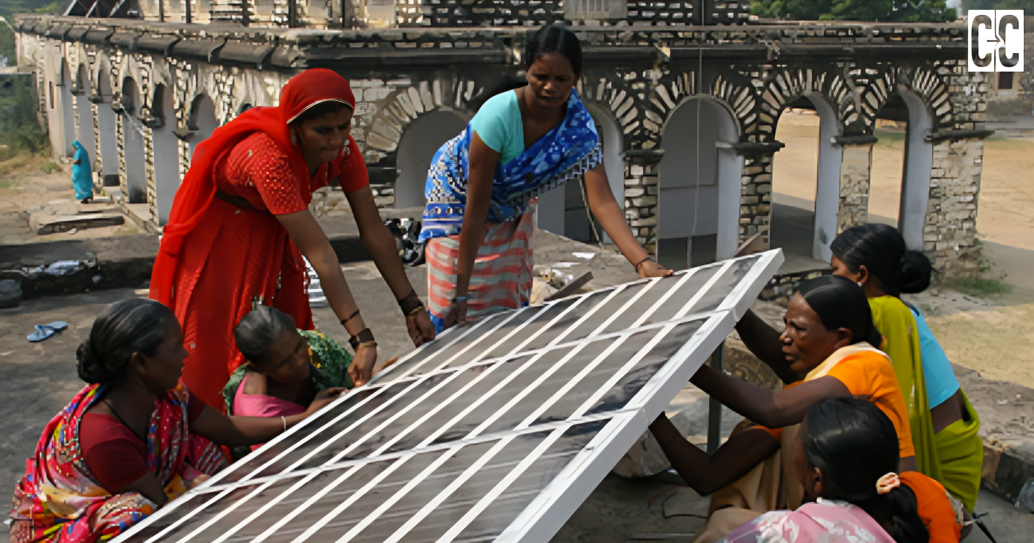
- India faces a crucial budget choice between welfare spending that provides immediate support to vulnerable citizens and development spending that drives long-term economic growth through infrastructure, education, and healthcare.
- Evidence suggests that while cash transfers and subsidies help reduce poverty in the short term, investments in human capital and infrastructure generate more sustainable benefits for employment, productivity, and national prosperity.
- The best path forward is a balanced approach that improves welfare efficiency while increasing high-impact development spending, ensuring both social protection today and economic growth tomorrow.
Budget Trends: Welfare vs Capital Expenditure
Recent Union budgets have explicitly favored capital investment. The table below summarizes Union spending; the capital (capex) share of total expenditure has climbed from ~17% in FY2022-23 to ~23% in FY2026-27. Revenue expenditure (salaries, subsidies, subsidies etc.) has grown more slowly. States, facing rising debt-to-GSDP ratios (>40% in some) and high committed costs, also report widening gaps between budgeted vs actual welfare spending.
Table: Union Budget – Revenue vs Capital Expenditure (₹ lakh crore)
| Year | Revenue Exp. | Capital Exp. | Capex % of total |
| 2022–23 (RE) | 34.59 | 7.28 | 17% |
| 2023–24 (BE) | 35.02 | 10.00 | 22% |
| 2024–25 (Actual) | 36.01 | 10.52 | 23% |
| 2025–26 (RE) | 38.69 | 10.96 | 22% |
| 2026–27 (BE) | 41.25 | 12.22 | 23% |
Sources: Finance Ministry/PIB Budget documents.
State budgets mirror this trend, capital outlay is rising but still a minority of spending, and social-sector allocations are often the first to be cut under fiscal strain. In the 2026-27 Union Budget, only 18% of spending was on social sectors (~2.5% of GDP), roughly the same share as in 2014-15. With interest payments absorbing ~25% of revenue outlay, governments argue that revenue (welfare) spending must be “restrained” to enable increased capex.
Poverty, Jobs, Education & Health
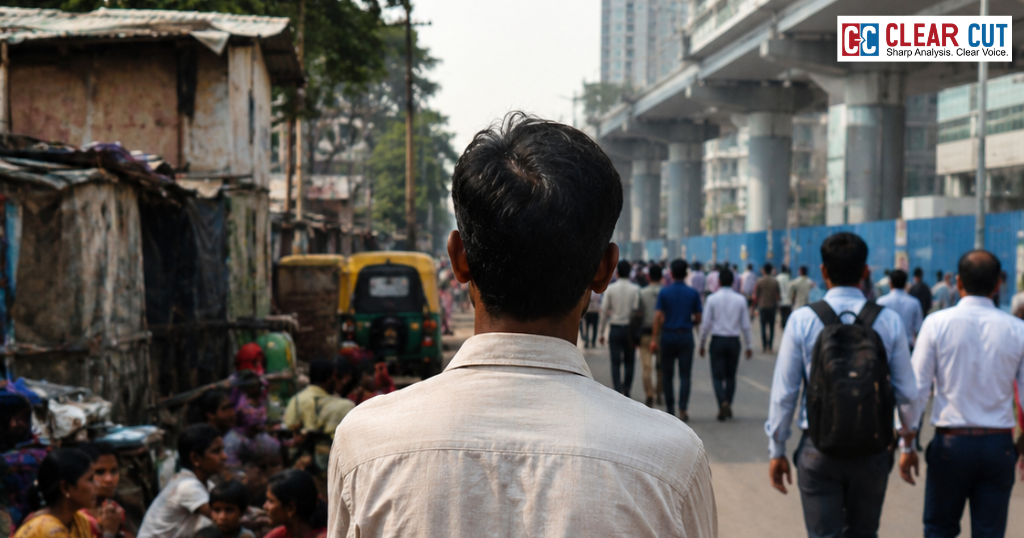
While investment in infrastructure and industry is a national priority, India’s social indicators show unfinished business. Under World Bank measures, only about 5.3% of Indians live in “extreme poverty” (<$3.00/day PPP) today, but nearly 24% are below $4.20/day (2022). Absolute numbers remain large, and inequality persists.
The unemployment rate has dropped to ~3.1% in 2025 from 3.3% in 2024 due to the growth of formal employment opportunities. However, the labor-force participation rate has just stabilized (~59%). Moreover, there is a problem of underemployment since many people are self-employed or are working informally.
There are some inconsistencies in education, while 68% of adults have finished secondary education or higher, the problem of literacy and poor quality of schooling remains regional and social. The health and nutrition situation has greatly improved, the under-5 mortality has dropped to 2.8% in 2023, and maternal mortality to ~103/100k in 2020. However, 35% of children are stunted.
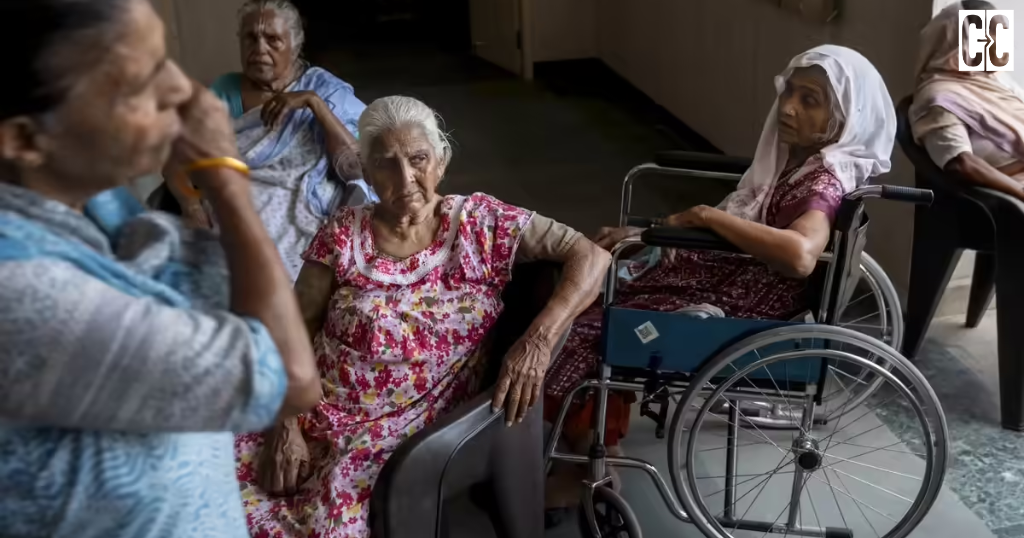
These trends imply that long-term human-capital investments in schools, clinics, nutrition programs are still needed alongside any cash support. Disinvesting now in health or education could erode decades of progress.
Cash Transfers vs Public Investment: Evidence
Direct transfers and subsidies have documented short-term benefits. For example, India’s Jan Dhan financial-inclusion and direct benefit programs have reduced leakages. Research shows conditional cash aid can lift families above poverty lines and improve child health and school attendance. Similarly, India’s free-ration schemes and MNREGA wages provide immediate food and income security to millions. Such welfare measures act like “Tylenol for poverty’s fever”, delivering quick relief and income multipliers at the local level, as poor households tend to spend transfers on food, health, education.
However, large-scale evaluations suggest that public investment often generates higher economy-wide returns. Infrastructure like roads, ports, power, directly increases productivity and jobs with sustained impact. Investment in education and R&D creates a skilled labor force for future growth. Multiplier analysis for fiscal measures will show that the impact on growth of spending on infrastructure projects will have a multiplier >1, meaning that every rupee invested gives more than 1 rupee of GDP. The 2023 Budget states that “investments in infrastructure have a large multiplier impact on growth and employment”.
Political-economy research warns that an outsized focus on giveaways can erode public services over time. According to an economist at Brookings, although cash payments may increase earnings, reducing poverty sustainably depends on providing good public goods and government efficiency. Importantly, surveys conducted in India reveal that the poor would rather receive improved health facilities and schooling than cash payouts. It implies that development spending by governments in support of the disadvantaged matches their preferences.
However, there is conflicting evidence in the macro-level analysis. The World Bank literature on cash transfers reveals that such programs may have positive effects. But outcomes depend on implementation. India’s challenge is to ensure transfers reach those truly in need, and are not duplicated by wasteful subsidies, while pushing infrastructural reforms.
Fiscal & Political Constraints
Even with the arguments above, policy is constrained. India’s fiscal deficit (~4.4% of GDP) and rising debt (about 86% of GDP in 2024) leave little room. A large share of revenue is committed to interest payments, nearly 40% of all revenue receipts, and pensions/salaries. State governments, covering ~60% of public spending, face wide fiscal gaps. Many states spend over 40% of revenues on wages and debt-servicing, crowding out welfare and capital outlay.
This “fiscal consolidation” pressure has led recent Union Budgets to cut back actual social spending even if headline allocations tick up slightly. For instance, in 2024-25 actual social-sector outlay fell to ~17% of spending, a decade-low. Under-spending in ministries for minority welfare, labor, health, and education has been as high as 20–78%. In simple terms, tightening budgets have meant welfare schemes often get trimmed so that infrastructure capital can be expanded.
Politically, states have also seen a surge in populist handouts; free electricity, farm subsidies, etc., which complicates the trade-off. Cash programs, however, may lead to vote-bank politics, even though they continue to be immensely popular among policymakers. In contrast, investment programs may take time to deliver results and thus lack political incentives. The trick is to coordinate incentives, for instance by giving states attractive low-interest rate loans for capital investments (₹1.85L in 2026-27) while leaving welfare expenditure unlinked.
We need to know who should receive money now and who from future development? Well-targeted cash transfers can protect the poorest in the immediate term (e.g. ensuring food security and basic incomes). Simultaneously, the nation cannot sacrifice schooling, healthcare, roads, power, and science if it aims for lasting prosperity. The recommendation is a mixed strategy: improve the efficiency of welfare programs, for example, by better targeting or digital delivery, so that less is “wasted,” while growing the capital budget in high-return areas. Strengthening tax revenue through disinvestments and GST growth can help finance both goals.
Conclusion: Charting a Balanced Path
In sum, India’s debate is not strictly Welfare vs. Development, it is Welfare and Development. Social protection safeguards vulnerable citizens today, but robust infrastructure, education and innovation investments determine tomorrow’s growth. The evidence and experience suggest tilting modestly toward development spending without abandoning the needy, yielding larger, sustainable gains. Given fiscal limits, this means reforming and reprioritizing budgets, cutting inefficient subsidies, closing leaks in transfer schemes, and crowding private investment into infrastructure.
It’s a delicate balance. But the choice frames itself starkly for citizens and policymakers alike.
“It’s your money… It’s your India… One word only: Welfare or Development?”
Clear Cut CSR, Livelihood Desk
New Delhi, UPDATED: June 23, 2026 09:00 IST
Written By: Mohita Bansal
Designation: Assistant Manager – MLE at Devinsights