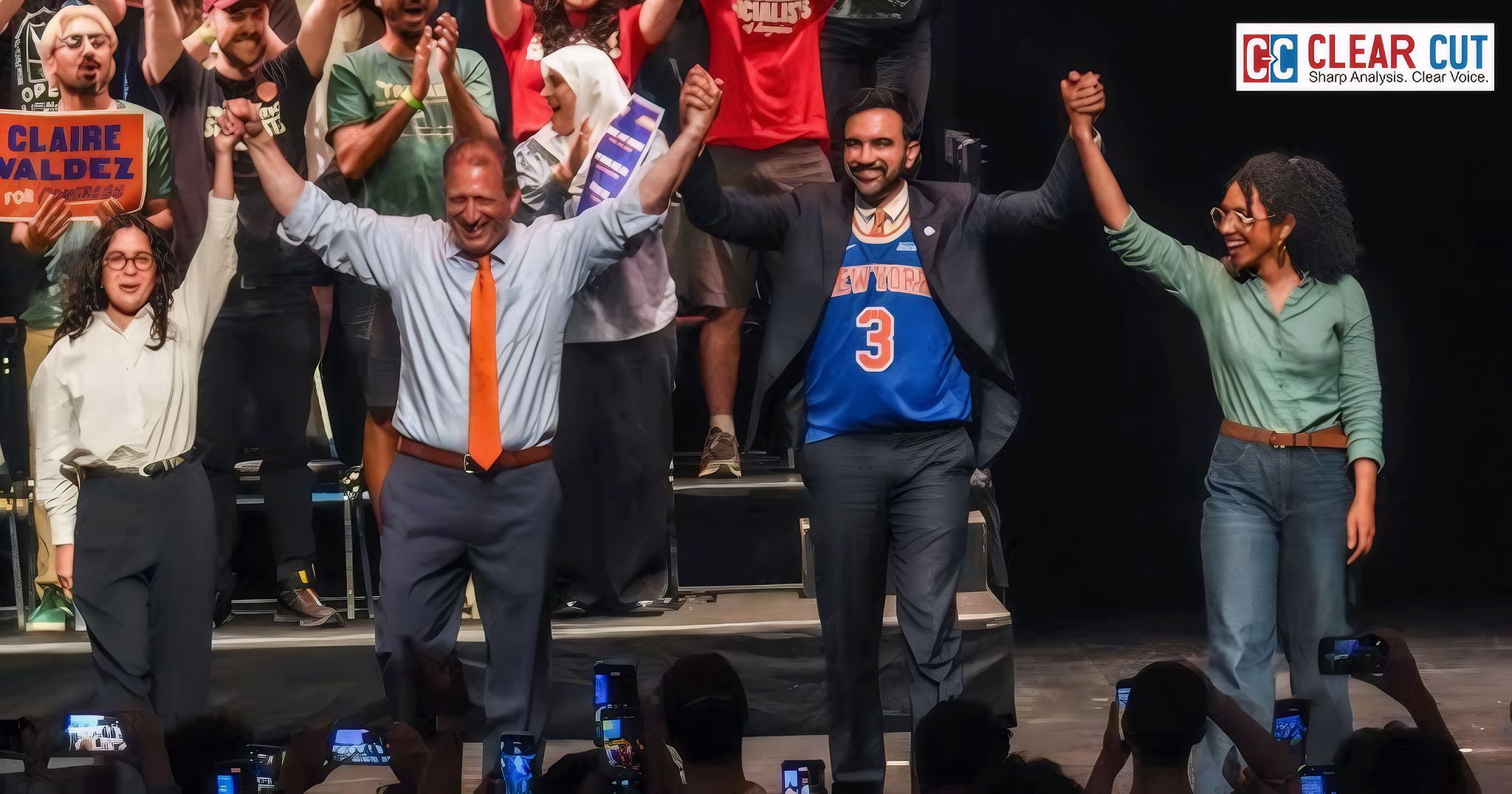
- Zohran Mamdani-backed candidates swept New York’s Democratic primaries, defeating several establishment-backed incumbents and strengthening the progressive movement’s influence within the Democratic Party.
- The results have intensified debate over the party’s future direction, with growing support for socialist-aligned candidates and increasing pressure on Democratic leadership ahead of future national elections.
A MOVEMENT, NOT A MOMENT
“A year ago, it was not the end of a political movement. It was the beginning.” Zohran Mamdani said those words to a celebrating crowd in Brooklyn on Tuesday night, June 23, 2026, and for once a politician’s victory-speech rhetoric matched the data sitting right in front of him. Every single congressional candidate Mamdani endorsed in New York’s Democratic primaries won in a result political observers across the spectrum are calling a watershed test of his influence beyond the mayor’s office he won barely a year earlier.
This was, by any reasonable account, a calculated gamble. Mamdani broke explicitly with Democratic Party leadership to back insurgent, further-left challengers in three competitive races. All three won.
| 3 of 3 Mamdani-Backed Candidates | 2 Incumbents Defeated | 5 Terms Espaillat Tenure Ended | 3 of 4 DSA-Backed State Races Won |
THE UPSET THAT DEFINED THE NIGHT
The most striking result came in New York’s 13th district, where Darializa Avila Chevalier, a 32-year-old democratic socialist and former Mamdani campaign staffer with no prior elected experience, narrowly defeated five-term incumbent Adriano Espaillat. The first Dominican-American ever elected to Congress and chair of the Congressional Hispanic Caucus. Brad Lander, the former New York City Comptroller, ousted two-term Rep. Dan Goldman in another closely watched race, while state Assembly Member Claire Valdez defeated Brooklyn Borough President Antonio Reynoso. The candidate hand-picked by retiring Rep. Nydia Velázquez in the open seat race for New York’s 7th district.
Beyond the three congressional wins, the Democratic Socialists of America also claimed three of four contested state Assembly races where Mamdani had not even formally endorsed. It suggested the organisational infrastructure behind the movement now operates independently of Mamdani’s personal involvement, a meaningful distinction for anyone trying to gauge whether this represents a durable structural shift or a personality-driven moment.
ESTABLISHMENT DEMOCRATS CAUGHT BETWEEN TWO SIGNALS
House Democratic Leader Hakeem Jeffries, whose preferred candidates lost across the board, sought to minimise the result’s significance: ‘There are 215 members of the House Democratic caucus. A handful of primaries that go in one direction or the other, in a given state or two, aren’t going to reshape who we are.’ New York Attorney General Letitia James struck a more candid tone, acknowledging ‘hurt feelings’ over Mamdani’s endorsements and conceding the party ‘needs to reckon with its left flank.’
Polling data lend some texture to why this matters nationally: a Fox News survey from March 2026 found 38 percent of Americans now believe moving away from capitalism toward socialism would be good for the country, up from 32% in 2022 and 18% in 2010. This figure rose to 66% among very liberal voters and Democrats under 45. Socialist-aligned candidates have also advanced in mayoral races in Seattle, Los Angeles, and the District of Columbia this cycle, suggesting Mamdani’s win last year was a leading indicator, not an isolated event.
THE QUESTION ONLY NOVEMBER CAN ANSWER
All three winning candidates now enter safe Democratic seats, making their general election victory in November close to a formality. The real consequence of Tuesday’s results plays out inside the House Democratic caucus, not at the ballot box. The Democratic Party leadership faces an uncomfortable choice it can no longer indefinitely defer: either find a credible answer to the affordability and inequality arguments fuelling this movement’s appeal, or watch primary challenges of this kind multiply in cycle after cycle.
Mamdani’s bet paid off this week. The accountability question belongs to the party he just publicly defied: does it treat this result as a localized anomaly tied to New York’s particular demographics, as Jeffries suggested, or as the early data point of a generational reordering it needs a substantive answer for before the 2028 presidential primary makes the question impossible to avoid.
Clear Cut Research, Review Desk
New Delhi, UPDATED: June 27, 2026 09:00 IST
Written By: Tanmay J. Urs