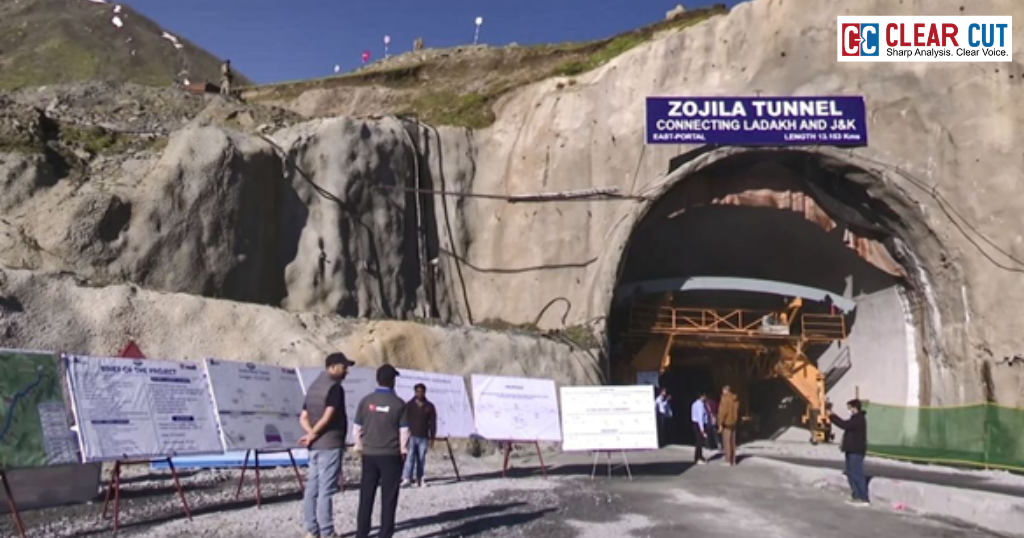
- The breakthrough of the nearly 14-km Zojila Tunnel marks a major milestone in connecting Kashmir and Ladakh through an all-weather route, reducing travel time from around 3 hours to just 20 minutes.
- Built beneath the challenging Zojila Pass, the tunnel will end Ladakh’s annual winter isolation, improve safety, and strengthen defence logistics in a strategically important border region.
- The project is part of a larger connectivity network aimed at boosting tourism, trade, employment, and year-round access across Jammu & Kashmir and Ladakh.
A MOUNTAIN THAT USED TO DECIDE WHO COULD TRAVEL
For most of the year, the Zojila Pass has been less a road than a closed door. Snow, landslides, and a terrain so unforgiving that the average crossing time stretched to 3 hours on a good day and to nothing at all for nearly 5 months of winter. When the pass shut completely, cutting Ladakh off from the rest of India by road. At Minamarg, in the Drass sector of Kargil district, that door has just been forced permanently open.
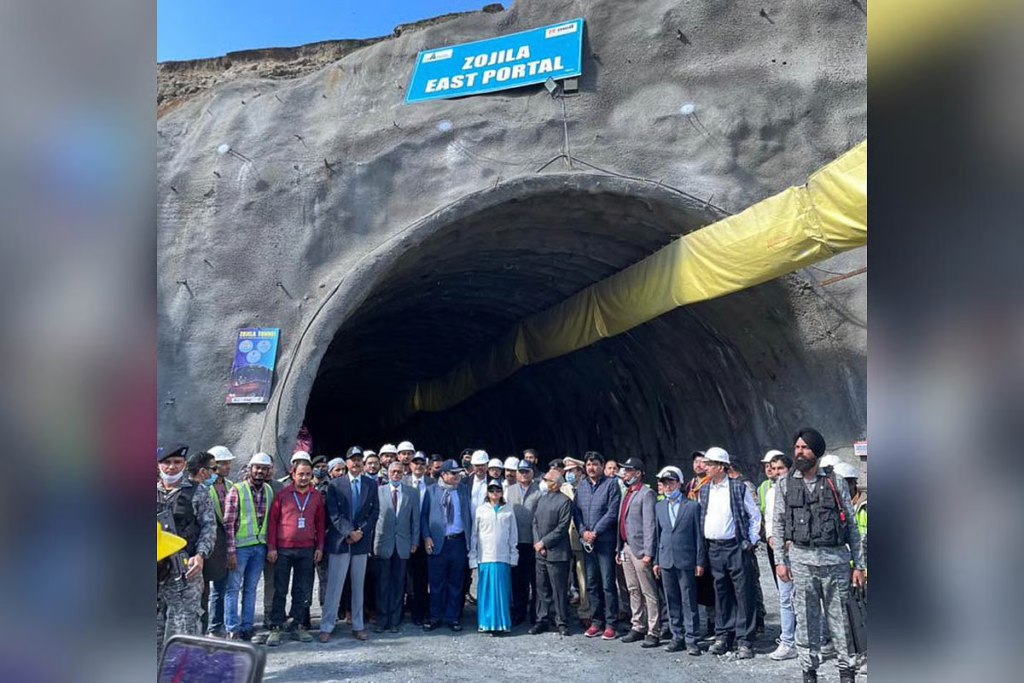
Union Minister for Road Transport & Highways Nitin Gadkari witnessed the historic breakthrough of the main tunnel at the eastern portal of the Zojila Tunnel Project. This is a moment that brings one of India’s most technically demanding infrastructure undertakings to its final stretch. Jammu & Kashmir Lieutenant Governor Manoj Sinha, Chief Minister Omar Abdullah, and Ladakh Lieutenant Governor Vinai Kumar Saxena, joining virtually, marked the occasion together — a rare instance of unified regional celebration around an infrastructure milestone.
| ~14 km Tunnel Length | ₹6,800 Cr Project Cost | ~3 Hours Travel Time (Before) | ~20 Min Travel Time (After) |
THE ENGINEERING BEHIND THE BREAKTHROUGH
Being constructed between Baltal and Minamarg on National Highway-1, the nearly 14-kilometre, bi-directional Zojila Tunnel is one of Asia’s longest road tunnels, designed as a horseshoe-shaped, single-tube structure passing beneath the Zojila Pass in the Himalayas. The terrain near the pass is among the most geologically unstable in the country. It is in fact reflected in the project’s repeatedly revised completion timelines stretching back to its original conception following the 1999 Kargil War, when the strategic necessity of all-weather connectivity first became impossible to ignore.
The tunnel will connect Sonamarg in the Kashmir Valley with Minamarg in the cold desert of ladakh, cutting through terrain where, historically, fatal accidents occurred nearly every winter season. Once operational, the project does not merely save time. It removes an entire seasonal cycle of isolation that Ladakh’s population and the Indian Army’s logistics chain have endured for generations.
“A three-hour mountain crossing collapsing to twenty minutes is not just an engineering statistic. For Ladakh, it is the end of five months of annual isolation.”
BEYOND THE TUNNEL: A CONNECTIVITY NETWORK
Gadkari used the occasion to outline a broader connectivity vision for the region. The proposed Fatu-La Twin-Tube Tunnel and Kela Pass Tunnel will improve access to tourism destinations including Pangong Lake. Additional tunnel projects are planned along the Manali-Leh axis at Baralacha La, Lachulung La, and Tanglang La together forming a network designed to make the historic dream of uninterrupted Kashmir-to-Kanyakumari road travel a practical reality, not a political slogan.
Highway development worth Rs 1.35 lakh crore is currently underway across Jammu & Kashmir, according to the Ministry’s review following the breakthrough. This is a scale of regional infrastructure investment with implications well beyond tourism, touching defence logistics, local employment, and trade access to a region that has historically been among India’s most underserved in physical connectivity.
THE VISION AND THE ACCOUNTABILITY GAP
Strategic infrastructure of this scale carries strategic responsibility. The 1999 Kargil War made painfully clear what happens when troop and supply movement depends on a pass that closes for half the year. The completed Zojila Tunnel will materially change India’s defence logistics posture in a sensitive border region. It is a benefit that justifies the Rs 6,800 crore investment many times over.
But breakthroughs are not completions. The Ministry of Road Transport & Highways must publish a binding, public completion timeline for final tunnel lining, electromechanical works, and operational testing without the recurring timeline slippages this project has seen since its inception. Ladakh has waited decades for this connectivity. It deserves a government that finishes what it starts, on a date it commits to in public, not just one it celebrates in a ceremony.
Clear Cut Research Desk
New Delhi, UPDATED: June 20, 2026 05:00 IST
Written By: Tanmay Urs