
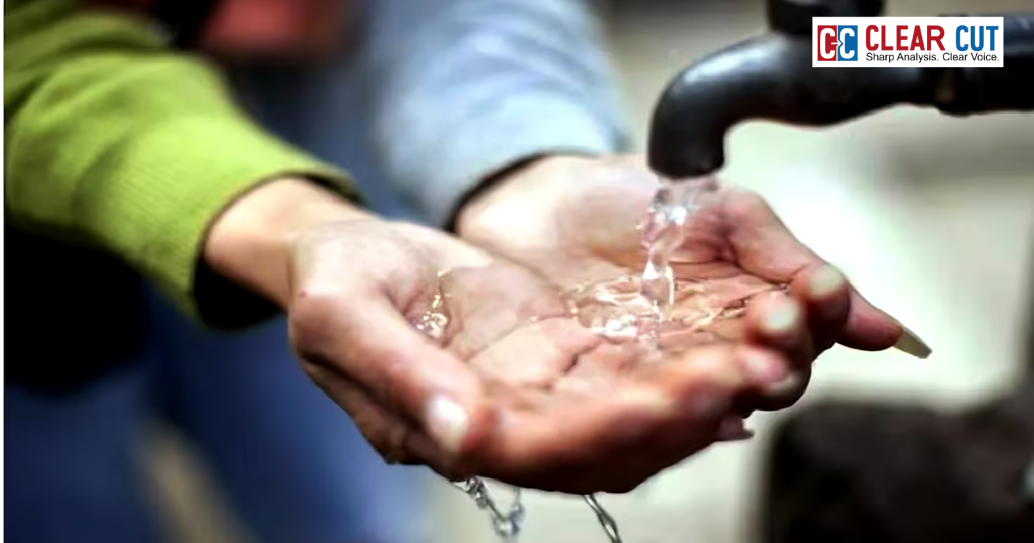
- The 10th District Collectors’ Peyjal Samvad highlighted Jal Jeevan Mission (JJM) 2.0’s shift from infrastructure creation to ensuring sustainable, 24/7 rural piped water supply through Jan Bhagidari, technology, and community-led water management.
- Districts including Kinnaur, Haveri, Dumka, South Goa, and Unakoti showcased successful models in water conservation, smart monitoring, operation & maintenance, and universal Har Ghar Jal coverage that can be replicated across India.
- The mission also aims to improve public health, women’s empowerment, and rural livelihoods while addressing long-term challenges such as climate resilience, funding for O&M, and sustainable community ownership of water systems.
On July 14, 2026, the 10th District Collectors’ Peyjal Samvad was organised by DDWS, Ministry of Jal Shakti, through video conference, where senior officers, DCs, and MDs participated and furthered the agenda of Jal Jeevan Mission (JJM) 2.0, where the focus shifts from creating infrastructure to ensuring assured, sustainable rural piped water service delivery with a framework of Jan Bhagidari (people’s participation).
The Secretary, DDWS, Shri Ashok K.K. Meena, stated the shift in his opening remarks, “Jal Jeevan Mission is in its next phase where the emphasis has been moving from infrastructure creation to ensuring assured, reliable and sustained service delivery to rural population on a 24/7 basis, community driven with the mandate of water management.” He requested speeding up the Har Ghar Jal Gram Panchayat certification process and the institutionalisation of Jal Arpan as an annual community event to strengthen local participation. More than 1.17 lakh activities have been carried out under the Jal Seva Aankalan, with O&M taken over by Gram Panchayats and village water supply and sanitation committees (VWSCs).
JJM aims to bridge existing gaps, particularly in rural India, where the assured availability of water at home is a critical determinant of health, women’s status, child education, and economic performance. JJM was launched to provide at least 55 Litres person per day with prescribed quality, 24/7 service delivery, and sustainability by building local capacity.
Best practices from the ground: Cross-learning across districts.
Five districts, from all over the country, presented replicable and inspiring models for addressing specific, localised issues:
Kinnaur district of Himachal Pradesh achieved the benchmark 100% Har Ghar Jal coverage across its 210 villages, in one of the toughest terrains. Solutions ranging from source augmentation to snow water harvesting, pond rejuvenation, and groundwater recharge were explored, alongside monitoring using GIS, Sujalam Bharat Digital Registry, and women-led water quality testing. Fairs such as the Jal Mahotsav and the Jal Arpan are used to instill a sense of ownership among locals.
In the Haveri district of Karnataka, which has registered 95.36% FHTC coverage, execution has been one of the main strengths. The DBOT models and the mobile application “Jeeva Jala,” used to test water quality, resulted in a 24/7 water supply in six villages in the district. This approach is being complemented by the adoption of an integrated O&M policy and geotagging, which have had remarkable results in the state.
Dumka district of Jharkhand ensured efficiency in O&M and grievance redressal through the creation of a consolidated Integrated Control Room, the development of local spare-parts chains, the use of Jal Sahiyas, and the recovery of user charges.
South Goa has completed all its 118 JJM works, is aiming for a Smart Water Utility with a new IoT- and SCADA-enabled infrastructure, is in the process of installing smart metering across the district, and currently relies on its surface water systems to supply almost 96% of the state’s water demand.
Tripura’s Unakoti district a leading district in the nation in providing high FHTC coverage to 47,800-plus households (89.16%). Kaligiri, the surface water project implemented across the state, helped Unakoti and the state achieve a major milestone by freeing rural and remote regions from reliance on water tankers and unreliable sources. By merging with SBM(G) and MGNREGS, it also had a significant positive impact on people’s health and livelihoods.
Shri Kamal Kishore Soan, Additional Secretary & Mission Director, NJJM, said, “Consistent service delivery, source sustainability, community mobilisation, and technology-enabled monitoring are the pillars forward.” He stated, “NJJM endeavours to utilise the 16th Finance Commission Grants for Water, Sanitation and Hygiene (WaSH) in these initiatives.”
Social Dimensions: Health, equity, and empowerment
On the social dimension, JJM 2.0 aims to address the deep-rooted inequities. The decrease in water collection for women and girls gives them time to attend school and gain employment. It reduces the spread of disease through contaminated water, thereby reducing child malnutrition and improving overall public health. As various experts have pointed out, these kinds of missions bolster social determinants of health. Although a study of JJM highlights positive results, it also identifies sustainability issues, emphasizing community-driven approaches to ensure the long-term sustainability of the interventions. Experts associated with reports from UNOPS and the Sankala foundation recommend evidence-based planning and third-party monitoring to tackle issues of source depletion and non-maintenance.

Through transparent, data-driven governance using available digital means, including geotagging (under Sujalam Bharat, where Pradhan Mantri Gram Sadak Yojana meets PM Gati Shakti), and the use of mobile apps and data dashboards, governance at the local level will be enhanced and leakages curbed.
Hurdles to overcome, the way forward
Although these successes are significant, the experts had strong reservations over the funding of O&M, climate change, and the guarantee of coverage in disadvantaged communities. The alignment of several departments and the periodicity of DWSM reviews are key. User charges and community control through VWSCs will make the schemes sustainable and increase ownership. Lauding the district authorities, Shri Soan stated that active mobilization of Jan Bhagidari will be the determinant for the success of JJM 2.0.
In the end, the Peyjal Samvad summed up a vision in which water becomes an engine for social development, rather than infrastructure, by focusing on sustainability and people-driven control to ensure “Har Ghar Jal” as a permanent status for the people, bridging the urban-rural divide, and helping achieve India’s developmental targets. The innovations and strategies provided by the district-level experts would serve as a blueprint for others to replicate.
Clear Cut Livelihood Desk
New Delhi, UPDATED: July 20, 2026 13:00 IST
Written By: Yatharth Pathak