

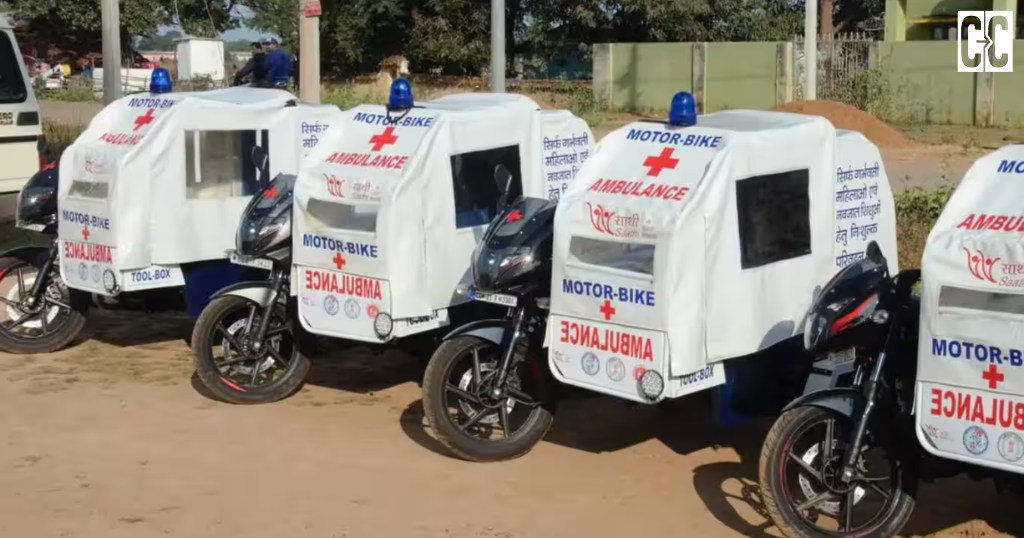
- The Ministry of Road Transport and Highways (MoRTH) has proposed draft rules to officially recognize and regulate two-wheeler ambulances, introducing national standards for their construction, safety, registration, and fitness.
- The new framework aims to improve emergency medical response in rural, remote, hilly, and congested areas by enabling faster last-mile healthcare access where conventional ambulances often cannot reach.
- After a 30-day public consultation, the government may notify the final rules, giving two-wheeler ambulances a formal legal identity under the Central Motor Vehicles Rules for the first time in India.
For years, a motorcycle ambulance has, in fact, made up for where India’s ambulance fleet generally fails: getting to a patient’s home that lies down a narrow lane, up a muddy path, or along a waterlogged rural road far more quickly than any car possibly could. States like Karnataka, Odisha, Chhattisgarh and Tamil Nadu have, over the years, piloted a range of customized bikes equipped to ferry trained paramedics and carry a portable medical kit to first respond to and stabilize a patient while waiting for the larger ambulance. Despite years of deployment in real-life situations, they had no specific identification, no set building norms, no construction standards, no fitness guidelines, and no means of registration mandated specifically for them.
That gap is now set to close. The Ministry of Road Transport and Highways (MoRTH) has issued a draft notification proposing amendments to the Central Motor Vehicles Rules, 1989, to formally define and regulate two-wheeled road ambulances as a distinct vehicle category.
Why a New Rule Was Needed?
According to the Ministry, two-wheeled road ambulances currently fall into a regulatory blind spot. There are no national requirements governing how they should be built, how safe they need to be, how patients should be handled and restrained, or how they should be type-approved, registered, and inspected for fitness. Every state that has deployed such vehicles has essentially had to improvise its own standards.
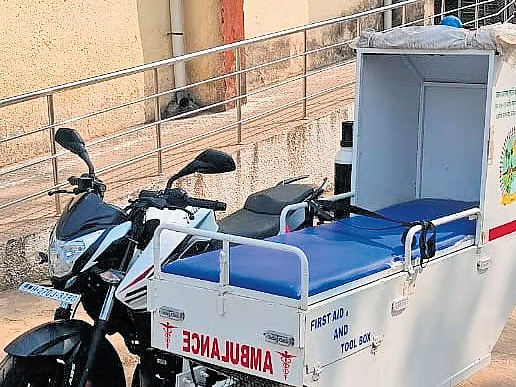
The Ministry has been direct about the purpose of the fix, noting that these vehicles can support rapid emergency response and last-mile access to medical care in rural and remote locations, as well as hilly terrain, precisely the settings where a standard ambulance struggles with narrow roads, steep gradients, or dense traffic.
What the New Standard Covers
According to the draft rules, a standard – AIS-209 (Part 1):2026 Construction and Functional Requirements for Life Support Two-Wheeled Road Ambulances – is proposed to be brought out, which would govern the usage. A two-wheeled road ambulance means an L2 category vehicle that is either provided with or can be equipped with an ambulance accessory unit or a patient conveyance system.
The standard lays out a fairly comprehensive set of construction and functional safeguards. These include requirements regarding vehicle stability and braking performance, parking brake and gradeability, rear visibility, coupling integrity when a sidecar or trailer unit is attached, emergency complicity and warning devices, and, critically, safe patient loading, restraint, and protection from the weather during transport. Top lights fitted on these ambulances are expected to comply with the AIS-209 (Part 1):2026 standard from October 1, 2027, giving manufacturers a runway to adapt existing designs.
Registration, Fitness, and Oversight
As per the draft norms, two-wheeled road ambulances would not be personal vehicles but would be transport vehicles, subject to strict compliance. It needs to be awarded a certificate of fitness, which must be renewed twice over two years, like other commercial and transport vehicles.
Fitness inspections will look closely at the practical, safety-critical parts of the vehicle: the secure mounting of the ambulance accessory or patient-conveyance unit, tires and rims, emergency warning lights, the patient stretcher and its locking mechanism, patient-restraint systems, loading and unloading mechanisms, and the availability, accessibility, and validity of the fire extinguisher on board.
Notably, the area of operation for these ambulances will be left to individual state governments to determine, meaning states will decide where and to what extent such vehicles can be deployed, rather than the Centre mandating a uniform rollout.
The Trade-offs
A couple of issues raised by observers of the draft include a disparity in application, as the state is left to make its own choices about the region of operation. As states like Odisha and Chhattisgarh already have two-wheel ambulance programmes in place, they may move faster than others. Another issue that remains to be addressed is the scope. Since the standard is based on L2 vehicle classification, certain types of two-wheelers already operating in states might not fall under the scheme, depending on the eligibility criteria for vehicles in the final rules.
What Happens Next
As with any draft notification issued under the Central Motor Vehicle Rules, the public and stakeholders will have 30 days to raise objections and suggestions regarding this draft notification. After these 30 days, the Ministry said comments on the drafted rules shall be considered, and a final rule may be notified. This, if it comes into place, would, for the first time, give formal, technical recognition to two-wheeler ambulances and bring them under a formal category in India, rather than state- and municipal-specific initiatives.
Clear Cut Health Desk
New Delhi, UPDATED: August 07, 2026 09:00 IST
Written By: Anaina Tomy
Designation: Senior Research Associate at Devinsights