

- The Vibrant Villages Programme has a combined outlay of ₹11,639 crore to develop more than 2,616 border villages across India.
- Despite government projects, several villages still face gaps in roads, electricity, connectivity and basic infrastructure.
- The key challenge is ensuring that investments translate into better living conditions, reverse migration and stronger border communities.
The Union government now has a combined outlay of Rs 11,639 crore committed to the Vibrant Villages Programme (VVP), its flagship scheme for developing villages along India’s international land border, according to a Press Information Bureau feature released this month. The Ministry of Home Affairs, which frames border residents as the eyes and ears of security forces, says the programme now spans more than 2,616 villages. Together, its two phases reach all 18 Indian states and Union Territories that share an international land border. Independent reporting from several of these villages, however, points to a gap between that framing and daily life on the frontier.

THE OFFICIAL PICTURE
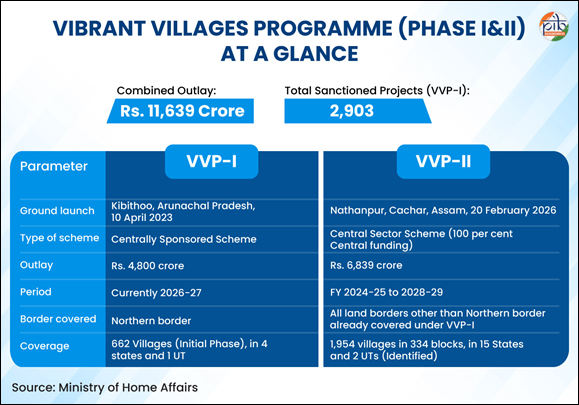
The VVP-I scheme- a Centrally Sponsored Scheme launched in 2023 is designed for the northern border and has an outlay of 4,800 crore through 2026-27 to develop 662 border villages in Arunachal Pradesh, Himachal Pradesh, Sikkim, Uttarakhand, and Ladakh. The VVP-II scheme is a fully Central government-funded plan that extends from 2025 to 2028-29 to further develop 1,954 villages in 15 new states and two Union territories, with an outlay of 6,839 crore.
| Metric | VVP-I | VVP-II | Combined |
| Approved | February 2023 | April 2025 | — |
| Scheme type | Centrally Sponsored (Centre + states) | Central Sector (100% Centre-funded) | — |
| Outlay | Rs 4,800 crore (2022–27) | Rs 6,839 crore (till 2028–29) | Rs 11,639 crore |
| Priority villages | 662 | 1,954 | 2,616+ |
| States / UTs covered | 5 (northern border) | 17 (all other land borders) | All 18 border states/UTs |
| Nodal ministry | Ministry of Home Affairs | Ministry of Home Affairs | Ministry of Home Affairs |
Figures: Press Information Bureau, September 2026.
According to the government’s own data, work is underway: 1,248 projects approved by July 2026; 111 road projects in 134 villages that did not have connectivity so far; and more than 8,800 outreach and mobilisation programs, from health camps to skill enhancement activities. Early signs of reverse migration are cited from the Kurung Kumey, Dibang Valley, and Shi-Yomi districts of Arunachal Pradesh, and Border forces like the ITBP are said to have purchased milk, eggs, vegetables, and grains directly from villages. A 2024 survey by Uttarakhand’s Rural Development and Migration Prevention Commission found that 11 villages in the Chamoli, Pithoragarh, and Uttarkashi districts had already been abandoned, indicating the challenges the project faces.
THE VIEW FROM THE VILLAGES
An NPR investigation across Sikkim’s border belt this February found a starker picture than the official figures convey. In Gnathang village, headman Sonam Bhutia said, “All we have received is one solar-powered lamp in our village,” which stopped working within a month of the scheme’s announcement in 2022. There are now between 750 and 1500 residents, whereas earlier it was more than 1500. At neighbouring Zuluk, senior Sherpa Sangpo Bhutia said that work on a proposed sporting ground and a culture centre, which state officials have pursued at numerous meetings, is indefinitely caught up in the administrative process. Arunachal Pradesh’s rural works minister, Pasang Dorjee Sona, has been more pointed, saying federal planners often finalised the programme’s first-phase village list without consulting local leaders — leaving some villages that sit directly on the border out of the scheme. In contrast, a few uninhabited ones made the cut.
Not every official voice is critical. Sikkim legislator Indra Hang Subba defends the slower pace as the price of India’s consensus-driven democracy, arguing that development achieved this way, though delayed, ultimately reaches people more fairly. Separately, analysts at the Observer Research Foundation have flagged weak monitoring and accountability as risks that could divert funds and further slow delivery.
These stakes are heightened because a key comparison on which the program was partly based. China has built hundreds of similar civilian villages along the same Himalayan border since 2016, a measure used to further its territorial claims through salami slicing, according to scholars and analysts. Even given terrain and a short working season, the scale of China’s building still visibly outperforms India’s, according to former Indian Army satellite analyst Vinayak Bhat.
For Pema Sherpa, who left a job in Delhi to return to her village of Kupup, the comparison with Beijing is beside the point. What matters, she says, is whether her own government can deliver reliable power and connectivity — the basics that might convince her siblings to come home too. Four years after the scheme’s launch, that remains the question the government’s own numbers cannot yet answer.
Clear Cut Livelihood Desk
New Delhi, UPDATED: September 08, 2026 19:30 IST
Written By: Dr. Yatharth Pathak